
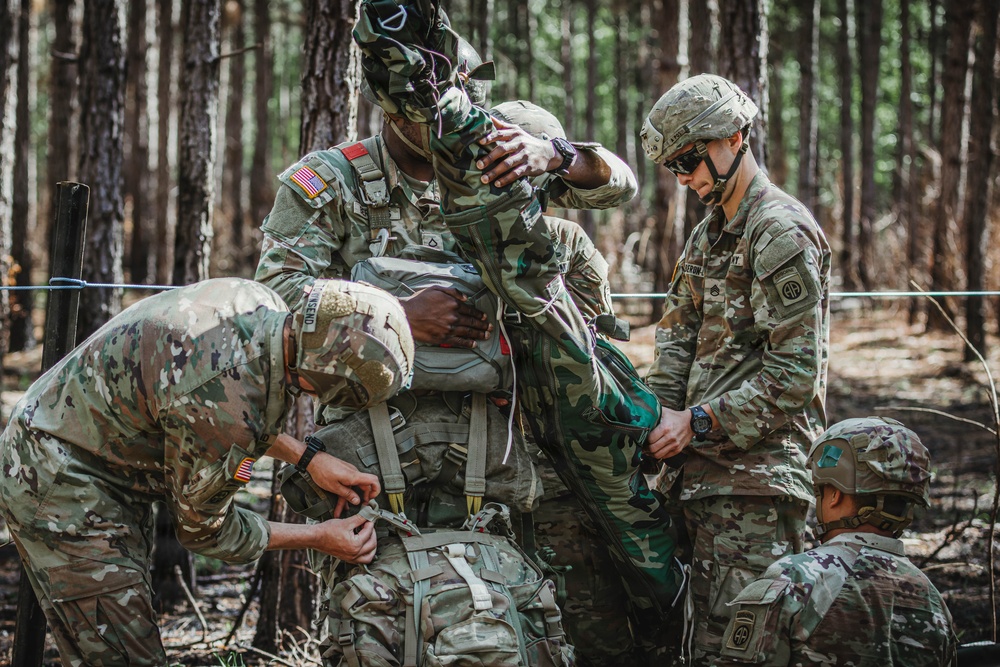
Photo By Capt. Stephanie Snyder | Team 3, comprised of Sgt. 1st Class Travis Ogen, and Staff Sgts. Alex Townsend, Tannor...... read more read more
 Subscribe
FORT BENNING, Ga. – To the uninitiated, the interior of a military transport plane is a chaotic mix of engine roar, vibrating aluminum, and the acrid scent of JP-8 fuel. To a jumpmaster, however, the cargo bay is a workplace governed by rigid checklists and mechanical certainty. From the metallic click of a reserve parachute buckle to the steady tension of a static line, every sensory detail is a critical data point.
The troop doors slide open to a 130-knot slipstream. The skies outside are a violent blur of gray and green. The jumpmaster stands in the door and begins the sequence that transforms chaos into a mission. Above the deafening roar of the engines, communication is reduced to tactile signals and the sharp, barked commands of "Stand Up," "Hook Up," and "Check Static Line." In this high-intensity environment, one individual holds the ultimate responsibility for every Soldier’s safety: the jumpmaster.
Seven teams comprising 28 jumpmaster-qualified Soldiers competed in the Army’s inaugural Best Jumpmaster Competition April 7–10, 2026, at Fort Benning. The event, hosted by the 1st Battalion, 507th Parachute Infantry Regiment, Airborne and Ranger Training Brigade, tested the technical expertise required to manage the chaos of an airborne exit.
"If you want to be a leader in an airborne formation, you have to be a jumpmaster," said Lt. Col. Michael Venafro, commander of 1-507th PIR. "We are asking people to do something that others will not or cannot do — to load combat equipment on themselves in the dead of the night, jump behind enemy lines, and conduct operations on behalf of the Army."
With the Airborne and Ranger Training Brigade team — Sgt. 1st Class Tedder Bridges, Staff Sgt. Nathan Byrd, Fischl, and Staff Sgt. Zachary Wiertalla — claiming the inaugural title, the 1-507th PIR is already looking toward expanding the field for 2027.
Organizers intend for this year’s event to serve as the baseline for a broader field of competitors next spring. The goal for future iterations is to draw representation from every corner of the airborne community. Whether representing heavy drop units or special operations elements, any Soldier wearing the jumpmaster star is considered a candidate for the title. Moving forward, the challenge is issued to every division and brigade to send their finest to determine who stands as the best in the force. Becoming a jumpmaster is not a requirement for all paratroopers; it is a voluntary progression into one of the Army's most demanding technical leadership roles. Before attending the U.S. Army Jumpmaster Course, a Soldier must be a corporal or above, have completed a minimum of 12 static-line jumps out the paratroop door of a U.S. Air Force high performance aircraft, and have served on jump status for at least 12 months.
The training itself is a three-week masterclass of memorization and mechanical precision. The curriculum is a relentless series of evaluations, including exams on nomenclature, pre-jump, written theory, and practical work inside the aircraft culminating in the jumpmaster personnel inspection and safety duties exams. The margin for error is razor-thin, particularly during the JMPI phase.
"School is where the foundation is laid, but the training never truly stops," said Staff Sgt. Riley Fischl, a member of the Airborne and Ranger Training Brigade team. " You spend hundreds of hours in the 'harness sheds' practicing your sequence until the movements are automatic, all so that when you are in the air, you don't have to think — you just do." A jumpmaster’s work is a study in precision under pressure. Before a paratrooper ever reaches the aircraft door, the jumpmaster conducts one of the most important tasks: JMPI.
"A JMPI is a high-speed, systematic dance with a paratrooper’s life," said 1st Sgt. Gustavo Quintero, of Headquarters and Headquarters Company, 1-507th PIR and one of the competition’s lane graders. "You aren't just looking; you are feeling for the mechanical seat of a canopy release assembly and the specific tension of a static line routed over the shoulder. Your hands verify what your eyes see, tracing every inch of webbing to feel for the slight irregularities — a twisted strap or a frayed edge — that could turn a routine jump into a catastrophe."
The inspection is an intense, tactile ritual. The jumpmaster moves with surgical economy, transitioning from the "Total Body Inspection" to the rear of the parachute, checking the curved pins and the integrity of the pack tray. "The sequence ends with a deliberate physical signal," Quintero explained. "You reach back, get a handful of air, and issue a seal of approval by tapping the jumper on the buttocks. When you give the command of 'recover' and move to the next man, you are signing your name to their safety. In that moment, their life is quite literally in your hands."
The competition tested this precision through a series of high-stakes events, headlined by a ruck march exceeding 13 miles. At graded stops along the route, competitors had to instantly pivot from total physical exhaustion to technical tasks, such as rigging specialized equipment. For Sgt. 1st Class Tedder Bridges, a competitor with the ARTB team, the hallmark of a jumpmaster is the ability to maintain zero margin of error despite the physical toll of the mission. "Being able to run, being exhausted, and still be precise is what makes a good jumpmaster," he said.
Participants also faced the Paratrooper Physical Fitness Assessment and a spot jump from a UH-60 Black Hawk, where they had to accurately judge wind and altitude to hit a specific point on the drop zone. Brig. Gen. Phillip J. Kiniery III, commandant of the U.S. Army Infantry School, presented the awards at Fort Benning’s Marshall Auditorium on April 10, 2026. The Best Jumpmaster Competition is held annually during the Maneuver Center of Excellence’s Infantry Week.
Beyond the trophy, organizers said knowledge sharing and standards reinforcements were baked-in benefits for all participants who are expected to return to their units with stronger technical skills and a heightened sense of identity as members of the airborne force. Units across the Department of Defense are encouraged to begin identifying teams for the 2027 competition by contacting the 1-507th PIR.
| Date Taken: | 05.08.2026 |
| Date Posted: | 05.08.2026 15:19 |
| Story ID: | 564843 |
| Location: | FORT BENNING, GEORGIA, US |
| Web Views: | 113 |
| Downloads: | 0 |

This work, Fort Benning names Army's first top jumpmaster team, by CPT Stephanie Snyder, identified by DVIDS, must comply with the restrictions shown on https://www.dvidshub.net/about/copyright.


No keywords found.




