
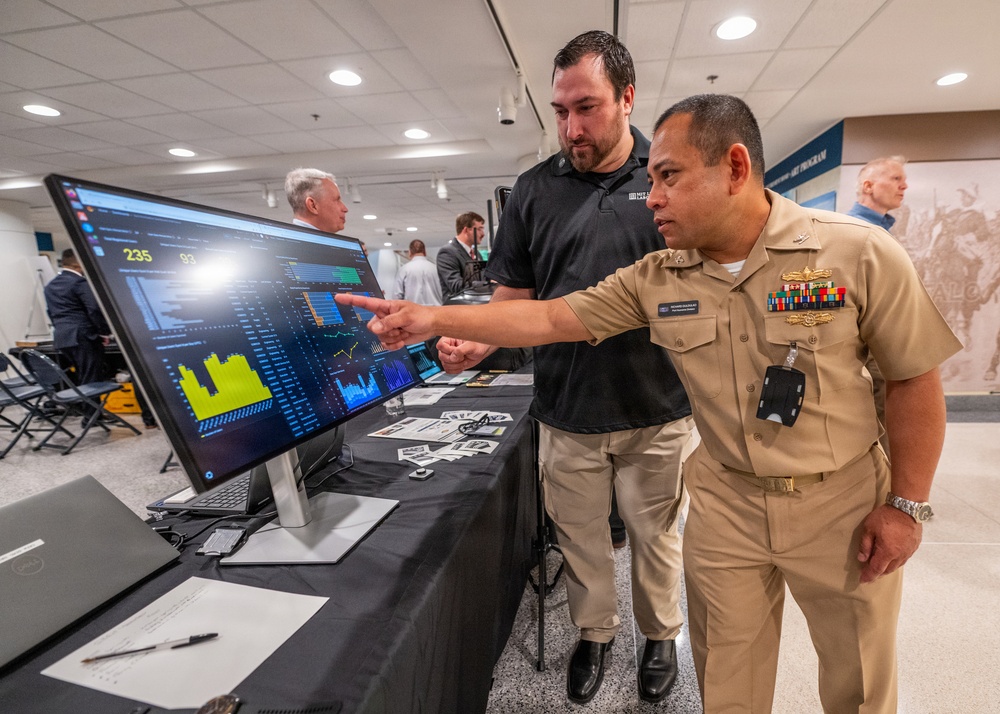
Photo By Bernardo Fuller | Christofer Budny, a staff member of the Human Health and Performance Systems with the...... read more read more
WASHINGTON, D.C.— Researchers with Navy Medicine Research & Development’s (NMR&D) Naval Health Research Center (NHRC), showcased innovative fatigue-monitoring technology during the Department of War (DoW) Lab Day at the Pentagon on May 6.
NHRC scientists, in collaboration with the Massachusetts Institute of Technology (MIT) Lincoln Laboratory, highlighted the Command Readiness, Endurance, and Watchstanding (CREW) System, wearable technology designed to address fatigue as a critical risk factor in naval operations.
Developed in response to recommendations to improve fatigue management following safety-related incidents, the CREW System enables near real-time identification of at-risk personnel and supports informed operational decisions.
Fatigue presents an ever-present risk to Sailor readiness and operational decision-making. In the absence of methods to track fatigue and exhaustion, mission-critical tasks may not be conducted properly.
The CREW System uses wearable smart devices to collect individual sleep and fatigue data, produce actionable insights for Sailors and command leadership. Designed for operational environments with minimum internet connectivity, the system uses passive, offline data synchronization to function with or without internet.
The CREW System effort has relied on commercially available wearable devices, with the latest iteration using smart rings, to capture sleep and fatigue data. The next iteration will expand on that approach to include smartwatches, increasing the range and accuracy of biometric data collected in operational settings.
Future systems can also incorporate applied artificial intelligence to enhance data processing and analysis, helping translate biometric data into actionable insights.
“The project is looking to develop and implement a passive, offline system that collects the wearable device data to inform decision-making and support readiness,” said Alice LaGoy, the CREW study execution lead. “It supports both leadership at the command level and individual Sailors by giving them access to their own data.”
“We find that providing individuals with their data is a key piece in driving engagement and helping Sailors better understand their personal health and readiness,” LaGoy added.
Sponsored by the Office of the Undersecretary of War for Research and Engineering (OUSW(R&E)), the DoW Lab Day event brought together organizations from all services, including multiple entities from across the Navy Research and Development Establishment (NR&DE). Participants included warfare centers, laboratories and research commands working to deliver advanced capabilities to DoW.
During the event, Pentagon personnel and senior leaders engaged directly with CREW researchers, exploring how wearable technology could be integrated into broader readiness initiatives.
“It’s been a great experience being here,” LaGoy said. “We’ve had a lot of different viewpoints and good questions about future directions for the technology and where else this capability could fit.”
NMR&D leadership, also in attendance, emphasized the importance of connecting research with operational needs.
“Pentagon Lab Day showcased how the DoW Science & Technology Ecosystem NR&DE is delivering cutting-edge innovations to the warfighter,” said Jill Phan, NMR&D science director. “We’re proud NHRC was selected to demonstrate CREW alongside MIT Lincoln Laboratory, giving leaders a hands-on look at how it can help assess operational readiness and support safer Navy operations.”
Researchers say the CREW Systems data infrastructure provides a secure means to transmit biometric data, enabling integration with shipboard systems and supporting future readiness analytics including and beyond sleep and fatigue management.
DoW Lab Day showcases the latest technology explorations happening across the Department's network of laboratories, warfare centers, and engineering centers. The one-day pop-up exhibition in the Pentagon apexes allows leadership to tour the groundbreaking research being pursued by the Department's scientists and engineers, and review the innovations being engineered for future battlefields.
NMR&D, a global collective of eight commands, conducts research in support of Navy, Marine Corps and joint U.S. warfighter health, readiness and lethality, across a broad spectrum of activity from basic science in the laboratory to field studies in austere and remote areas of the world to investigations in operational environments. NMR&D studies infectious diseases, biological warfare detection and defense, combat casualty care, environmental health concerns, directed energy health effects, aerospace and undersea medicine, medical modeling, simulation, operational mission support, epidemiology and behavioral sciences.
NHRC, part of NMR&D, supports Navy, Marine Corps and joint U.S. warfighter readiness and lethality with research and development that delivers high-value, high-impact solutions to the health challenges U.S. military population faces on the battlefield, at-sea, home and abroad.
| Date Taken: | 05.08.2026 |
| Date Posted: | 05.08.2026 13:22 |
| Story ID: | 564800 |
| Location: | DISTRICT OF COLUMBIA, US |
| Web Views: | 248 |
| Downloads: | 0 |

This work, NHRC Showcases CREW Fatigue Risk Monitoring System at Pentagon Lab Day, by Tommy Lamkin, identified by DVIDS, must comply with the restrictions shown on https://www.dvidshub.net/about/copyright.


No keywords found.





