
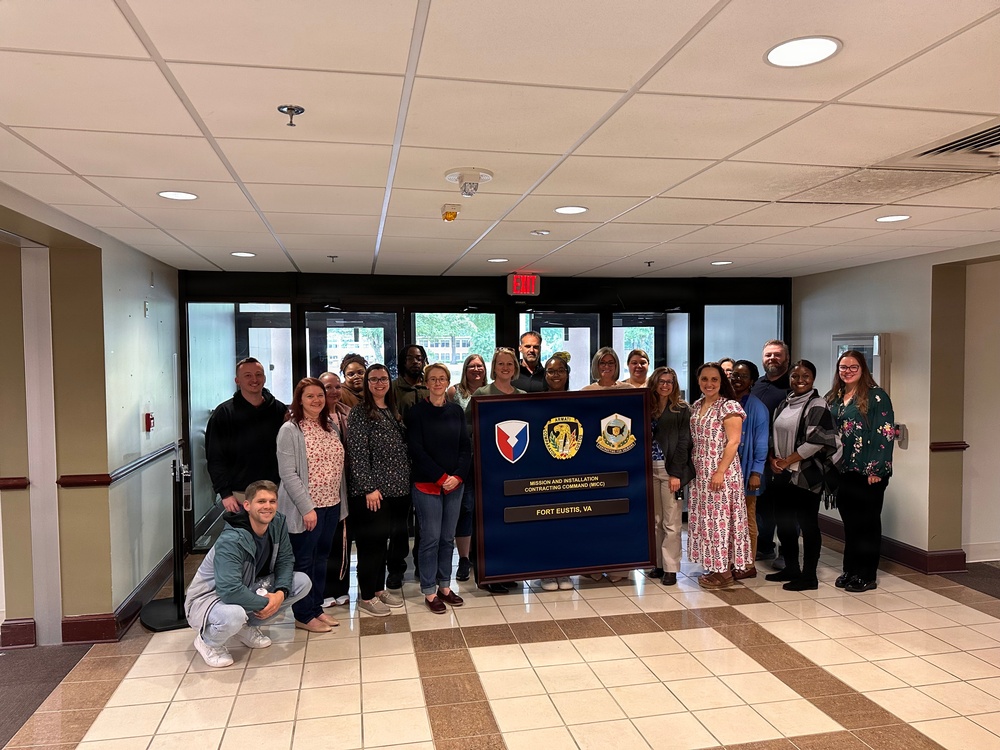
Photo By Tish Williamson | The Mission and Installation Contracting Command Fort Eustis, Virginia team gathers...... read more read more
JOINT BASE SAN ANTONIO-FORT SAM HOUSTON, Texas — The reauthorization of two federal small business innovation programs is expected to strengthen how the Mission and Installation Contracting Command delivers emerging technology, shortens procurement timelines and expands opportunities for industry partners supporting Army readiness.
The Small Business Innovation and Economic Security Act of 2026, signed into law April 13, reauthorized the Small Business Innovation Research (SBIR) and Small Business Technology Transfer (STTR) programs through Sept. 30, 2031. The action restored continuity to programs that experienced a lapse after the end of fiscal year 2025, placing some Phase I and Phase II efforts on hold.
The SBIR and STTR programs use a competitive three-phase process to align innovative small businesses with critical Army priorities. Phase I focuses on determining technical merit and feasibility, Phase II advances prototype development and demonstration, and Phase III transitions technologies toward operational use and commercialization through non-SBIR funding sources.
Headquartered at Joint Base San Antonio-Fort Sam Houston, the MICC is a subordinate command of the Army Contracting Command, under the Army Materiel Command. The command includes three contracting brigades and two field directorates comprising 34 contracting offices worldwide, including MICC-Fort Eustis, Virginia.
David Clark, a newly assigned division chief and contracting officer at MICC-Fort Eustis, has over 20 years of combined military and federal Civilian service, with over seven years in contracting. As a top SBIR and STTR expert within the MICC, Clark said one of the greatest advantages of a SBIR Phase III award is that competition requirements are generally satisfied during earlier phases, allowing contracting teams to move more quickly since requirements derive from prior research and development efforts.
“Because competition occurs during Phase I and Phase II, Phase III can provide a faster, more efficient path to award when requirements align to prior SBIR work,” Clark said. “That allows the MICC to engage directly with our mission partners and potential vendors, reducing redundancy and administrative delays.”
Unlike traditional procurements, SBIR Phase III efforts are not limited by dollar value, quantity or duration, providing contracting activities flexibility to scale promising technologies to meet operational requirements.
According to Clark, MICC-Fort Eustis saved approximately $14 million on a fiscal year 2025 requirement through an SBIR Phase III award and about $5 million on a fiscal year 2026 action. He also said a $30 million SBIR Phase III contract awarded in January 2026 moved from receipt to award in seven days, compared with an average lead time of 120 days.
Brig. Gen. Freddy Adams, commanding general for MICC, said those efficiencies may mean faster access to innovative technologies and quicker support of mission requirements for MICC’s customers. He lauded the SBIR and STTR programs as valuable acquisition tools for today’s operational contracting environment.
“SBIR and STTR help us move contracting capability to the field faster while creating opportunities for small businesses supporting national defense,” Adams said. “That balance of speed at the point of need, innovation and efficient stewardship is critical.”
He admits that one of the biggest barriers to broader use of the authority is limited familiarity across the contracting enterprise and legal stakeholders, not limitations within the requiring activities. In response, Adams directed Clark to lead a professional development training session for MICC contracting professionals focused on increasing understanding of SBIR and STTR authorities and identifying ways to better leverage the programs in support of mission partner requirements. More than 320 MICC personnel participated virtually May 6 during the training hosted by the command’s Headquarters Contracting Operations office, part of a broader effort to build subject matter expertise across the contracting enterprise.
“Phase III represents commercialization under the program and should not be confused with a standard commercial-item procurement,” Adams said. “It is my intent that our contracting experts become more familiar with SBIR and STTR as new innovations, to ensure a clear understanding between the government, the requiring agency and potential contractors.”
To further promote a shared understanding about these and other innovative contracting tools, MICC is hosting their sixth annual Advanced Planning Briefing for Industry, or APBI 2026, scheduled virtually May 18-22. The event provides current and future industry partners with early insight into planned initiatives, upcoming contracting opportunities and important regulatory updates affecting the acquisition community.
Adams said initiatives such as the 2026 APBI and the renewed Small Business Innovation Research and Small Business Technology Transfer authorities reflect the government’s commitment to transparency, partnership, expertise and mission readiness.
“When government and industry have the information they need early, we can plan smarter, move faster and deliver better outcomes for Soldiers and the Army,” Adams said. “That is exactly the kind of collaboration MICC is committed to driving across the enterprise.”
MICC planners encourage organizations interested in the programs to review current guidance and frequently asked questions through official https://usg01.safelinks.protection.office365.us/?url=https%3A%2F%2Farmysbir.army.mil%2Fphase%2Fphase-iii%2F&data=05%7C02%7Cletitia.n.williamson.civ%40army.mil%7C1faa69a8cdf24a608be708dea783f983%7Cfae6d70f954b481192b60530d6f84c43%7C0%7C0%7C639132382432170933%7CUnknown%7CTWFpbGZsb3d8eyJFbXB0eU1hcGkiOnRydWUsIlYiOiIwLjAuMDAwMCIsIlAiOiJXaW4zMiIsIkFOIjoiTWFpbCIsIldUIjoyfQ%3D%3D%7C0%7C%7C%7C&sdata=e91sSXkZIwF4jDgkAnxJLcj8ww3l1kEP60hakDQ6KlA%3D&reserved=0. Businesses interested in attending MICC’s 2026 APBI may register at no cost through May 17.
About the MICC Headquartered atJoint Base San Antonio-Fort Sam Houston, Texas, theMission and Installation Contracting Commandcomprises about 1,500 military and civilian members who are responsible for contracting goods and services in support of Soldiers as well as readying trained contracting units for the operating force and contingency environment when called upon. A subordinate command of theArmy Contracting Commandand theArmy Materiel Command, MICC contracts are vital in feeding more than 200,000 Soldiers every day, providing many daily base operations support services at installations, facilitate training in the preparation of more than 100,000 conventional force members annually, training more than 500,000 students each year, and maintaining more than 14.4 million acres of land and 170,000 structures.
| Date Taken: | 05.08.2026 |
| Date Posted: | 05.08.2026 12:31 |
| Story ID: | 564789 |
| Location: | FORT SAM HOUSTON, TEXAS, US |
| Web Views: | 81 |
| Downloads: | 0 |

This work, MICC highlights renewed small business innovation authority, by Tish Williamson, identified by DVIDS, must comply with the restrictions shown on https://www.dvidshub.net/about/copyright.


No keywords found.





