
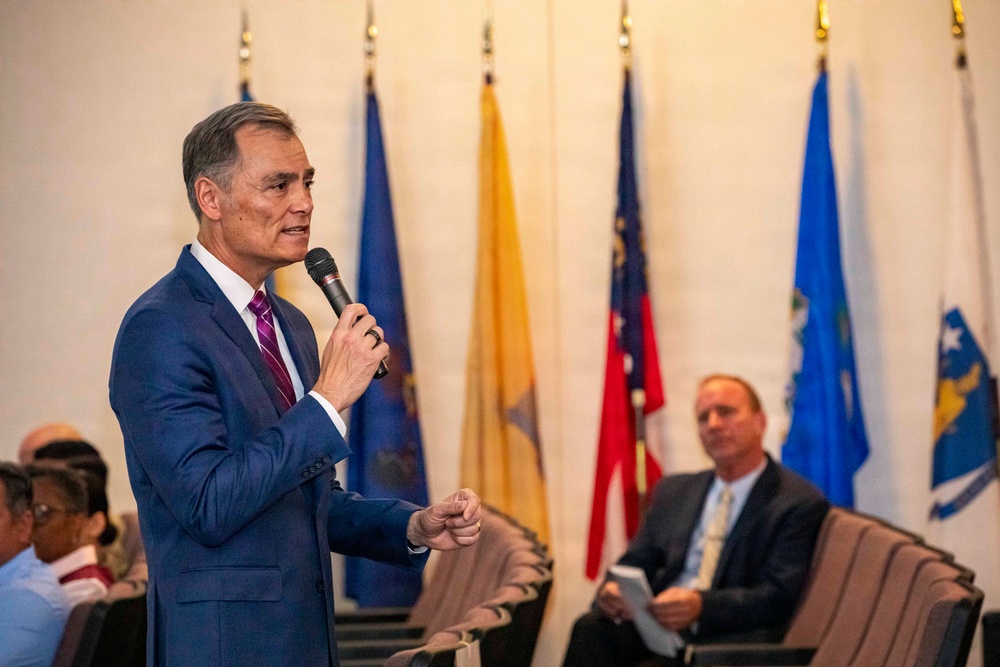
Photo By Petty Officer 2nd Class Travis Decker | 260504-N-KC192-1008 PORTSMOUTH, Va. (May 4, 2026) Dr. Michael McGinnis, Bureau of...... read more read more
PORTSMOUTH, Va – Navy Medicine is modernizing expeditionary medical (EXMED) logistics to support the Fleet and Marine Corps in contested environments. During the 2026 Navy Medicine Logistics Symposium, leaders focused on sustaining scalable, modular systems designed to handle prolonged care and delayed patient movement.
“The operational environment is changing, and Navy Medicine has to move with the speed, scale and agility of the Fleet,” said Dr. Michael McGinnis, Bureau of Medicine and Surgery (BUMED) executive director.
“Distributed maritime operations, contested logistics and prolonged casualty care require us to think differently about how we generate, sustain and employ expeditionary medical capability. What we’ve demonstrated over the last several years is that integrated, manned, trained, equipped and certified medical forces are no longer optional — they are essential to warfighting readiness.”
Central to that effort is a fundamental evolution in how EXMED capabilities are designed and deployed. BUMED capability and requirements analyst, Lt. Cmdr. Joseph Musmanno explained Navy Medicine is moving from viewing EXMED teams as individual systems to an integrated framework of care that spans every role, from point of injury to definitive treatment.
“These are modular, scalable teams are designed to operate across platforms, and as the Fleet continues to employ them, we’re refining the equipment, manpower and design to ensure they perform in operational environments,” he said.
To sustain these modular systems, the EXMED Concept of Logistics Support (COLS) aligns supply chains and distribution directly with operational requirements. According to Col. Kristofer Hagman, deputy director of logistics for Army Medical Logistics Command, medical logistics can no longer operate as a separate system from operational sustainment.
“In a contested environment, the ability to forecast demand, standardize medical supply data and integrate with joint logistics networks is what ensures medical capability reaches the warfighter at the right place and the right time,” Hagman said. “If we can’t communicate our requirements in a way the larger sustainment enterprise understands, we risk creating gaps in care when forces are forward and under pressure.”
By achieving this enterprise-wide visibility and strengthening operational flexibility, commanders will ultimately reduce their reliance on fixed medical treatment facilities during crisis or conflict.
During the symposium, attendees toured the Naval Medical Readiness Logistics Command (NMRLC) in Williamsburg, Virginia, to observe how expeditionary medical systems are assembled, maintained, and staged for rapid deployment. The tour highlighted modular tent systems, biomedical maintenance, RFID-enabled warehouse modernization, and integrated logistics overhauls.
Attendees also viewed the specific packaging and stowage methods for Expeditionary Resuscitative Surgical Systems (ERSS), Expeditionary Resuscitative Casualty Systems (ERCS), Forward Deployed Preventive Medicine Units (FDPMU), and pandemic response kits—demonstrating how NMRLC improves visibility and deployment speed for austere environments.
To ensure these capabilities are ready when needed, Navy Medicine conducts Operational Readiness Evaluations (OREs) to test how expeditionary teams receive casualties, stabilize patients, conduct surgery, and coordinate movement across distributed environments.
“We’re not just training units — we’re validating the entire medical system’s ability to operate together under realistic operational conditions,” said Capt. Kevin Bailey, commanding officer, Navy Expeditionary Warfighter Development Center.
Bailey explained that these evaluations increasingly combine Navy, Marine Corps, and Air Force medical assets into a single training environment to strengthen joint interoperability. Recent evolutions featured integrated ERSS, ERCS, and Air Force patient movement teams executing casualty transfers from Role 2 facilities to air evacuation platforms. Ultimately, the goal is to generate medically integrated forces fully certified and ready to perform in competition, crisis, and combat.
At sea, that capability comes to life aboard platforms like the expeditionary fast transport USNS Point Loma (T-EPF 15). During the symposium, attendees toured the vessel to see firsthand how it brings medical capability closer to the point of need.
Capt. TJ Pekin, ship master of the EPF explained, “[Point Loma’s] speed, allows us to operate in remote and austere environments, receive casualties by air, sea or ground, and quickly move patients through the continuum of care,” he said. “That mobility is critical in distributed maritime operations where time, access and survivability matter.”
Beyond its speed, the vessel supports multiple patient movement pathways—including receiving casualties from V-22 aircraft, 11-meter boats, and ground vehicles—and provides scalable spaces for embarked EXMED teams during combat operations, disaster response, or humanitarian assistance missions.
Across symposium sessions, leaders emphasized the growing demand for integrated medical logistics to support these high-end operations.
“We need leaders at every level to think strategically, generate requirements and push solutions forward,” McGinnis told attendees. “Navy Medicine headquarters does not have all the answers. We need the expertise and feedback from the operational force to ensure we are building the right capabilities for the future fight.” To secure those capabilities, leaders emphasized that medical planning cannot happen in a vacuum.
Director of Enterprise Support for the Deputy Chief of Naval Operations David Menzen emphasized, “What we want are not just medical requirements — we want Fleet requirements that have medical capability built into them. When the Fleet deploys, medical capability must deploy with it. The two are inseparable.”
Menzen noted that to compete successfully within Navy resource and acquisition priorities, medical supply and sustainment processes must be entirely integrated into the broader Fleet logistics architecture.
Ultimately, the symposium reinforced a clear message: readiness starts long before a unit deploys. Robust medical logistics are critical to ensuring warfighters receive the care they need, wherever the mission takes them.
For 250 years, Navy Medicine – represented by more than 44,000 highly-trained military and civilian healthcare professionals – has delivered quality healthcare and enduring expeditionary medical support to the warfighter on, below, and above the sea, and ashore.
| Date Taken: | 05.08.2026 |
| Date Posted: | 05.08.2026 11:06 |
| Story ID: | 564775 |
| Location: | PORTSMOUTH, VIRGINIA, US |
| Web Views: | 232 |
| Downloads: | 1 |

This work, From Warehouse to Warfighter: How Navy Medicine Logistics Enables Expeditionary Readiness, by Jennifer Goulart, identified by DVIDS, must comply with the restrictions shown on https://www.dvidshub.net/about/copyright.


No keywords found.





