Balikatan 2026 Debuts Groundbreaking Common Operating Picture
Photo By Sgt. Sar Paw |
U.S. and Armed Forces of the Philippines service members alongside service members......read moreread more
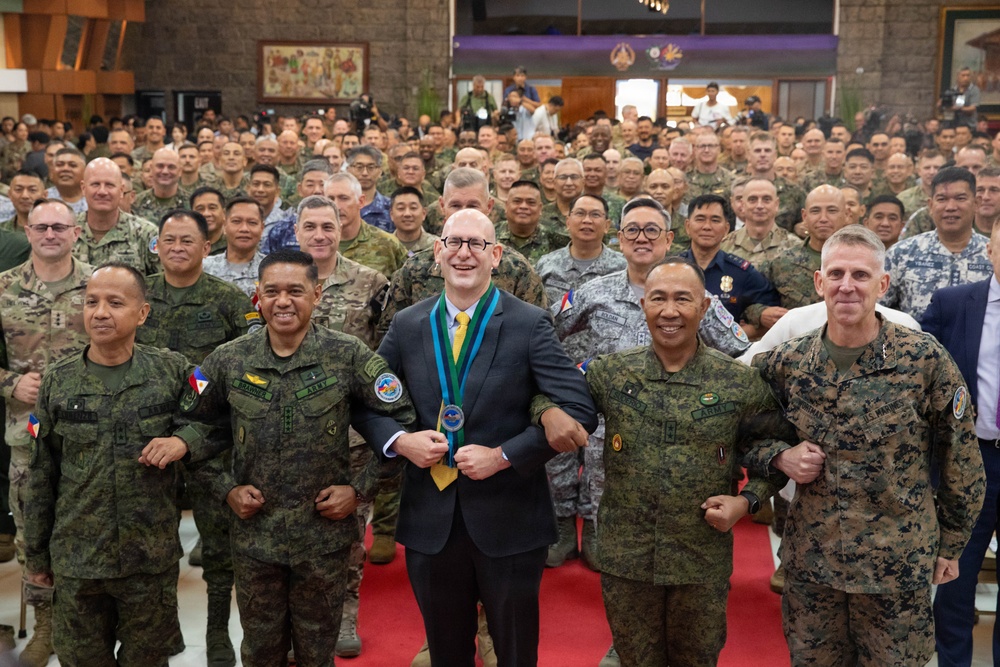
Photo By Sgt. Sar Paw | U.S. and Armed Forces of the Philippines service members alongside service members from Australia, Japan, Canada, France, and New Zealand joined in the locking of arms to signify the shoulder-to-shoulder nature of Exercise Balikatan 2026 during the opening ceremony at Camp General Emilio Aguinaldo, Manila, Philippines, April 20, 2026. Balikatan is a longstanding annual exercise between the AFP and U.S. military designed to strengthen our ironclad alliance, improve our capable combined force, and demonstrate our commitment to regional security and stability. (U.S. Army photo by Sgt. Brendon Donahue) see less
| View Image Page
Balikatan 2026 Debuts Groundbreaking Common Operating Picture
CAMP AGUINALDO, Quezon City, Philippines—Exercise Balikatan 2026 marks a significant milestone for coalition command and control in the Indo-Pacific, as Philippine, U.S. and allied forces operate for the first time with a Common Operating Picture accessible to eight nations, April 20 to May 8, across the Philippine archipelago.
The U.S. Indo-Pacific Command Mission Network, USINDOPACOM J7 Pacific Multi-Domain Training and Experimentation Capability, and joint interface control officers enabled this achievement. Military leaders and diplomats alike are hailing the COP as a significant step forward in multinational collaboration and operational effectiveness.
“The development of the COP has been an enormous additive to our exercise,” said Ambassador Alphonse La Porta, a career member of the Senior Foreign Service and former Ambassador to Mongolia.
La Porta, political/military advisor for the BK26 exercise control group, said the importance of context and information flow for commanders cannot be overstated.
"The challenge is to give the allies and partners enough information in terms of what's going on in this scenario to make it worthwhile, to support their participation,” said former Ambassador La Porta. “That’s a big challenge when you have multilevel classification exercises. To be able to have the COP, and to be able to understand the tools that go into and creating the COP, that’s terribly important."
Those tools and the technical integration required to achieve this milestone were substantial and more than eight years in the making, according to Scott Senerius, USINDOPACOM J6 C4/cyber exercise branch chief and BK26 ECG HHQ J6 lead.
“The progression of the multinational COP has been dependent on a constant change of participation in countries in BK and evolving participation that really exceeds the networks that we traditionally support,” said Senerius.
This year marks the most challenging and complex Balikatan to date. More than 17,000 personnel from the United States, the Philippines, Australia, Canada, France, Japan, and New Zealand are participating.
The increase in ally and like-minded partner nation participation represents a growing awareness of the importance of Philippine defense and maritime security in the region, according to Philippine Navy Cmdr. James Maligaya, Joint Simulation and Wargaming Center, Armed Forces Philippines Education and Training Command.
Maligaya said the multinational BK26 training audience needed a COP that they could manipulate.
“We now have a common platform,” said Maligaya. “For real-world application, we can’t just swivel and shift. IMN is a good way to start.”
IMN provides a platform for approved coalition partners.
“They can come in and play in the same sandbox,” said Senerius. “It includes files, chat rooms, and other features.”
Developing the platform and building the network was only the beginning. Operationalizing the multi-classification, multi-lateral COP is an impressive team effort. Senerius works closely with joint interface control officers (JICOs), as well as with modeling and simulations personnel, foreign disclosure officers, and others to make sure data is tagged appropriately to make it through the associated networks and cross domain solutions that feed the BK26 COP.
Senerius credits the JICO community for managing the COP during BK26.
U.S. Marine Corps Cpt. Jacob Anderson, assigned to Pacific Air Forces, 613 Operations Center, is the BK26 JICO lead. He and his team ensure the COP not only supports live events, but also simulated and constructive training.
“With a combination of the CPX (command post exercise) and FTX (field training exercise), there's a lot going on,” said Anderson. “We have live assets. We have constructive assets. And we have a lot of simulation supporting both events. My job is to ensure that it's making it out to the exercise audience, and that all the data displayed throughout the Philippines is not only correct for our U.S. COP, but for the multinational COP as well. That has been a huge focus point for this exercise.”
“In today’s battle space seeing everything is more important than ever,” said Anderson. “When you have live fires, a lot of deconfliction comes into play. Whether it's air, ground or surface, you need to see everything out there. Our ability to integrate that with the COP, as well as data sharing, is extremely important. We know the ‘fight tonight’ construct is how we have got to fight. We don't plan anything in the exercise that we wouldn't plan to use in the real world.”
The significance of the BK26 multi-lateral COP extends beyond the technical realm. By setting a new benchmark for secure, scalable, and inclusive information sharing, the multi-level, multinational COP is strengthening the foundation for future joint and combined operations in the Indo-Pacific.
PMTEC ECG lead Abe Webb emphasized the COP’s operational impact.
"The ability to tailor the COP to each nation’s security requirements, while still maintaining a unified view of the battlespace, is a game-changer,” said Webb. “It means we can share what we need to, when we need to, and with whom we need to—without compromising sensitive information or operational security.”
"This flexibility allows us to synchronize our actions, respond faster to emerging threats, and build confidence in our ability to operate as a true coalition."
The BK26 COP implementation demonstrates that with the right digital architecture, coordinated information sharing agreements, and a shared commitment to regional security, coalition partners can achieve secure, real-time information sharing across domains and classification levels, setting a new standard for multinational operations in the Indo-Pacific.
According to former Ambassador La Porta, the BK26 COP is a tangible metric of success.
“In terms of really proving the interoperability of our command and control to operate under duress or in times of stress, and how we coordinate with each other,” said former Ambassador La Porta. “We can't go to war without effective command and control…we have to make doggone sure that it works.”
Balikatan is a longstanding annual exercise between the Armed Forces of the Philippines and U.S. military that represents the strength of our alliance, improves our capable combined force, and demonstrates our commitment to regional peace and prosperity.

 Subscribe






