
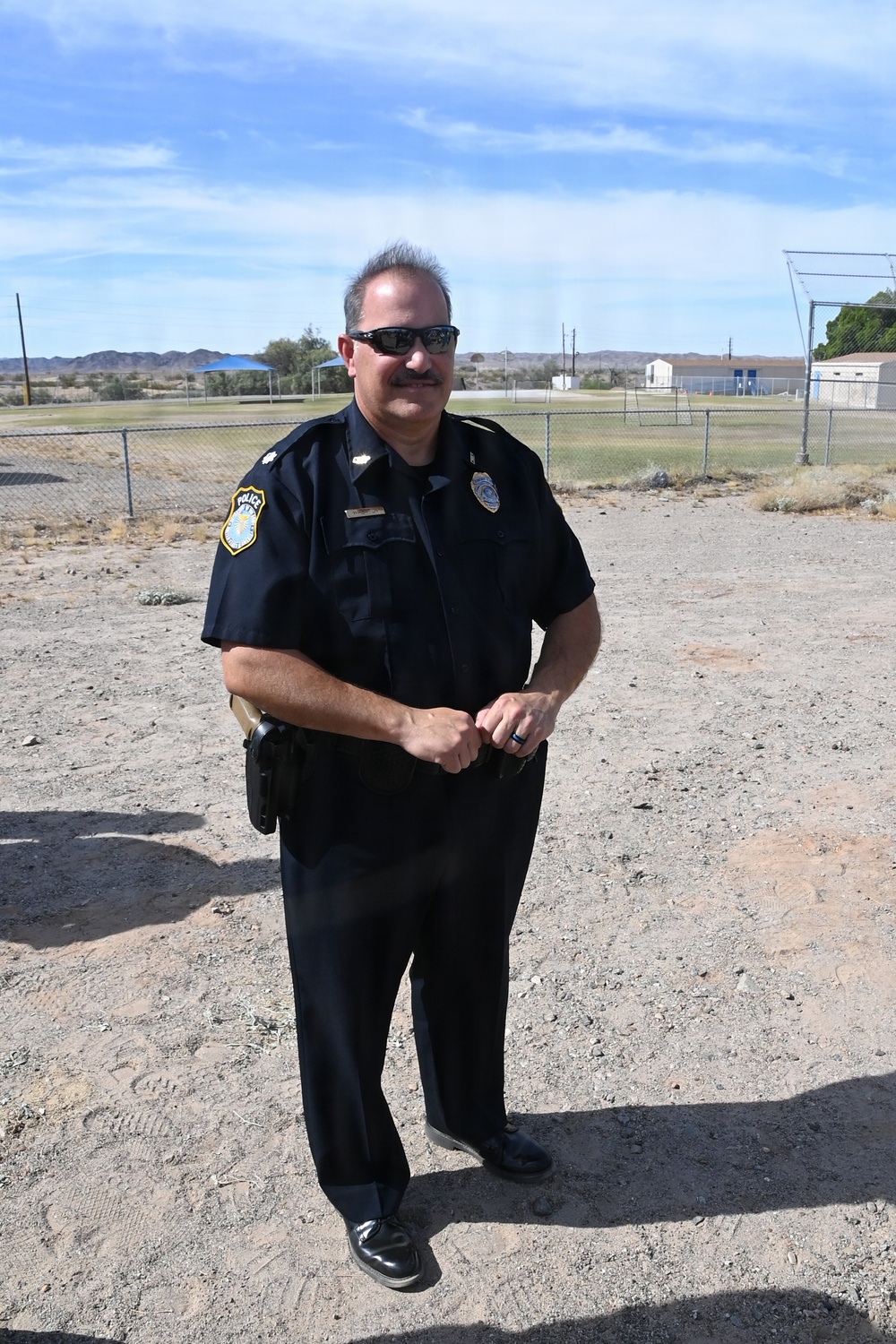
Photo By Mark Schauer | U.S. Army Yuma Proving Ground interim police chief Albert Wheaton was a non-roster...... read more read more
 Subscribe
Growing up in rural Georgia, U.S. Army Yuma Proving Ground (YPG) Interim Police Chief Albert Wheaton was a die-hard Atlanta Braves fan.
Just as the team was on the cusp of being the dominant National League franchise, he decided to attend a Braves-sponsored try-out at the local community college in the summer of 1990.
“I was getting close to 21,” he recalled. “I had been a Braves fan since I was old enough to know what baseball was and went out just to see what it was about.”
Rooting for Atlanta wasn’t easy at that moment. Though a long run of future glory was near, it was nowhere in sight that summer: the team was headed toward another last-place finish, their seventh consecutive season of sub-.500 ball. The wholesome multi-MVP winner Dale Murphy, face of the franchise throughout the 1980s, had declined precipitously and was about to be traded to the Philadelphia Phillies for spare parts. Aside from future star David Justice playing towards an eventual Rookie of the Year award, there wasn’t much to be excited about.
Wheaton’s reception at the tryout was similarly inauspicious.
“I showed up in my uniform because I worked at the Sheriff’s Department and they thought I was there to apprehend somebody,” he said with a laugh. “I had to change out to try out.”
Having played baseball and football in high school, Wheaton was unknowingly the exact profile major league teams would flag as legitimate prospects in venues like this. At the time, though, he was thrown by the fact that he seemed to be the oldest one in the group trying out.
“You did your warm-ups and then tried out in the positions you thought you were good at, and then they put you where they wanted you. I originally played third base, so that’s where I wanted to play. Then they put me in the outfield.”
As what turned out to be six hours of try-outs continued, they had him pitch.
“I really didn’t know much about pitching. I had messed around with a knuckleball just playing around, but nothing outside of little league.”
He managed to strike out a lengthy run of batters, but he chalked it up to the age difference he had on the younger players.
“I never thought I would hear anything else from them. To me it was cool just to see a couple of the Braves coaches that I had seen on TV.”
Not long after, Saddam Hussein’s Iraqi Republican Guard invaded neighboring Kuwait. Wheaton was deployed to Saudi Arabia as part of Operation Desert Shield and reduced to a single phone call per week back home. As Operation Desert Storm to drive the Iraqi military out of Kuwait became inevitable, his then-wife had unexpected news on their weekly call.
“She said, ‘you got a letter in the mail with the Braves logo on it. Did you order something?’”
He said he hadn’t and asked her to open the letter.
“’It says they’re inviting you to a baseball camp in Florida,’” she said.
He asked her to forward the letter to him. When he finally received it, he was stunned to find he was a non-roster invitee to the team’s 1991 spring training as a pitcher, and that he had missed the limited time they had given him to respond.
“I wrote them back and explained my situation. They replied with a care package and a letter that thanked me for my service, but said the invitation was a one-time offer they wouldn’t be able to extend, and to contact the front office when I got back home.”
Nearly 10 games out of first place at the All-Star break, the 1991 Braves heated up in the second half of the season, battling down the Los Angeles Dodgers to clinch their division on the second-to-last day of the regular season, propelled in large part by a talented young pitching staff that was the envy of the majors. They overcame a 3-2 deficit in a seven-game National League Championship Series against the Pittsburgh Pirates, then played the Minnesota Twins in the World Series.
When Wheaton called the team after his deployment, he was told there would be free tickets for him and his family to attend a game at Atlanta-Fulton County Stadium whenever he was able. Approaching two years after his tryout, he and his family finally went, early in the season after the worst-to-first Braves had come out on the wrong side of a 1-0 10-inning Game 7 that capped what many consider the greatest World Series of all time.
At the will-call window, however, the ticket agent excused herself to make a phone call when he asked for the tickets. A front office employee came out and told the Wheatons he would be their tour guide before the game and took them through the home clubhouse and the broadcast booth. Then he invited Wheaton and his family into the dugout before the game.
Reigning National League Most Valuable Player Terry Pendleton, reigning Cy Young-winning pitcher Tom Glavine, David Justice, and Ron Gant were just a few of the Braves legends on hand.
“I was like a kid in a candy store seeing all these guys. Not many people get to live out their dream of playing ball, so just to have that opportunity was pretty good.”
Atlanta has been a legitimate contender for most of the 35 years since. Among the awards and memorabilia of a long and successful law enforcement career in Chief Wheaton’s office hangs an autographed photo of Chipper Jones.
“I’m still a Braves fan through and through, however the season goes.”
| Date Taken: | 07.20.2026 |
| Date Posted: | 05.21.2026 10:15 |
| Story ID: | 564707 |
| Location: | YUMA PROVING GROUND, ARIZONA, US |
| Web Views: | 211 |
| Downloads: | 0 |

This work, Yuma Proving Ground Interim Police Chief narrowly missed shot at baseball glory, by Mark Schauer, identified by DVIDS, must comply with the restrictions shown on https://www.dvidshub.net/about/copyright.


No keywords found.




