
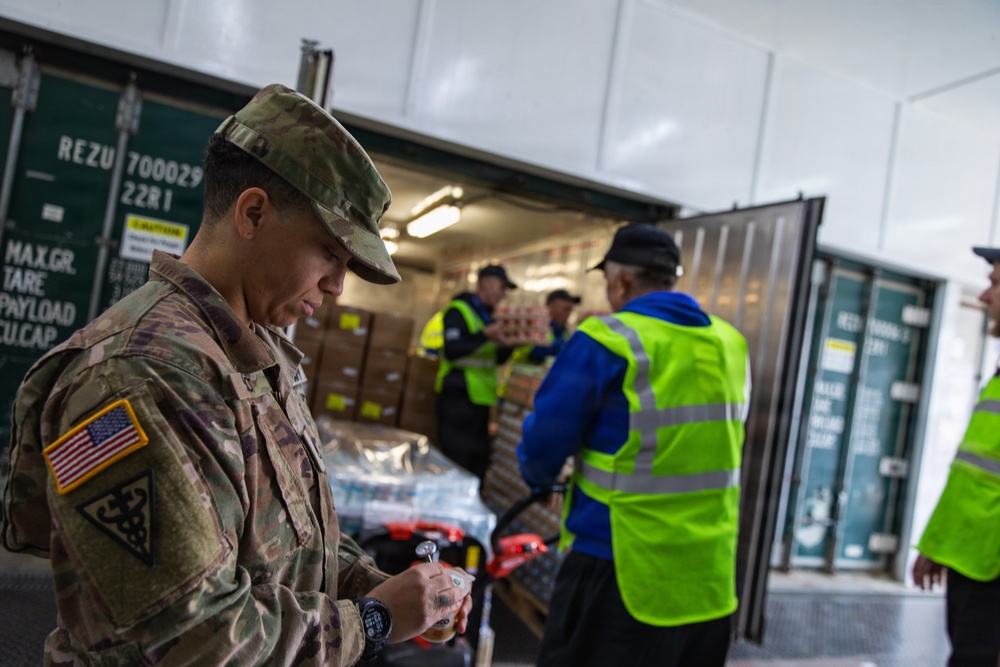
Photo By Staff Sgt. Spencer Rhodes | U.S. Army Reserve Staff Sgt. Kayla Scott, a veterinary food inspection specialist...... read more read more
 Subscribe
Ask any number of Soldiers, “Who do you think inspects food items when they arrive on base?” and you’ll probably get a plethora of guesses ranging from logistics to medical. Most would never assume that it is in fact your veterinarian staff that handles food inspection for anything used prior to cooking.
Staff Sgt. Kayla Scott, a reserve soldier assigned to NATO’s Kosovo Force, Regional Command East (RC-E) Veterinary Services team, is the sole Veterinary Food Inspection Specialist for RC-East, and is responsible for multiple sites across, and an additional site in Bosnia at Camp Butmir.
As soon as a truck arrives, Scott inspects the refrigeration trucks’ temperatures and packaging before it’s allowed to be unloaded. The goal is not just quality control for food welfare, but also about verifying contracts are being honored and that the Army isn’t spending money on wasted food. Whereas an uninformed observer may look at all the various boxes, labels, barcodes and stamps and see no issue, Scott can quickly tell when something is off because it’s missing a label, or stamped date.
“You do these inspections so much, you get used to what products we get or even what boxes look new,” she says, as she picks out a rectangular box off a pallet. The contents: Fresh pepperoni she didn’t recognize from previous deliveries. After a quick inspection of its tags and stamps, it's deemed good to go.
She continues the inspection by checking the time stamps on the cooler trucks, verifying they were not only cool enough, but remained that way through the entire trip. Pieces of produce are selected for inspection. A temperature reading is taken, and then it's sliced open to visually check the quality. After she’s finished inspecting the deliveries, she continues with her weekly check of the cleaning stations and the food storage.
It’s a very detailed and smooth process, one that in her experience, hasn't always been very smooth. On her last deployment to Kuwait, she was responsible for traveling to over 5 countries to conduct inspections. Sometimes drivers had turned off a refrigeration truck and turned it back on, but not before food spoiled. Packaging would be damaged or intentionally slashed open.
Scott says that it was a great way to learn, but at Camp Bondsteel, she doesn’t have to worry about any of those issues.
They have a really well maintained facility,” said Scott. “Here, it's almost always perfect. It makes it an easier process, between the consistency, organization and the people we work alongside. They really have it down and know what right looks like.”
So … why the Army Vet Corp for food inspection? Scott explains that the food inspection process often starts with animals pre-mortem [still alive] with inspection specialists and a Vet visiting processing centers regularly to ensure animals are healthy enough to be consumed as food. Some inspection specialists even work at the plant as a liaison full time.
That’s what keeps it tied to the Vet Corp,” said Scott.
| Date Taken: | 03.19.2026 |
| Date Posted: | 05.11.2026 07:49 |
| Story ID: | 564648 |
| Location: | ZZ |
| Web Views: | 66 |
| Downloads: | 0 |

This work, The Veterinary Corp mission most Soldiers never see, must comply with the restrictions shown on https://www.dvidshub.net/about/copyright.


No keywords found.




