
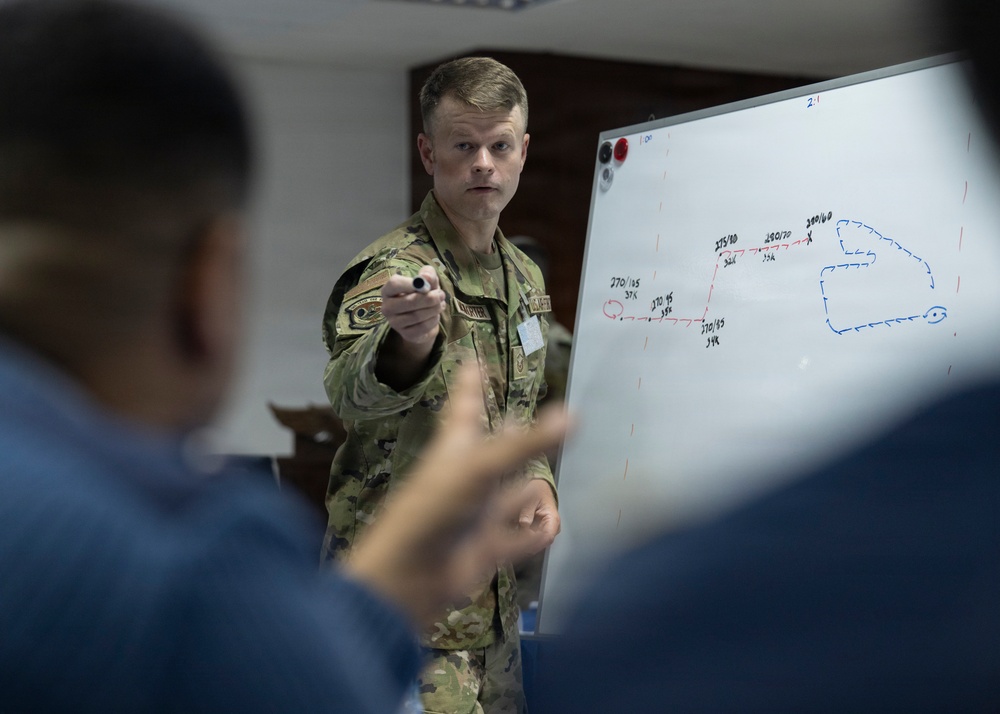
Photo By Staff Sgt. Nash Truitt | U.S. Air Force Master Sgt. Christopher McWhorter, a weapons director with 123rd Air...... read more read more
 Subscribe
RABAT, MOROCCO — Beneath the surface of the city, down a series of turns and stairwells, the noise of the outside world fades. In its place, quiet intensity, low voices, and the steady rhythm of decisions being made in seconds that could matter for lives.
Inside a secure operations space April 28, 2026, U.S. Air Force and Royal Moroccan Air Force airmen leaned over consoles and screens, sharpening a skill few ever see, but one that shapes everything in the sky above them.
Air battle management.
It’s a discipline built on precision, timing and trust. Air battle managers are responsible for command and control, guiding aircraft, tracking threats, and ensuring pilots have the situational awareness needed to execute missions safely and effectively. Their voice can determine whether an aircraft engages, maneuvers or holds.
During exercise African Lion 26, Airmen from the 123rd Air Control Squadron brought that responsibility into the classroom and simulator, training Moroccan counterparts on the fundamentals of intercepting enemy aircraft. The exercise, U.S. Africa Command’s largest annual joint exercise, designed to strengthen collective security capabilities of the U.S., Africannationsand global allies.
But in Rabat, the focus narrowed to something more immediate: communication.
Inside the classroom, U.S. instructors introduced procedures, terminology, and the precise language used to relay information between controllers and pilots. Every word has a purpose. Every phrase must be understood the same way, across accents, backgrounds and experience levels.
“We conduct tactical command and control,” said U.S. Air Force 1st Lt. Jeremy Booher, a 123rd ACS air battle manager. “Once the aircraft are cleared from air traffic control, we make sure they have situational awareness to safely and effectively execute their mission.”
Then came the transition; from theory to execution.
Split into groups, Moroccan airmen moved deeper into the facility, pairing with U.S. counterparts inside a simulator room designed to replicate real-world engagements. Screens lit up with aircraft tracks and evolving scenarios, forcing quick decisions under pressure. Instructors watched closely, ready to pause, correct and guide.
Here, mistakes aren’t failures, they’re opportunities.
Each simulated engagement required rapid analysis by identifying potential threats, communicating clearly and advising pilots on the right course of action. In a real-world scenario, those same decisions would unfold in seconds, carrying significant consequences.
“Lives are on the line,” Booher said. “What we relay directly contributes to making the right call, whether someone should engage or not. Exercises that test these skills and give us opportunities to work together are critical to ensuring we control the airspace.”
As the training progressed, confidence grew.
Students began making faster, more accurate calls. Instructors refined techniques, corrected missteps, and reinforced the importance of clarity and timing. By the end of the session, Moroccan airmen walked away with more than just knowledge. They carried a deeper understanding of how to assess threats and make decisions that could define an operation.
That shared understanding is exactly what African Lion is designed to build.
Led by U.S. Army Southern European Task Force, Africa, the exercise runs from April 20 to May 8, 2026, across Ghana, Morocco, Senegal and Tunisia. With more than 5,600 participants from over 40 nations, it emphasizes innovation, interoperability, and partner-led regional security.
Back in the underground operations center in Kenitra, the screens eventually dimmed and the scenarios came to a close.
But the impact of those decisions, the ones practiced, corrected and refined, will carry far beyond the walls of that room. Because when it matters most, control of the airspace doesn’t just depend on aircraft. It depends on the voices guiding them.
| Date Taken: | 04.27.2026 |
| Date Posted: | 05.10.2026 14:50 |
| Story ID: | 564619 |
| Location: | RABAT, MA |
| Web Views: | 99 |
| Downloads: | 0 |

This work, US, Moroccan airmen strengthen air battle management, must comply with the restrictions shown on https://www.dvidshub.net/about/copyright.


No keywords found.




