
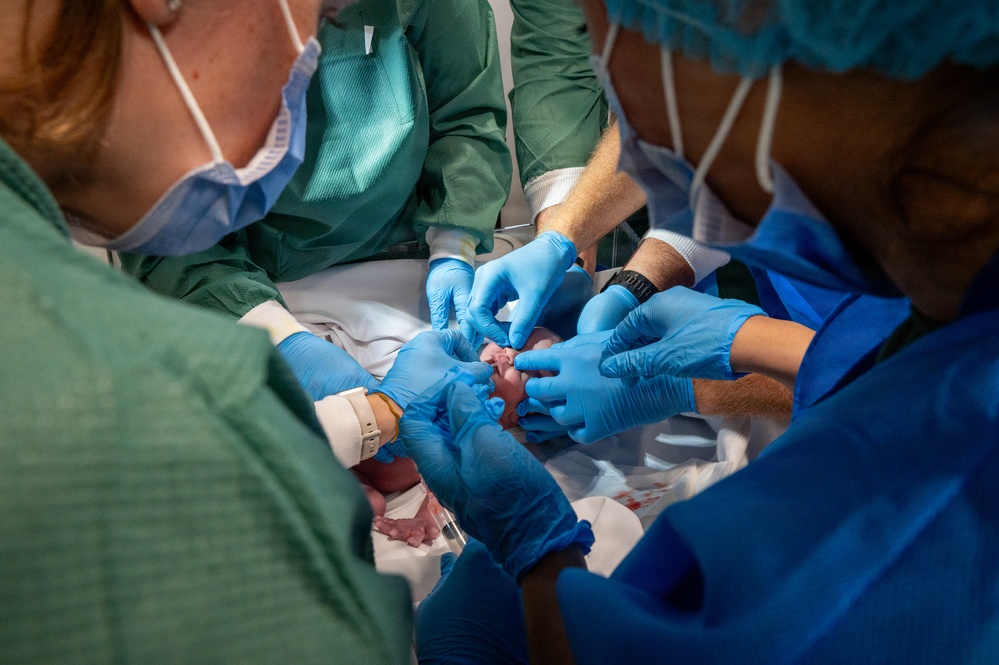
Photo By Sgt. Lark Sine | A group of U.S service members and Royal Moroccan Armed Forces perform care on a...... read more read more
 Subscribe
EL FAID, Morocco - U.S. service members and the Moroccan Royal Armed Forces are redefining what partnership looks like through shared expertise, innovation and expanding access to impactful care, under a network of expeditionary medical tents in central Morocco, April 20- May 8, 2026.
The humanitarian civic assistance site, part of African Lion 26, has become a cornerstone of medical readiness and partner entrustment. AL26 brings together military medical professionals from both the U.S. and Morocco to deliver care side by side. African Lion, led by U.S. Army Southern European Task Force, Africa (SETAF-AF), is Africa Command’s largest annual joint event. It spans four countries and includes more than 5,600 personnel from over 40 nations, all working to strengthen regional security through collaboration and innovation.
Each day, more than 1,000 patients pass through the tents of the HCA site, receiving care that often requires multiple interventions, and totaling between 2,000 and 3,000 procedures daily. Approximately 55% of patients are women, 30% men, and 15% are children.
Shared experiences and historic firsts define this year’s operation. On April 30, 2026, U.S. and Moroccan medical teams performed the first emergency cesarean section at the HCA site, a milestone that underscores both the evolution of the exercise and the strength of the partnership behind it.
Lt. Ahlam Abbassi, a gynecologist-obstetrician with the Royal Moroccan Armed Forces, described the urgency of the situation. “Our facility mainly receives pregnant women for their check-ups and follow-up care,” Abbassi said. “Yesterday, we received a 35-year-old woman who was 35 weeks pregnant. We did her check-up, her body exam, and her ultrasonography, followed by fetal cardiotocographic monitoring that showed the baby had fetal distress with severe bradycardia.”
With little time to spare, a combined team of U.S. and Moroccan medical personnel assembled and acted quickly.
“Given the urgency of the situation, we quickly admitted the patient in the operating room for an emergency cesarean section,” Abassi said. “As it was the first C-section ever done in a company hospital, while everyone was excited, we were under intense pressure and stress.”
The multinational team, including the Moroccan medical team, Dr. Saad Benali, Dr. Abbassi, and midwives, and U.S. personnel worked in unison. Inside the operating tent, the moment carried a weight felt by everyone present. As the baby was delivered, the room fell silent. U.S. and Moroccan service members stood shoulder to shoulder, holding their breath, waiting.
“The C-section proceeded smoothly and efficiently,” Abbassi said. “It was a truly emotional moment when the baby cried for the first time. Fortunately, the baby and the mother are in good condition, thanks to the coordinated efforts of Moroccan and U.S. service members.”
When the newborn cried, the silence broke into cheers. The work, however, was far from over. While Moroccan surgeons continued to care for the mother, a joint U.S. and Moroccan team immediately shifted focus to the newborn, who showed signs of distress.
“He wasn’t crying rapidly,” said U.S. Army Col. Marcus Blackburn, a pediatrician with Utah National Guard and doctor for the HCA site. “He was very low tone and floppy, so they brought it to us. Luckily, we had some of the equipment that we needed. They actually had a warmer here. We were able to stimulate the baby, get him to start breathing better. He still had fluid in his lungs, so we ended up having to give some positive pressure breaths to help clear the lungs and get it to be more vigorous.”
Blackburn and his team, which included personnel with neonatal intensive care experience, were called in to assist. The team’s ability to respond quickly was bolstered by both innovation and the diverse expertise service members bring to the mission. Both U.S. and Moroccan medical personnel played an equally critical role.
“We had to transport the baby to a local hospital to receive further care, but with the staff that we have and the variety of experience that we had here, with so many soldiers being in different civilian occupations, we had a U.S. [neonatal intensive care unit] nurse, and a Moroccan resuscitation nurse who works in a local newborn nursery, so the baby was able to do quite well.”
As the newborn stabilized, the Moroccan resuscitation nurse and two U.S. service members accompanied the baby to a local hospital, monitoring closely and prepared to intervene if necessary. Before leaving the HCA site, the mother kissed her baby and announced that she named her baby after the surgeon who saved their lives. On May 2, 2026, as the mother recovered at the HCA site, U.S. and Moroccan service members visited the mother to check on her condition and present small gifts, continuing the care beyond the operating room.
“Obviously, we weren’t expecting that to be a part of what we accomplished here,” Blackburn said, “but the team came together really well to provide the care that was necessary.”
Adaptability, shared purpose and mutual respect define the HCA mission. Beyond emergency care, the site is a dynamic exchange of knowledge and capability-building. U.S. and Moroccan personnel train side by side, sharing techniques that strengthen both forces long after the exercise ends.
Additional firsts that occurred at the HCA site include U.S. Army Lt. Col. Timothy Soeken, an ophthalmology surgeon, who introduced a small-incision cataract surgery technique to his Moroccan counterpart, expanding ophthalmologic capability; and U.S. Army Cpt. Kirk Waldron, a physician for the HCA site, who demonstrated trigger point injections, offering an alternative for long-term musculoskeletal pain management. Moroccan surgeons, in turn, trained U.S. medics in procedures such as suturing following cyst removal, reinforcing the two-way nature of the partnership.
“We see the same people every time we come back here,” said Col. Wesley Tillmann, commander of the Utah National Guard Medical Readiness Detachment. “We see the same doctors, the same command, and we get to build that relationship. The big difference for us is we get to heal people.”
Each year, the HCA continues to evolve, with improved laboratory turnaround times, expanded surgical capacity, and new equipment, enhancing both readiness and patient outcomes. A huge factor in enhancing the capabilities of the site are based on the specialists who participate at the site. Specialized teams from across the U.S. military medical community, including providers from Brooke Army Medical Center in San Antonio, Texas, as well as individuals from Fort Bliss, Texas, and Joint Base Lewis-McChord, Washington, brought advanced surgical and diagnostic capabilities to the site, reflecting both patient demand and a shared commitment to long-term community wellness. For leaders overseeing the mission, the significance extends beyond individual procedures.
This partnership, forged over decades between the U.S. and Morocco, including the enduring ties with the Utah National Guard, continues to deepen through missions like the HCA, where readiness and relationships are strengthened through real-world care. Surrounded by tents, sand, and language barriers, readiness was tested, partnership was strengthened, and a life was saved: a powerful reminder of what is possible through years of friendship, shared knowledge, and trust.
| Date Taken: | 05.03.2026 |
| Date Posted: | 05.10.2026 14:49 |
| Story ID: | 564615 |
| Location: | MA |
| Web Views: | 8 |
| Downloads: | 0 |

This work, A cry in the desert: In a moment of firsts, decades of partnership made the difference, by SGT Lark Sine, identified by DVIDS, must comply with the restrictions shown on https://www.dvidshub.net/about/copyright.


No keywords found.




