CCAD Honors Naval Legacy at final USS Albemarle and USNS Corpus Christi Bay Reunion
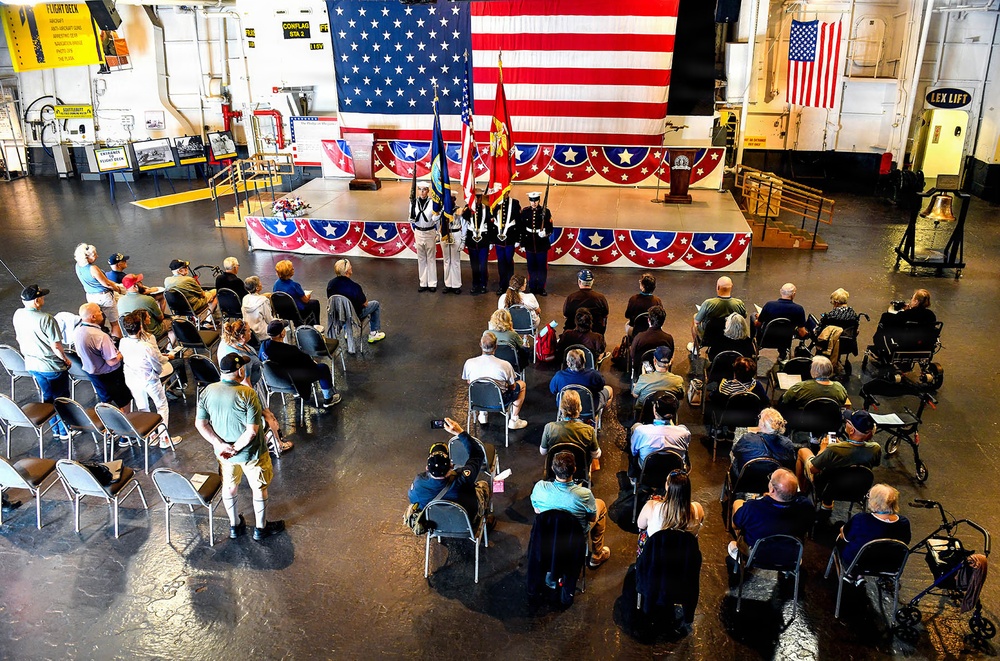
Corpus Christi Army Depot, Texas-- Celebrating America’s 250th birthday, the Corpus Christi Army Depot recently participated in the final reunion of the USS Albemarle (AV-5) and USNS Corpus Christi Bay (T-ARVH-1), an event dedicated to honoring the ship’s legacy and the sailors who shaped its heritage.
Rick Stevenson, CCAD managing director of components, served as the keynote speaker for the final USS Albemarle/USNS Corpus Christi Bay reunion and memorial service. He also had a distinguished naval career, rising from the enlisted ranks to naval officer. During his speech, Stevenson emphasized the deep connection between these veterans and the modern workforce:
"Our depot exists because of you and the generations who followed in your footsteps. For the last 22 years, I have stood on your shoulders, striving to uphold the mission for both our country and this installation. Your history is rich, and your legacy is our [CCAD’s] foundation."
The gathering marked a rare return to the Coastal Bend. The last time the group met in Corpus Christi was May 22, 2006, for a ceremony at the CCAD headquarters entrance held in conjunction with the reunion’s 40th anniversary, followed by a tour of the depot and USS Lexington.
"This reunion has become a family, no matter the distance or the time,” said Ron Kruse, chaplain for the USS Albemarle and USNS Corpus Christi Bay reunion. “We keep the love and the kinship we share.”
This year, 20 years later, the ceremony was held aboard the USS Lexington, permanently moored in Corpus Christi, Texas. In the wake of vessels like the Albemarle and its "sister of the sea," the Lexington, one can find the blueprint of American resilience.
The USS Lexington, famously known as the Blue Ghost, stands as a silent sentinel of naval aviation. It provided the perfect backdrop to honor the crew of USS Albemarle/USNS Corpus Christi Bay, whose contributions are equally etched into the history of national defense. Both ships found their greatest purpose during wartime.
During World War II, the USS Lexington earned the nickname "The Blue Ghost" by repeatedly returning to battle after Japanese forces claimed to have sunk it on four separate occasions. This persistence frustrated and confused Imperial Japanese command, cementing the carrier's status as a global icon of naval endurance.
But the USS Albemarle executed a different kind of feat. When the conflict shifted to the jungles of Vietnam, the ship transformed. Reborn as the USNS Corpus Christi Bay, it became a floating repair depot for army aviation.
Army aviator Col. John Sullivan oversaw the conversion of USS Albemarle, a World War II Navy seaplane tender, into a sophisticated repair depot that was rechristened USNS Corpus Christi Bay.
The result was the first army floating aircraft maintenance facility, with 37 repair specialties, including molten-salt heat-treating ovens, metal plating, chemical and metallurgical testing, and two deck cranes for unloading helicopter engines and other heavy freight.
The USS Lexington projected power as a mobile air base and was itself an offensive weapon that launched the strike. The USS Albemarle/USNS Corpus Christi Bay provided sustainability and ensured the fleet could keep flying. These events proved that the Army and Navy could work together to achieve the impossible. One was the sword; the other was the shield that kept the edge sharp.
Hosting the final reunion aboard the USS Lexington while honoring the USS Albemarle and USNS Corpus Christi Bay signifies more than historic vessels. It represents a lineage of excellence that connects military veterans, DOD civilians, and the young sailors and soldiers entering the workforce today.
The transition from the historical era to the present was underscored during the memorial service.
“So, our ship has passed away in history, and all we have are our memories,” said Ron Kruse, the reunion chaplain. “Our final award service, our final reunion—one ship, one keel, three eras. We remember those who served and honor our shipmates who have gone before us.”
This lasting heritage of their innovation provided the original foundation for what would become the Army Aeronautical Depot Maintenance Center, established in 1961 and later renamed the Corpus Christi Army Depot in 1974.
Today, the depot has evolved into the world's leading facility for helicopter repairs, supporting global operations. By ensuring every aircraft, component, and system return to the field stronger and more capable, CCAD upholds a sacred trust with the warfighter to be ready to fight tonight and win tomorrow. The depot remains prepared to sustain and modernize Army aviation and emerging systems, continuously adapting its capabilities to align with the Army’s transformation and the demands of future warfare.
Whenever a helicopter is remanufactured and delivered to the warfighter, it carries the legacy of the maintenance standards established by the first mobile aeronautical maintenance facility. The mission of the USS Albemarle and USNS Corpus Christi Bay continues daily through the operations of the Corpus Christi Army Depot.
One year older than the nation it defends, the U.S. Army has dedicated itself to fighting and winning the nation’s wars for 250 years. The depot was proud to participate in this final reunion of the USS Albemarle/USNS Corpus Christi Bay, reflecting on the rich history and legacy of service.