
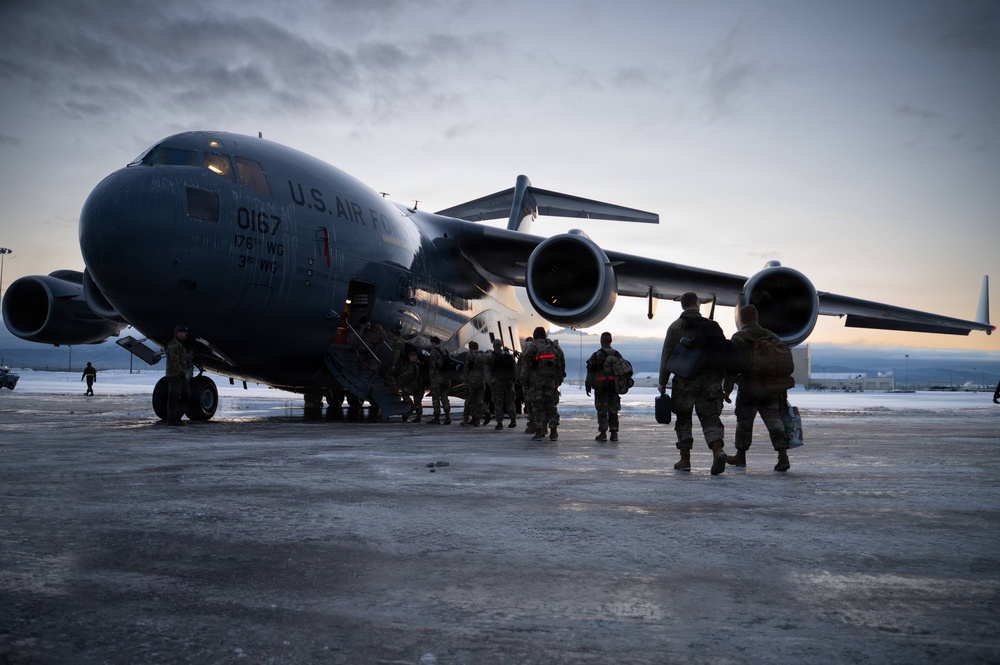
Photo By 2nd Lt. Daniel Bellerive | Alaska Air National Guardsmen embark on a 144th Airlift Squadron C-17 Globemaster III...... read more read more
ANDERSEN AIR FORCE BASE, Guam —Airmen from the 176th Communications Squadron recently completed FISGA RAIN, a high-stakes joint exercise designed to sharpen the U.S. military’s ability to maintain a digital edge in contested environments in the INDOPACOM theatre of operations.
Hosted at the austere Andersen North Field on Guam, the exercise required Alaska Air National Guardsmen to communicate, move and rapidly reconstitute combat power in dense jungle terrain with limited logistical support.
Operating far from hardened infrastructure, the 176th Communications Squadron (CS), alongside the 176th Mission Support Group, 176th Security Forces Squadron, 176th Logistics Readiness Squadron, 176th Air Defense Squadron (ADS),168th Communications Flight and 239th Combat Communications Squadron proved that the Wing can generate combat capability from a bare base under contested conditions and integrate with U.S. Marines, Navy, and Coast Guard units.
The exercise proved that the joint force can establish and defend vital communication networks even when faced with contested logistics highlighting the modern reality of an adversary attempting to disrupt supply lines and digital signals.
"FISGA RAIN represents a fundamental shift in how we prepare for the high-end fight," said Alaska Air National Guard Lt. Col. Steve Wackowski, 176th Communications Squadron commander. "It isn’t just about plugging in radios, it’s about proving that our Airmen can operate with limited logistics support, solve complex problems on the fly, and ensure the joint force remains connected when the stakes are highest."
Airmen demonstrated multiple tactical communications skill sets throughout the exercise—from satellite and line-of-sight radio systems to network architecture, cyber defense, and cross-domain data integration. Working in austere jungle conditions required improvisation and disciplined execution as teams balanced force protection, sustainment and technical complexity simultaneously.
The technical proficiency of the 176th CS became a focal point when several critical systems failed to interface across the joint network. 176th CS Airmen rapidly diagnosed and reconfigured the joint network architecture, restoring connectivity and preventing mission degradation at a critical juncture.
"There was a moment where the mission hit a wall because the cross-service systems just weren't talking to each other," said Master Sgt. Tony Jager, special missions flight chief. "The 176th Airmen stepped up and troubleshot the configurations that had everyone else stumped. Seeing them restore connectivity when it looked like we might lose communications was a testament to the technical expertise they bring to the joint fight."
A pivotal moment of the exercise came when 176th CS and 176th ADS Airmen successfully integrated Link-16 tactical data into a secure common operational picture. The capability allowed joint forces to share real-time situational awareness across air, land and maritime domains.
The exercise also highlighted the success of the Tactical Radio Application Extension deployment. TRAX is a critical software gateway that allows for data sharing across different radio frequencies and branches of service, essentially translating information so that forces on the ground and a Navy pilot can share the same digital picture.
Following a successful digital handshake between these cross-domain systems, the tactical center dispatched a U.S. Navy Helicopter Sea Combat Squadron Two-Five aircraft for a search and rescue mission.
The helicopter crew used emergency beacons, sea dye and signaling mirrors to locate personnel in the Pacific Ocean. In a display of joint integration, a Navy rescue swimmer worked alongside 176th Mission Support Group commander and combat rescue officer, Col. Matthew Kirby, to recover simulated casualties and load them onto a USCG vessel.
Through the synchronized data picture, commanders maintained shared awareness of aircraft movements, maritime assets and recovery forces—demonstrating the power of interoperable, secure communications in real-world contingency operations.
"Now more than ever, when it comes to the current threat picture on the international level, we’re looking at new ways to be able to develop and ensure that all of our doctrines are in line with each other," said Marine Gunnery Sgt. Devin Zeballos, key management infrastructure manager at Marine Corps Base Camp Blaz, Guam. "Each individual service and each asset the services bring forward is going to be critical for us to have mission success."
FISGA RAIN reinforced the fact that secure tactical communications is more than equipment—it is mobility, survivability and integration under pressure. From securing Andersen North Field in jungle terrain to integrating Link-16 into a secure joint common operational picture at an austere operating location, the 176th Wing demonstrated that Alaska Air National Guard Airmen can deploy anywhere, operate with anyone, and deliver secure communications in contested environments.
| Date Taken: | 12.10.2025 |
| Date Posted: | 05.29.2026 10:41 |
| Story ID: | 564561 |
| Location: | ANDERSEN AIR FORCE BASE, GU |
| Web Views: | 64 |
| Downloads: | 0 |

This work, 176th Wing Airmen demonstrate expeditionary communications dominance during FISGA RAIN, by 2nd Lt. Daniel Bellerive, identified by DVIDS, must comply with the restrictions shown on https://www.dvidshub.net/about/copyright.


No keywords found.





