
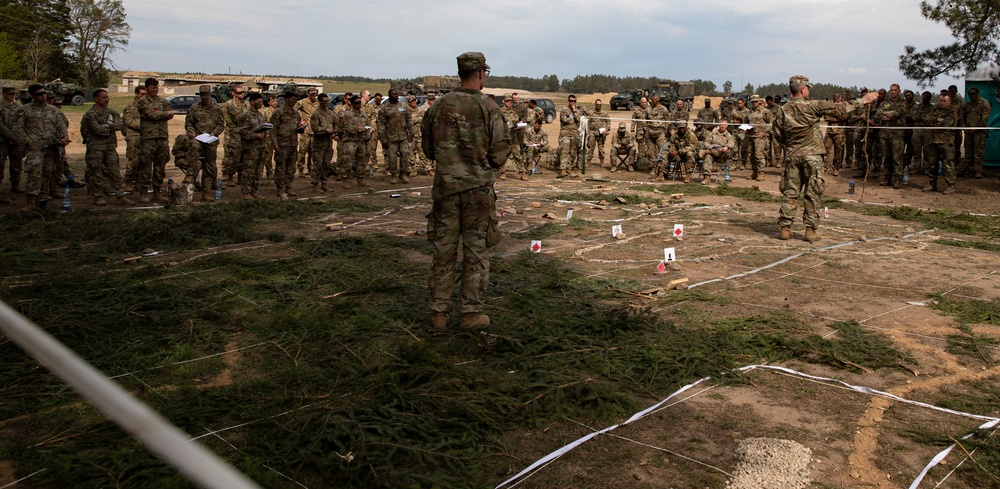
Photo By Staff Sgt. Emilie Lenglain | U.S. Army Capt. Colten Kennedy, assistant intelligence and security staff officer, 2nd...... read more read more
 Subscribe
BEMOWO PISKIE, Poland - “The BPTA terrain features open fields, dense forests, hills, and water obstacles, shaping the environment," said U.S. Army Capt. Colten Kennedy, assistant intelligence and security staff officer, 2nd Cavalry Regiment (2CR).
U.S. Soldiers from 2CR, 12th Combat Aviation Brigade, and Polish Territorial Defence gathered at Red Diamond range, Bemowo Piskie Training Area (BPTA), Poland, on May 5, 2026, to conduct a Combined Arms Rehearsal under 2CR’s Regimental Commander, Col. Donald R. Neal, Jr., for Saber Strike part of Sword 26.
Sword is a yearly U.S. Army Europe and Africa-led exercise to boost NATO interoperability, combat readiness, and deter regional aggression. It features large-scale combined-arms live-fire exercises, command post exercises, and rapid troop movements, throughout the European theater.
2CR officers briefed on exercise conditions, reporting on field artillery fires, unarmed systems, expected enemy movements, different courses of action, radio frequencies, jamming, and radar systems, ensuring scenario understanding.
They also assessed the enemy’s actions, discussed the likely next steps, and analyzed the enemy’s capabilities to anticipate potential challenges.
Kennedy discussed his Priority Intelligence Requirement (PIR): key intelligence on the enemy, terrain, or environment essential for command decisions and mission success. While speaking of PIR, Kennedy states that if the enemy chooses a swift response, this choice would be, “in order to penetrate multinational defense northeast elements' offensive lines.”
Kennedy described how the Launched Effects Battery’s radars scan named areas of interest for valuable targets and transfer intelligence handovers to 1-2CR’s medium-range-radars.
The Regimental’s mission is to establish a screen enabling multinational forces to defend and protect the north and central corridors through the alliance.
Operations and signal intelligence discussions highlighted the Polish forces’ critical role during engagements.
It was also discussed how unarmed aircraft systems will be employed and how communication with the Polish Liaison Officer—co-located within the Launch Effects Battery, Field Artillery Squadron—will be maintained.
During the rehearsal, Polish artillery forces also discussed their capabilities and equipment.
Capt. Alexander Jaques, battery commander, Field Artillery Squadron, 2CR explained how their fire support allows the regiment to establish a screen, details on equipment, capabilities, flight, and processing times required to destroy the enemy.
Capt. Matthew Rohleder, troop commander, 1st Squadron, 2CR explained that their task is to conduct a move into contact along a designated phase line to deny the enemy further maneuver north.
“The exercise happening here in BPTA and in Lithuania is a simulation and a part of one exercise,” said Capt. Drew McMurrin, Launch Effects Battery Commander, Field Artillery Squadron, 2CR.
Of the scenario, McMurrin said,”The enemy we are fighting has maneuvered from the North and is fighting 2-2CR in the North and then fighting us here in the south with 1-2CR.”
2CR commanders also addressed sustainment, including transportation, maintenance, and medical support.
“The Combined Arms Rehearsal synchronizes a tactical operation across all echelons of the unit,” said Capt. Gabe Glazer, Squadron Communication Officer, Field Artillery Squadron, 2CR.
Glazer continued, “After rehearsal, leaders know how to lead their units effectively.”
Saber Strike simulates a potential adversary scenario, testing Soldiers’ readiness for possible threats.
A verification team from the NATO Allied Land Command (LANDCOM) was also present in order to “verify the capability of the US FLF Brigade to deploy,” stated a French Armed Forces officer from NATO LANDCOM.
“The 2CR Combined Arms Rehearsal for Saber Strike 26 synchronized not only all Dragoons but also the multinational allies we will be fighting alongside to support the expansion of forward land forces,” said Glazer.
From April 27 to May 31, 2026, U.S. and Allied forces will exercise NATO’s Eastern Flank Deterrence Initiative, demonstrating NATO’s ability to fight and win on the modern battlefield.
Nearly 15,000 troops from eleven nations will train in the High North, Baltic region, and Poland, executing rapid maneuvers, air defense, counter-drone operations, and cyber defense to validate NATO’s regional defense plans live.
This series of linked exercises, including Saber Strike, Immediate Response, and Swift Response, turns investment into capability.
Soldiers use unmanned systems, AI-enabled command and control, and live data networks to make faster decisions and operate across all domains.
Sword 26 demonstrates how U.S. Army Europe and Africa is driving transformation at scale while simultaneously strengthening deterrence across the region.
Together with our Allies, we are building a unified, lethal force ready to defend NATO territory and respond to any threat.
| Date Taken: | 05.05.2026 |
| Date Posted: | 05.06.2026 07:23 |
| Story ID: | 564488 |
| Location: | US |
| Hometown: | DALLAS, TEXAS, US |
| Hometown: | MILWAUKEE, WISCONSIN, US |
| Web Views: | 195 |
| Downloads: | 0 |

This work, Saber Strike highlights the readiness, resilience, and support capabilities of U.S. and Polish forces, by SSG Emilie Lenglain, identified by DVIDS, must comply with the restrictions shown on https://www.dvidshub.net/about/copyright.


No keywords found.




