
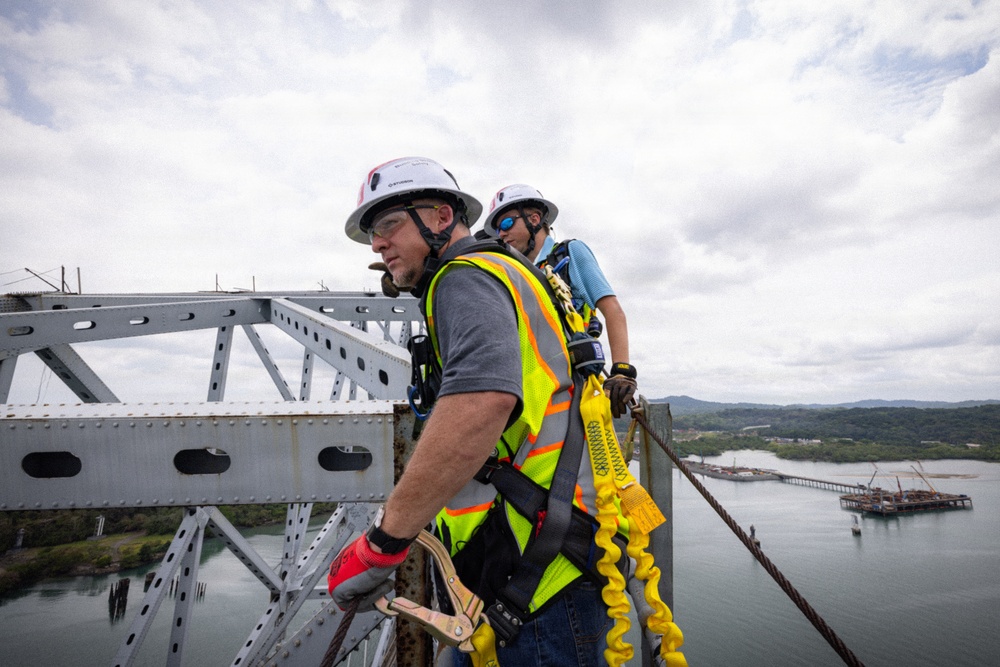
Photo By Staff Sgt. Rydell Tomas Jr | A group of engineers from the U.S. Army Corps of Engineers and Panamanian partners...... read more read more
 Subscribe
One missed step, one missed connection, and one split second can turn a routine task at height into a life-changing event.
Falls from height remain the leading cause of death in construction, often during routine tasks where gaps in planning can turn into serious accidents. According to the Bureau of Labor Statistics, 421 workers died from falls in 2023, accounting for nearly 38 percent of all construction fatalities.
And yet, falls are preventable.
The U.S. Army Corps of Engineers, alongside the U.S. Occupational Safety and Health Administration and partners across the construction and engineering industry, supports the 13th annual National Fall Prevention Safety Stand-Down, May 4-8, 2026, a nationwide effort to pause and ensure every worker has the equipment, training and mindset to plan for safe work at height.
As the Nation approaches its 250th anniversary, USACE is reinforcing its commitment to protecting the workforce and strengthening how it plans and executes work at height. While USACE projects report significantly fewer fatal falls than the industry average, leaders say when it comes to safety, the work is never finished.
This year’s stand-down provides an opportunity to focus on what matters most: planning, preparation and protection against the most common causes of construction fatalities.
“We have truly great people in USACE, and we must always keep our focus on taking care of these great people. That means ensuring we are safe in everything we do. It means managing risk, rather than avoiding it,” said Lt. Gen. William H. Graham Jr., 56th Chief of Engineers and commanding general of the U.S. Army Corps of Engineers. “The National Fall Protection Safety Stand-Down serves as an important reminder that we must take care of each other, follow the safety guidelines, and deliver with a sense of urgency. Our Nation is counting on us.”
USACE has helped shape modern safety practices from the beginning. Its Safety and Health Requirements Manual, EM 385-1-1, was first published in 1941, 30 years before OSHA was created. Originally designed for contractors, it is now required across USACE projects and widely adopted throughout the construction and engineering industry.
USACE continues to evolve its safety manual using current data and emerging trends, ensuring it remains a proactive system for identifying hazards early and implementing controls that prevent injury and loss of life.
The manual’s five-step risk management process is foundational to effective fall prevention and the protection of USACE employees, partners, and the mission:
1. Identify Hazards: Systematically examine each work activity to uncover potential fall hazards. 2. Assess Hazards: Evaluate the severity and likelihood of each risk\, prioritizing action where needed. 3. Develop Controls: Design feasible\, effective controls\, prioritizing elimination\, fall prevention\, and engineered solutions. 4. Implement Controls: Integrate controls into work methods\, ensuring certified fall protection equipment is selected\, maintained\, and ready for use. 5. Evaluate Controls: Continuously verify the effectiveness of controls\, adjusting based on feedback\, observations\, and lessons learned.
Leaders emphasize that procedures alone do not prevent falls consistent execution, engaged supervision, and an informed workforce are what turn requirements into results.
“Accidents are preventable when risk management is applied with discipline, from planning through execution," said Jason Walsh, Safety and Occupational Health Manager at the U.S. Army Corps of Engineers HQ office.
Safety depends on understanding why these steps matter. Equipment is only part of the equation. Workers must know how to use it correctly and consistently, and supervisors must ensure teams are trained, equipped and empowered to speak up when conditions change. Safe work at height begins before anyone leaves the ground and continues through every phase of the mission. Safe work at height is readiness.
Building the Nation for 250 years requires more than great engineering that solves our nation’s toughest problems. It requires delivering projects safely and continuous improvement to refine its approach to fall protection through updated guidance and tools designed to make safe decisions easier at every job site.
As we commemorate America’s 250th birthday, we reaffirm our commitment to safety improvement shaped by real world lessons that reinforce a culture of safety so we can continue building for our warfighters and our great nation.
| Date Taken: | 12.31.1969 |
| Date Posted: | 05.05.2026 11:33 |
| Story ID: | 564398 |
| Location: | US |
| Web Views: | 54 |
| Downloads: | 0 |

This work, USACE Continues Building a Safer Future as America Turns 250, by Kathryne Gest, identified by DVIDS, must comply with the restrictions shown on https://www.dvidshub.net/about/copyright.

No keywords found.




