
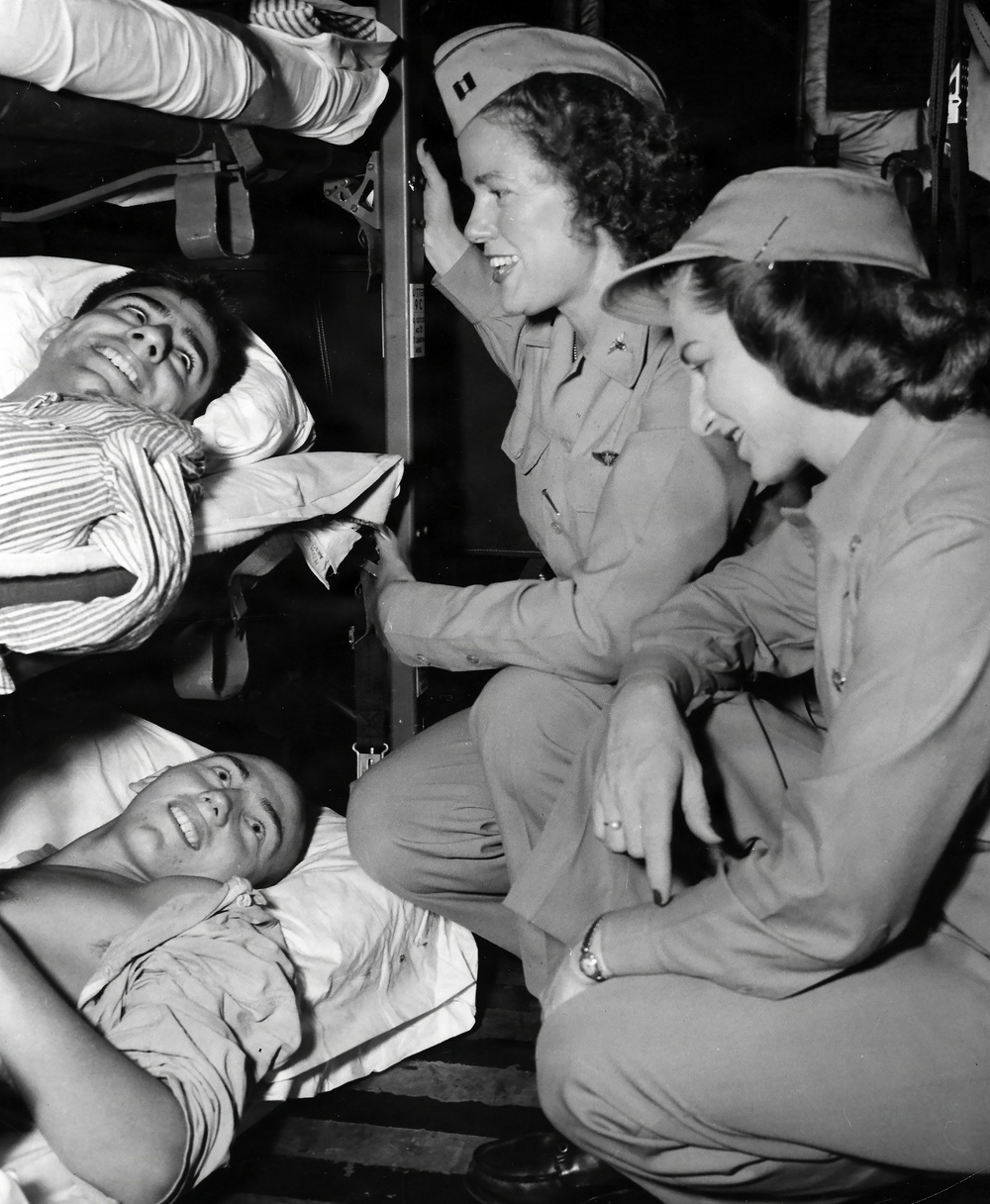
Courtesy Photo | Capt. Sara Hall and Ensign Gizella Papp, U.S. military nurses, tend to several injured...... read more read more
 Subscribe
The origins of U.S. military nurses trace back to the Revolutionary War, when women volunteered to care for wounded soldiers, and evolved during the Civil War era into an established nursing force providing much-needed care on the battlefield.
Military nursing in the United States grew from wartime necessity into a permanent arm of military medicine, shifting from improvised bedside support to a profession vital to keep service members healthy and lethal.
The impact of military nurses on warfighter readiness continues today, with more than 23,000 nurses serving in military hospitals and clinics under the Defense Health Agency.
“Nurses are well known for their care of service members after injury, assisting with healing and getting the patient back into the fight,” said Andy Watson, chief of the Army Medical Department Center of History & Heritage. “This is part of mission readiness.”
Nurses like Clara Barton, who worked with the Union Army during the Civil War, bringing in food and essential supplies, comforting the wounded, and assisting surgeons. “I may be compelled to face danger, but never fear it,” she said. “While our soldiers can stand and fight, I can stand and feed and nurse them.”
U.S. Army nurses serving the warfighter since the American Revolution
The U.S. Army Nurse Corps became a permanent part of the Army Medical Department Feb. 2, 1901, under the Army Reorganization Act. The corps evolved from basic support functions to skilled clinical care as military medicine became more organized and professional, according to Watson.
Along with advancements in nursing specialties and responsibilities, “leadership opportunities increased so positions that were previously not considered became open to U.S. Army nurses,” said Watson. Nurses now serve as commissioned officers in hospitals, clinics, and operational settings. They care for patients in military hospitals and clinics, support deployments, and advise commanders on health readiness.
A pioneer of this growth in the profession, he noted, was Lt. Gen. Patricia Horoho, a nurse who rose to lead U.S. Army medicine and became the first woman and first nurse to serve as U.S. Army surgeon general and commander of the U.S. Army Medical Department in 2011.
Yet, Watson emphasized, it began with those who served as historical pillars of warfighter medical readiness. Milestones that paved the path for U.S. Army nursing include:
Legacy of U.S. Navy Nurse Corps supporting Sailors and Marines’ readiness
The U.S. Navy Nurse Corps was established by Congress May 13, 1908. Later that year, the first nurses, known as the “Sacred Twenty,” reported for duty and indoctrination at the Naval Hospital, Washington, D.C.
In the decades following the establishment of the corps, “Navy nurses truly became foundational figures as caregivers, clinicians, leaders, and especially educators,” said André B. Sobocinski, Historian, Navy Bureau of Medicine and Surgery. “Whether on the hospital wards or at training schools, Navy nurses have historically played a key role in directing and educating newly minted hospital corpsmen on patient care, and it is no surprise that the advances in hospital corps training in the first decades of the twentieth century coincided with the growth of the nurse corps.”
Today, U.S. Navy nurses include active duty and Reserve Component nurses across more than 20 specialties and serve in hospitals and clinics, education and research commands, aboard hospital ships, on expeditionary and humanitarian missions, and in operational environments worldwide. Their work supports force health protection, medical readiness, and the U.S. Navy and U.S. Marine Corps' ability to stay mission-ready.
Sobocinski noted the profession was spearheaded by trailblazers and key moments of U.S. Navy nursing history, including:
U.S. Air Force nurses’ history of care in the sky and on the ground
The U.S. Air Force Nurse Corps grew out of wartime need, and it was part of the new Air Force Medical Service at its inception on July 1, 1949. From the beginning, U.S. Air Force nursing centered on mobility, speed, and care linked closely to operations. Its roots reach back to World War II, when Army Air Forces nurses helped establish flight nursing and aeromedical evacuation as practical wartime capabilities, according to Joseph Frechette, Air Force Medical Service senior historian.
That identity took shape in 1943, when Lt. Elsie S. Ott, a nurse with barely a year in the military, helped prove seriously ill and wounded patients could be moved long distances by air. Frechette said Ott’s historical mission from Karachi to Washington showed the value of aeromedical evacuation and helped establish a model for care in transit. “She’s one of the grand figures of nursing.”
In 2026, U.S. Air Force nurses serve in military hospitals and clinics, operational units, and mobility missions, including aeromedical evacuation and other settings where care must move with the force, with landmark moments and historical figures including:
As military medicine evolved and continues to advance, so does the role of the military medical nurse. From early field hospitals to modern medical centers to hospital ships and operational settings around the world, military nurses have adapted to where the mission needs them most.
“There is no military medicine without nurses. They are an essential component of the enterprise, enabling us to achieve our primary mission of combat readiness,” said Sobocinski.
| Date Taken: | 05.05.2026 |
| Date Posted: | 05.05.2026 10:02 |
| Story ID: | 564379 |
| Location: | US |
| Web Views: | 965 |
| Downloads: | 1 |

This work, U.S. military nursing: From bedside support to combat-ready care, by Robert Hammer, identified by DVIDS, must comply with the restrictions shown on https://www.dvidshub.net/about/copyright.


No keywords found.




