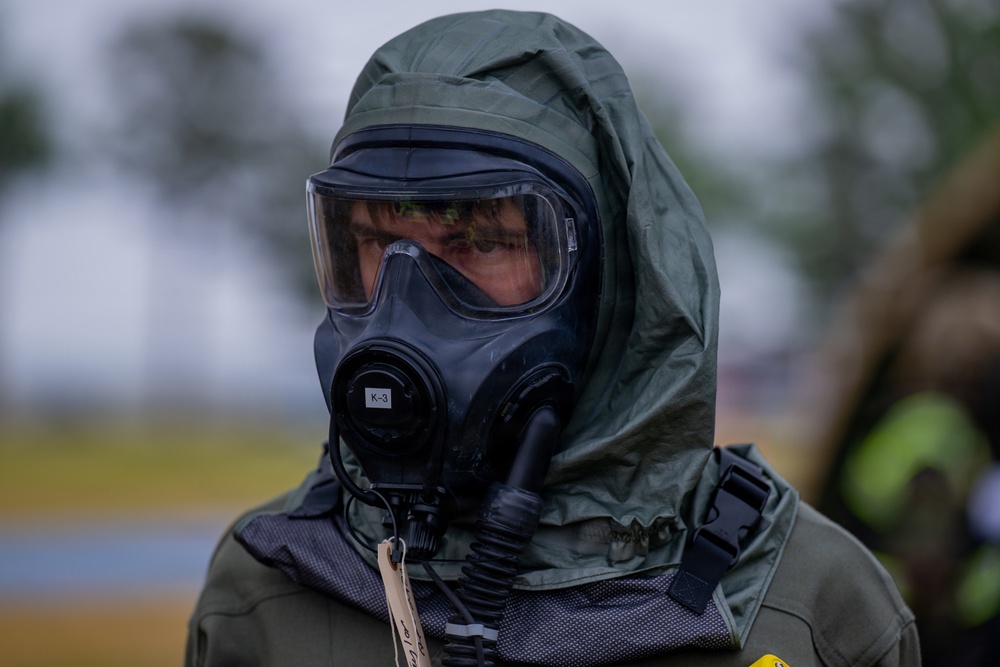
Photo By Airman 1st Class Noah Noonan | U.S. Air Force aircrew flight equipment specialist, wears a chemical, biological, radiological and nuclear (CBRN) mask during Toxic Magnolia, at Moody Air Force Base, Georgia, April 27, 2026. The training reinforced standardized procedures that ensure aircrews can safely return to the fight after a CBRN threat. (U.S. Air Force photo by Airman 1st Class Noah Noonan) see less
| View Image Page
Ready in the Fight: AFE leads CBRN defense during Toxic Magnolia
MOODY AIR FORCE BASE, Ga. — Airmen from across the Air Force converged at Moody Air Force Base April 27–May 1 for Exercise Toxic Magnolia. The service’s premier aircrew flight equipment (AFE) training event, focusing on preparing teams to operate in chemical, biological, radiological and nuclear (CBRN) environments.
As an annual, Headquarters Air Force-directed exercise, Toxic Magnolia validates and employs AFE’s Aircrew CBRN capability. Planning for this year’s iteration began months in advance, with Moody selected to host. Unlike previous iterations that included joint participation, this year’s focus remained Air Force-centric, allowing teams to refine service-specific procedures and enhance readiness.
The exercise centers on the employment of the 9ALCW unit type code, the Air Force’s dedicated aircrew CBRN response capability. Designed to simulate contested, real-world conditions, Toxic Magnolia challenges AFE Airmen to deploy, integrate and execute decontamination operations that enable aircrews to safely return to the fight.
“It is the Air Force’s capability to respond to a contested environment where our aircrew may face a CBRN threat,” said Christopher Harvey, Air Combat Command Toxic Magnolia exercise director. “Our goal is to neutralize that threat and return them to the fight so we can continue generating the airpower needed to accomplish the mission.”
This year’s iteration brought together more than 50 AFE Airmen from across the Total Force, all working to enhance aircrew contamination control area (ACCA) and aircrew contamination control station (ACCS) capabilities. Despite different levels of experience, participants were able to gain hands-on proficiency operating these systems while expanding their understanding of aircrew chemical, biological, radiological and nuclear (ACBRN) operations and their direct impact on AFE mission execution.
Throughout the week, participants rotated through complex scenarios across the installation, gaining experience with both ground and aircrew CBRN equipment, including a newly fielded radiological detector. Operating in Mission Oriented Protective Posture (MOPP) gear, Airmen navigated to unfamiliar sites, established decontamination lines and responded to simulated chemical and radiological threats.
From the installation perspective, Moody’s AFE leadership focused on validating its ability to execute those mission sets in austere conditions.
“We’re validating our 9ALCW capability and our ability to operate ACCA and ACCS in deployed, austere environments, wherever that may be and with whatever aircraft we’re supporting,” said Master Sgt. Mark Rocamontes, 347th Operations Support Squadron AFE superintendent and Moody lead for the exercise.
The varied setups reinforced the unit’s ability to execute those capabilities in both large-scale and distributed operations. Training included both large-scale and mobile decontamination systems. The open-air kit allowed teams to process up to 60 aircrew members, while the smaller forward operating base decontamination kit enabled two-person teams to rapidly respond and operate in dispersed locations. Each scenario varied in threat type, scale and location, forcing teams to adapt quickly and apply standardized tactics, techniques and procedures.
A core objective of the exercise was not only to reinforce existing knowledge, but also to identify gaps and improve processes across the force.
“One of the key goals is for Airmen to take what they’ve learned here back to their units and teach others,” Harvey said. “Another is to identify gaps in our tactics, techniques and procedures and strengthen them based on lessons learned, so we have a reliable and efficient process to take care of our aircrew in an operational environment.”
To better replicate real-world conditions, planners introduced unexpected challenges, or injects, into each scenario, ranging from language barriers with simulated coalition partners to medical emergencies and varying aircraft equipment configurations.
“It’s not always going to be a perfect scenario,” Rocamontes said. “We’re throwing curveballs at them so they can use risk management, adapt on the spot and accomplish the mission.”
The exercise also highlighted the challenges of integrating Airmen from different units into cohesive teams, a reality they are likely to face in deployed settings.
“Integrating teams can often be a challenge,” Harvey said. “But after the first few iterations, they’ve formed into cohesive teams more quickly than expected, which speaks to their experience and professionalism.”
“This is the largest exercise we have annually for AFE,” said Master Sgt. Paul Kronk, exercise setup liaison. “Everyone here is TDY from across every major command, so you’re constantly working through unfamiliar teams, unfamiliar gear and unfamiliar environments.”
Beyond technical proficiency, Toxic Magnolia is designed to build confidence and resilience in high-threat environments.
“The goal is to spread sites out across the installation, so teams have to rely on maps, communication and coordination to get to where they need to go,” said Kronk.
Participants also rotated roles, acting both as AFE specialists and as aircrew members undergoing decontamination.
“Airmen rotate roles, so they experience both sides—being the AFE member and being the aircrew going through decontamination,” Kronk said. “It gives them a better understanding of the mission from every angle.”
The approach provided a broader understanding of mission requirements and reinforced the importance of precision when handling specialized equipment across a wide range of aircraft platforms.
The success of the exercise relied heavily on coordination across multiple base agencies and subject matter experts. The 23d Wing Emergency Management Flight and 23d Medical Group Bioenvironmental Engineering Flight provided critical technical expertise and detection capabilities, enhancing participants’ understanding of CBRN threats and mitigation procedures. Their support, alongside an intelligence briefing from the 347th Rescue Group Intel Flight outlining allied and adversary ACBRN capabilities, helped create a realistic and operationally representative training environment.
“It’s a total team effort,” Rocamontes said. “In a real-world scenario, we rely on that coordination to understand the threat and respond effectively.”
Coordination from Headquarters ACC ensures the exercise’s success, with planners synchronizing logistics, personnel and training objectives across participating units. This collective effort reinforces AFE’s essential role in ensuring uninterrupted mission execution and safeguarding aircrew against evolving chemical, biological and radiological threats. By strengthening cross-functional coordination, validating operational capabilities and sharpening technical proficiency, Toxic Magnolia ensures participating Airmen return to their home stations fully prepared to execute their life-saving mission anytime, anywhere.

 Subscribe






