
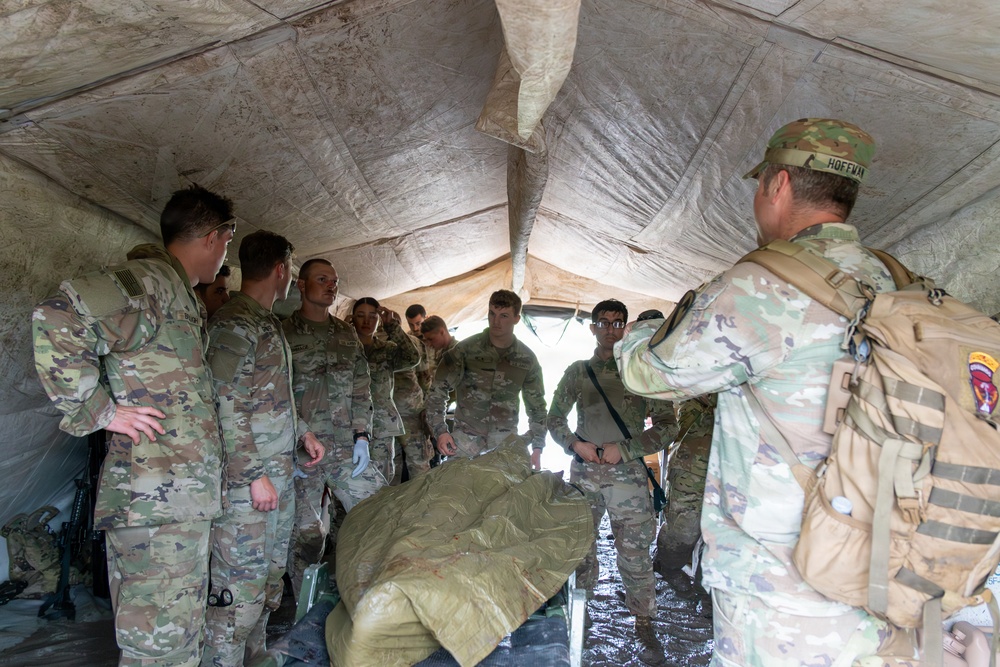
Photo By Staff Sgt. Zelika Stewart | Troopers assigned to the Ironhorse brigade discuss a medical plan of action for...... read more read more
 Subscribe
FORT HOOD, Texas — Combat medic specialists with the 1st Cavalry Division’s 1st Armored Brigade Combat Team “Ironhorse” conducted reanimated tissue training using cadavers April 21-22. The exercise aimed to establish trauma management benchmarks and reinforce critical life-saving interventions for real-world scenarios. The Ironhorse brigade collaborated with Maxfi Surgical Simulations and Safeguard Medical to procure human cadavers, artificial blood, and pump technology that simulates pulsatile blood flow at controllable rates, pressures, and stroke volumes.
"This training is critical to our success on the battlefield," said Staff Sgt. Dalton Howell, a medical platoon sergeant with the 115th Brigade Support Battalion, 1st Armored Brigade Combat Team. "With reanimated tissue training, medics can see the immediate effectiveness of their interventions."
Howell oversaw medical treatment and casualty evacuation throughout the exercise. He emphasized that the simulation provides the closest possible representation of actual casualties, allowing soldiers to safely learn and make corrections.
"Practicing these advanced procedures is fundamental to the outcome for real patients," Howell said.
Experienced combat medics led the training, fostering mentorship for personnel from across the post.
“Working with reanimated tissue greatly improved my understanding of human anatomy in a trauma setting," said Pvt. Anthony Brough, a combat medic with the 2nd Battalion, 8th Cavalry Regiment. "We normally train with mannequins, so this level of realism is incredibly beneficial.”
Brough and Pfc. Caden Blue, also assigned to the 2nd Battalion, 8th Cavalry Regiment, noted the stark difference between standard mannequins and cadavers.
"Standard mannequins are rigid. With a cadaver, there are actual joints, muscles, and skin tissues," Blue said. "The cadaver we used today had an amputated leg where you could see the bone, tissue, and the blood coming from the artery."
Beyond individual skills, the exercise provided leadership with data to assess unit readiness.
“It set the standard for realistic combat trauma management,” said 1st Lt. James Hoffman, a physician assistant with the 2nd Battalion, 8th Cavalry Regiment. “Commanders can identify capabilities and training gaps at all levels, which are then integrated into brigade combat team operations.”
Hoffman noted the training reinforced advanced interventions necessary for large-scale combat operations. “Reanimated tissue training is the closest we can get to battlefield injury without war,” Hoffman said. “Testing systems like walking blood banks and prolonged casualty care are essential for LSCO.”
The training improved technical proficiency while encouraging leadership and teamwork under pressure. By utilizing the most realistic simulations available, the 1st Cavalry Division ensures its troopers remain prepared to provide life-saving care in any environment.
| Date Taken: | 04.22.2026 |
| Date Posted: | 05.03.2026 09:28 |
| Story ID: | 564171 |
| Location: | FORT HOOD, TEXAS, US |
| Web Views: | 97 |
| Downloads: | 0 |

This work, IRONHORSE conducts reanimated tissue training, by SSG Zelika Stewart, identified by DVIDS, must comply with the restrictions shown on https://www.dvidshub.net/about/copyright.


No keywords found.




