
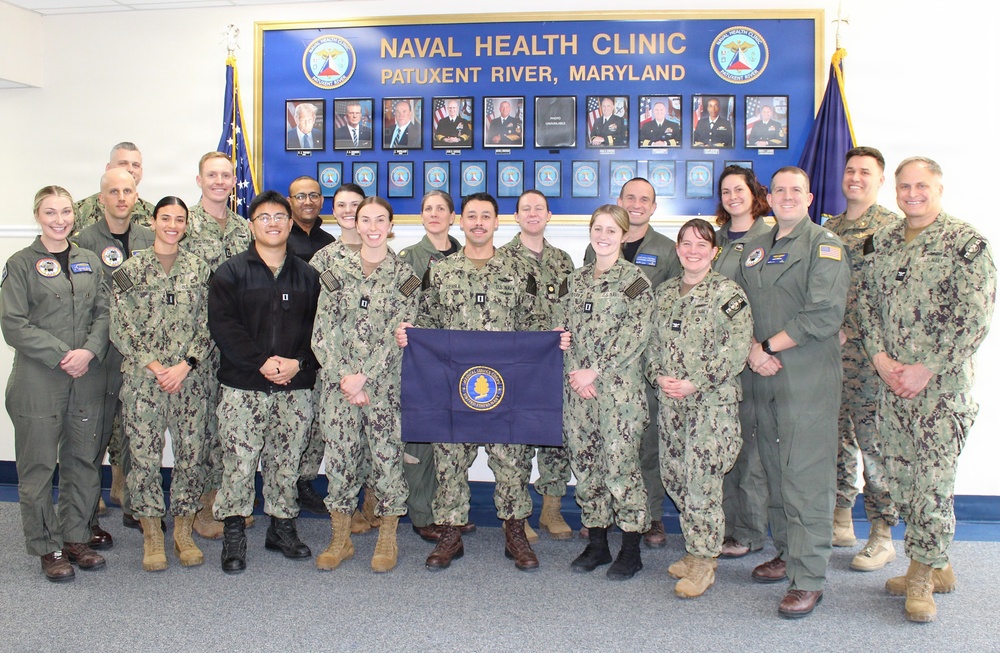
Photo By Maria Scott | Capt. Kristin Hodapp (front row, center), Deputy Chief of the Navy Medical Service...... read more read more
NAVY MEDICINE READINESS AND TRAINING COMMAND PATUXENT RIVER, Md.– The highly specialized aviation and test missions at Naval Air Station (NAS) Patuxent River rely on a unique level of medical and scientific support, delivered directly by the Navy’s Medical Service Corps (MSC). Spanning 31 diverse specialties, the MSC operates across three core pillars: Healthcare Administration, Clinical Care, and Research and Applied Sciences. Across the Southern Maryland installation, these clinicians, administrators, and scientists are integrated within both Navy Medicine Readiness and Training Command (NMRTC) Patuxent River and NAVAIR tenant commands. This network of MSC experts delivers vital operational medical care, leads aviation survival training, and drives cutting-edge aerospace research.
To engage directly with this diverse force, Capt. Kristin Hodapp, Deputy Chief of the Medical Service Corps, traveled to Patuxent River in late February. The day featured a "State of the Corps" address, individual career discussions, and a specialized brief by MSC Chief Liaison LT Kionna Myles, which provided a clear roadmap for enlisted sailors aspiring to join the officer ranks.
“The Medical Service Corps is a force multiplier for Navy Medicine,” said Capt. Ken Radford, Commanding Officer of NMRTC Patuxent River. “At Pax River Main and Branch Clinics, we have PAs delivering primary care, a clinical psychologist and licensed clinical social worker supporting mental health readiness, a lab officer running our diagnostic services, and healthcare administrators keeping four geographically dispersed sites running. That's clinicians, scientists, and administrators all under one Corps. For a shore-based ambulatory care command, that breadth is remarkable, and our patients feel it every day.”
EXCELLENCE ACROSS THE CORPS MSC clinical providers have a significant impact on operational forces. For example, LT Natalie Grose recently received a Navy and Marine Corps Achievement Medal (NAM). Fleet Air Reconnaissance Squadron Four (VQ-4) specifically submitted her for this honor to recognize her critical partnership. LT Grose stepped up as the primary competent medical authority during a challenging time. She completely overhauled the command’s Personnel Reliability Program (PRP) for Medical Readiness. The PRP is a 24/7, no-fail requirement tied directly to the nation's strategic nuclear deterrence. By revamping procedures and leading training, she ensured uncompromising support for VQ-4's high-stakes mission. To recognize her efforts, VQ-4 Officer in Charge, Cmdr. Daniel Maine, personally presented the award.
“LT Grose and the dedicated professionals of NMRTC Pax River exemplify what it means to support a no-fail mission. The Personnel Reliability Program (PRP) is not a checkbox, instead, it’s a critical safeguard underpinning our Nation’s nuclear deterrence posture,” Capt. Radford noted. “Our partnership with the Shadows of VQ-4 is one I’m deeply proud of, and this Navy Achievement Medal is a testament to the exceptional skill and commitment our Navy Medicine team brings to every aspect of that mission.”
Research and Applied Scientists are just as vital to the warfighter and LCDR Hadley Sulpizio, an Aerospace Operational Physiologist stationed at the Navy Aviation Survival Training Center (ASTC) Patuxent River, is a prime example. ASTC serves as a vital link for warfighter readiness, providing CNO-mandated training for over 2,500 joint warfighters annually. In her role, LCDR Sulpizio brings the Naval Survival Training Institute’s (NSTI) standardized curricula to life. Leading a specialized team of aerospace physiologists, survival instructors, and medical staff, she oversees a multimillion-dollar, high-risk training facility, ensuring strict safety protocols during rigorous evolutions like underwater egress, parachute drags, and hypoxia training.
Operating in a highly specialized environment, LCDR Sulpizio and the ASTC actively collaborate with units like Naval Test Wing Atlantic to tailor these rigorous standards for Patuxent River’s unique demographic of test pilots, flight engineers, and DoD civilians. By channeling operational data, training metrics, and instructor feedback to NSTI headquarters and Commander, Naval Air Forces (CNAF), the ASTC Patuxent River team directly shapes fleet curriculum improvements, elevates safety mitigations, and helps secure future survival for joint warfighters around the globe.
Naval Aerospace/Operational Physiologist LCDR Juliette Ruff showcases how Medical Service Corps (MSC) scientists contribute to the NAVAIR mission by working at the confluence of research and acquisition. Currently serving with NAVAIR Systems Command, Naval Test Wing Atlantic as the Aeromedical Safety Officer, she provides vital aeromedical support and human factors integration for the developmental test community. Her work focuses on rapidly evaluating current and future naval aviation technologies, delivering aeromedical and aircrew life support systems training, and advising on human systems integration across five development test squadrons encompassing over 20 Type/Model/Series aircraft. By ensuring Naval aircrews can safely execute complex, high-altitude research missions, LCDR Ruff helps turn laboratory innovations into operational Fleet capabilities. Ultimately, her comprehensive efforts are critical in risk management, mishap prevention, and mishap survivability
LCDR Matthew Christensen exemplifies the dynamic and seasoned leadership style typified by the Medical Service Corps’ Healthcare Administration community. Serving as the Director for Administration (DFA) at NMRTC Patuxent River, he effectively acts as the command’s “chief operating officer,” expertly balancing a wide array of competing and high-priority operational requirements. This position is a competitively screened Milestone billet—a high-stakes leadership role designed to prepare officers for eventual Executive and Commanding Officer assignments. Daily, Christensen orchestrates the complex administrative framework that sustains medical readiness for thousands of beneficiaries across three distinct naval installations. A critical component of his tenure involves spearheading infrastructure renovation for aging facilities, a task that requires him to serve as the primary external liaison with the Naval Facilities Engineering Systems Command (NAVFAC), Commander, Navy Installations Command (CNIC), and the U.S. Army Corps of Engineers to ensure clinical spaces meet modern mission requirements. Christensen's extensive responsibilities encompasses human resources management for active-duty, civilian, and contract personnel; oversight of information management; physical security; emergency management; fleet management, and patient records. By integrating these logistical and operational demands, Christensen ensures the command’s clinical staff remain fully focused on their core mission of delivering high-quality patient care and sustaining warfighter readiness
Through complex healthcare administration, clinical excellence, and applied science, Medical Service Corps officers onboard NAS Patuxent River do more than sustain the force. As the ultimate force multipliers, they actively drive the readiness, lethality, and technological superiority of the Fleet.
| Date Taken: | 05.01.2026 |
| Date Posted: | 05.01.2026 15:53 |
| Story ID: | 564169 |
| Location: | PATUXENT RIVER, MARYLAND, US |
| Web Views: | 293 |
| Downloads: | 0 |

This work, From Clinic to Flight Line: How the Medical Service Corps Drives Readiness at Patuxent River, by Maria Scott, identified by DVIDS, must comply with the restrictions shown on https://www.dvidshub.net/about/copyright.


No keywords found.





