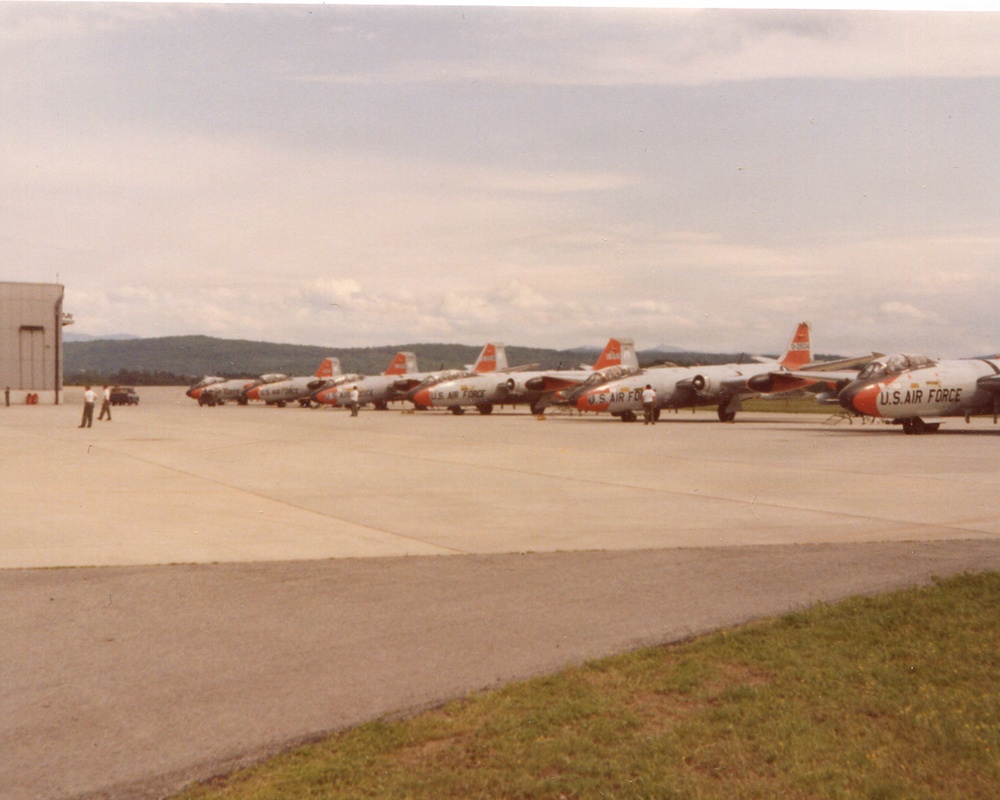
Photo By Airman 1st Class Raymond LaChance | U.S. Air Force EB-57s, assigned to the Vermont Air National Guard, wait on the runway in South Burlington, Vermont. The photo is used to provide historical context to the story, but does not feauture the pilots described in the story. (U.S. Air Force photo) see less
| View Image Page
Charles W. Diggle III and Bertrand White were young officers with the Vermont Air National Guard, earning their place in the demanding profession of Air Force pilots, where precision is routine, and risk is never far away.
Diggle was a Vermonter, from Randolph, and White was a New Yorker from Glens Falls, and by the mid-1970s, they were flying missions that put them in the middle of one of the Cold War’s less-visible front lines: training America’s air defenses to recognize and respond to threats.
Both were assigned to the 134th Defense Systems Evaluation Squadron, flying as targets for the F-106 Delta Dart.
On March 17, 1976, Diggle, an Air National Guard captain, was at the controls of an EB-57, a modified version of the Martin B-57 Canberra used in electronic warfare and training support, with White, also a captain, in the back seat as the electronic warfare officer.
That afternoon, the aircraft went down near Tyndall Air Force Base in Florida. Diggle and White were both killed.
The F-104 pilot reported seeing a burst of black smoke come from one of the engines before losing sight of the aircraft.
An investigation board found that while on a low-level flight, a bird strike caused an explosion in one of the engines, causing catastrophic damage to the wing.
Diggle was born on July 15, 1941, in Plainville, Connecticut, before moving to Randolph, where he graduated from high school in 1959 and later from the University of Vermont in 1963.
He was married to Sheila Kehoe and had been in the Vermont Air National Guard for 13 years, having earned his silver pilot wings in 1966 and later, his senior pilot rating.
White was born on Dec. 8, 1945, in Hartford, Connecticut, and served for six years with the Strategic Air Command as a navigator before joining the Vermont Air National Guard in 1974.
By the time Diggle was flying the EB-57, the aircraft had become part of a specialized niche. The 134th DSES’ broader mission was supporting air defense training, acting as a “friendly enemy” and helping evaluate radar and systems under degraded conditions, the kind of scenario planners worried about during an era defined by nuclear deterrence and Cold War readiness.
In plain terms, some crews were trained to intercept; others helped create the conditions that made training real.
Two decades later, Diggle’s and White’s names appeared in a U.S. Senate floor statement by Sen. Patrick Leahy marking the Vermont Air National Guard’s 50th anniversary, specifically in a list of guardsmen who have died in the line of duty since 1946.
It’s a brief mention, but it underscores the way service can echo beyond a single moment: a name read into the public record, anchored to the institution’s memory, tied to the generations that follow.
A fatal training crash can leave families and units with two parallel realities: pride in service and the brutal finality of how quickly it can end. In a profession built on checklists and redundancy, the final margin can still be thin.
In the communities they left behind and in the Guard’s lineage of “citizen soldiers,” Charles W. Diggle III and Bretrand White remain part of the story, two names that mark the cost of readiness.

 Subscribe






