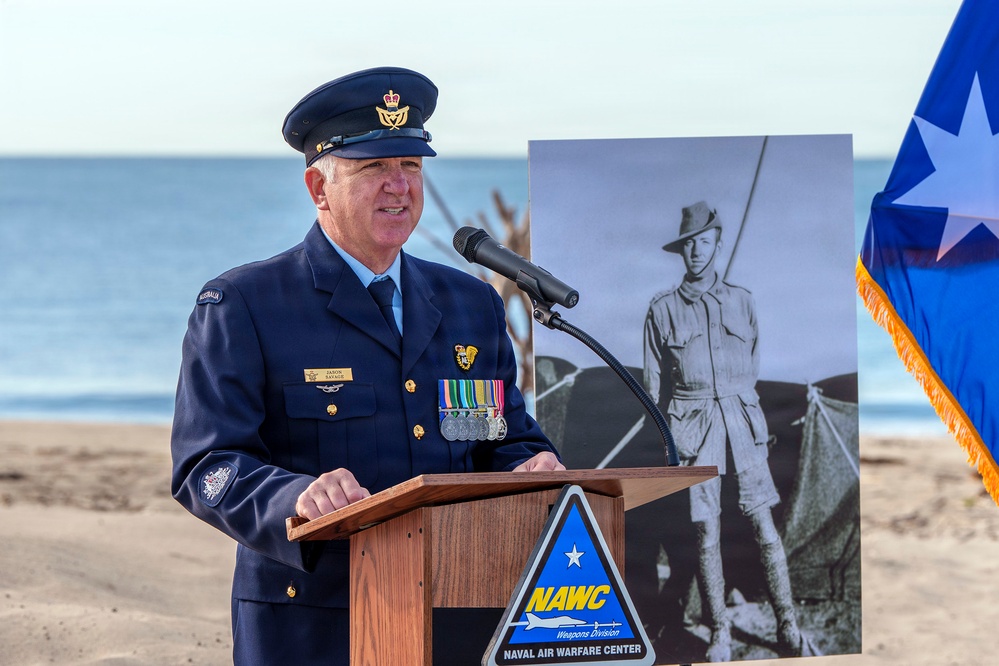
U.S. Navy and Royal Australian Air Force personnel gathered April 23 to commemorate Anzac Day, marking a century-old sacrifice that now anchors 12 years of daily partnership in electronic warfare operations at Naval Air Warfare Center Weapons Division.
More than 20 years of cooperative science and technology between Australia and NAWCWD has produced fielded EW capability for both nations’ aircrews. Australia is the only nation besides the United States to operate the EA-18G Growler. The two nations co-developed the Next-Generation Jammer, which is replacing the legacy ALQ-99.
In December 2024, the Royal Australian Navy destroyer HMAS Brisbane launched a Tomahawk cruise missile from the Point Mugu Sea Range. Australia became the third AUKUS nation to demonstrate the capability.
The ceremony honored the origin of that alliance.
About 72 people took their seats just before 8:30 a.m. Dolphins passed close to shore minutes before the ceremony began. Mugu Rock stood behind a thin marine layer, the Pacific breaking gently against its base.
Each chair held a small gift bag marked “Lest We Forget.” Inside: a sprig of rosemary and a red poppy pin, both emblems of remembrance. Alongside them, a koala keychain and an Anzac biscuit.
A Royal Australian Air Force warrant officer opened the service by telling a story most of his American audience had never heard, a story called the “Bridge of Valor.”
At Gallipoli in 1915, the warrant officer said, the guns fell silent one afternoon. A Turkish soldier climbed from his trench carrying a white flag. He was not surrendering. He was crossing into enemy fire. He was there to save.
He walked into no man’s land, lifted a wounded Australian and carried him across broken ground to the Australian line. He placed the man in the arms of his mates, turned and walked back alone. Only then did the firing resume.
“They remind us that even in the darkest chapters of human history, compassion can cross the deepest trench,” the warrant officer said, pointing to monuments at Gallipoli that depict the moment.
Anzac Day marks the anniversary of the first major military action by Australian and New Zealand forces in World War I. They landed at Gallipoli on April 25, 1915.
The campaign lasted eight months and cost more than 8,000 Australian and nearly 2,700 New Zealand lives. For Australians and New Zealanders, Anzac Day is a day of national remembrance.
“In Australia, it needs no explanation,” the warrant officer said. “In California, it does: who the Anzacs were, why Gallipoli mattered, and why remembrance still resonates.”
The American thread in the Anzac story runs further back than many Americans realize. Before the United States entered World War I, dozens of young Americans crossed the Pacific to enlist in the Australian Imperial Force.
They wore the slouch hat, shared bully beef rations and fought alongside Australian diggers in the trenches. The warrant officer called them the “Aussie-Yanks,” the first quiet bridge between the two democracies.
Three years later, American and Australian troops fought together for the first time.
At the Battle of Hamel on July 4, 1918, American troops fought beside Australian forces under the command of Australian Gen. John Monash. Monash launched the attack on America’s Independence Day as a mark of respect.
When last-minute orders came for Americans to withdraw, many refused. They donned the Australian slouch hat and went into battle beside their Australian mates.
A RAAF sergeant traced the alliance from Hamel through World War II, Korea, Vietnam, Iraq and Afghanistan. The two nations formalized the relationship in the ANZUS Treaty of 1951, which Australia invoked for the first time on Sept. 11, 2001.
“This mateship, forged on a battlefield over 100 years ago, has built an unbreakable foundation,” the sergeant said. “On that foundation we will build the bond of friendship for the next 100 years. We are mates.”
NAWCWD’s Airborne Electronic Attack Integrated Product Team has collaborated with RAAF counterparts since 2009. Uniformed RAAF personnel have been stationed full-time at Point Mugu since 2014.
RAAF engineers and uniformed personnel work daily alongside NAWCWD counterparts at Point Mugu, embedded across programs that include the Next-Generation Jammer, broader EW science and technology and mission data analysis.
A secure collaborative workspace at Point Mugu lets Australian and U.S. personnel develop EW capability side by side. A separate joint countermeasures facility, which reached early operational capability in July 2024, provides another workspace where the two nations collaborate on shared aircraft.
A NAWCWD electronic attack programs lead said the partnership delivers what neither nation could deliver alone.
“Our countries have fought and bled together for more than a century and it is critical that we honor the sacrifices they have made for us all,” the lead said.
A member of Australia’s Defence Science and Technology Group described small traditions that carry the day forward, including the rosemary pinned to lapels. The herb grows wild on the Gallipoli Peninsula and serves as an Australian emblem of remembrance.
Another member of DSTG member spoke about Capt. Albert Jacka, Australia’s first Victoria Cross recipient of World War I. Jacka’s name joined a long list of Australians the day remembers.
A second RAAF sergeant closed the scripted portion of the ceremony with a direct address to the American audience.
“Thank you for standing with us,” the sergeant said. “Our nations have served alongside one another for more than a century, and Anzac Day reminds us of the values and commitment we continue to share.”
The Ode of Remembrance followed. Then the Last Post. One minute of silence. The Rouse. The U.S. national anthem, then the Australian national anthem.
The warrant officer thanked the teams who set up the ceremony. Then he invited everyone to breakfast.
The gunfire breakfast traces back to British troops who received an early cup of tea before first parade. Today it typically includes coffee and rum, bacon and eggs. At Point Mugu, the table held all of it.
As attendees gathered at the table, the warrant officer’s words still carried. He had ended his opening remarks with a challenge to everyone listening.
“May we live our lives worthy of their sacrifice. May we build bridges of valor in our own communities.”
| Date Taken: |
05.01.2026 |
| Date Posted: |
05.01.2026 13:22 |
| Story ID: |
564140 |
| Location: |
POINT MUGU NAWC, CALIFORNIA, US |
| Web Views: |
21 |
| Downloads: |
0 |
PUBLIC DOMAIN

This work, Bridges of valor: U.S.-Australia partnership delivers EW capability, by Michael Smith, identified by DVIDS, must comply with the restrictions shown on https://www.dvidshub.net/about/copyright.