
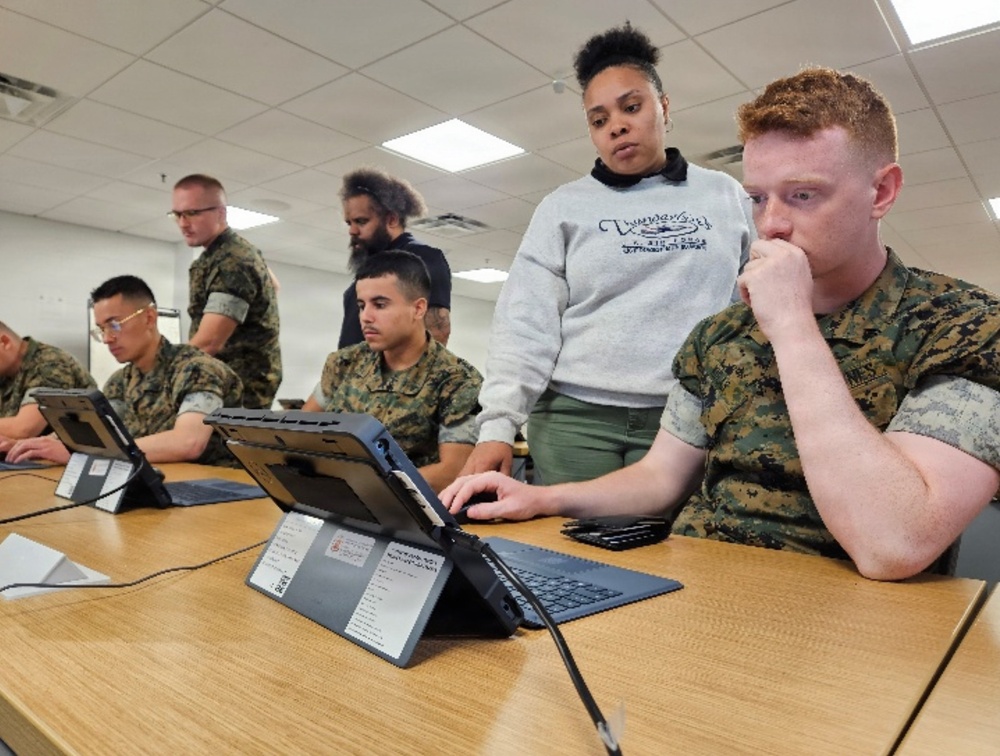
Photo By Master Sgt. Latasha Esperon | U.S. Marine Corps reservists with 6th Communication Battalion, Force Headquarters...... read more read more
 Subscribe
MARINE CORPS BASE QUANTICO, Va. — When the Marine Corps Cyberspace Operations Group needed an immediate surge of capability, they turned to Force Headquarters Group, Marine Forces Reserve. On March 26, 2026, the response from 6th Communication Battalion was fast: orders were drafted and approved within 36 hours, and a team of Reserve component defensive cyberspace operations Marines arrived on station ready to work.
Initial support was extended to provide 60 days of surge capability. The speed of that response came down to preparation. In addition to technical expertise, the Marines who showed up were medically and administratively ready before the opportunity arose, and that readiness enabled their rapid employment.
“In the face of emerging threats and an ever-expanding digital battlefield, responsiveness is the key to relevance. The individual actions taken by these Marines that set conditions for their rapid employment in support of an active component element were the decisive part in a case study of Reserve-active component integration,” said Brig. Gen. David Winnacker, commanding general, Force Headquarters Group.
These Reserve Marines possess a variety of civilian careers that complement the skills needed to support the mission: a cyber threat-hunting lead at the Defense Threat Reduction Agency, an information system security officer supporting a National Reconnaissance Office contractor, a security operation center analyst managing incident response for a hospital network and an information technology specialist handling identity infrastructure for one of the country’s largest ferry operators. Each arrived with relevant real-world, hands-on experience that applied directly to the mission.
6th Communication Battalion contributed automation capabilities, threat detection workflows refined through commercial SOC work and incident response techniques drawn from both government and private-sector environments, adding to what an already capable force had in place.
“Our strength is our footing in two worlds,” said Maj. Zzmarr Stone, Defensive Cyberspace Operations - Internal Defensive Measures, Bravo Company, 6th Communication Battalion, Fort Devens, Massachusetts. “As a Reserve cyber Marine, you don’t leave your civilian expertise at the door. You bring it to the forefront of national security, tackling the nation’s most complex challenges while continuing your career.”
For most Marines on the team, volunteering was not a difficult decision. Many had been waiting for a chance to apply their training in a real operational environment.
“The skills that the Marine Corps taught me were very helpful for kickstarting a civilian career, but I joined in the first place so I could do something for my country,” said Cpl. Jacob Kulas, a cyberspace warfare operator. “There was no chance I’d miss it.”
The 36-hour activation and the mission extension that followed demonstrated what is possible when individual Marines stay ready and the right people are in the right billets. As the Marine Corps continues to demand specialized capability across a range of missions, the reserve offers a reliable source of experienced professionals who carry their civilian careers into every deployment.
| Date Taken: | 04.08.2026 |
| Date Posted: | 05.01.2026 13:08 |
| Story ID: | 564128 |
| Location: | QUANTICO, VIRGINIA, US |
| Web Views: | 199 |
| Downloads: | 0 |

This work, Civilian Expertise, Military Speed: How Individual Readiness Fuels Force Headquarters Group's Rapid Cyber Deployments, by MSgt Latasha Esperon, identified by DVIDS, must comply with the restrictions shown on https://www.dvidshub.net/about/copyright.

No keywords found.




