
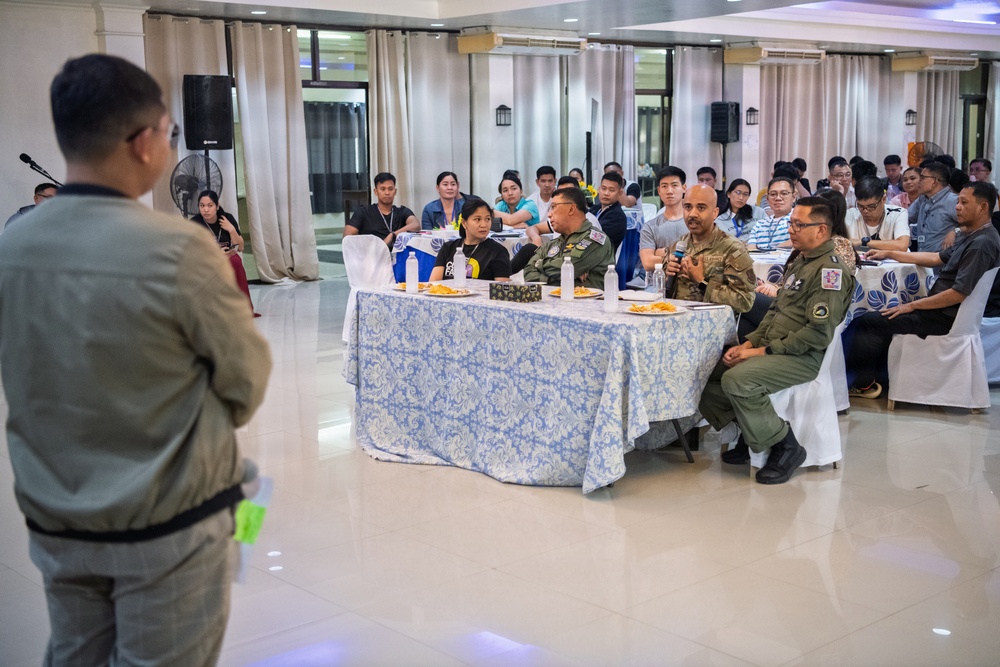
Photo By Sean P. Houlihan | U.S. Air Force Chief Master Sgt. Israel Nunez, seated with mic, Air Force Reserve...... read more read more
 Subscribe
MANILA, Philippines—In a major step toward building allied partnership capacity, six U.S. Air Force Reserve Airmen mentored more than 120 Philippine Air Force personnel during the inaugural Reserve Allies and Partner Program Leader Development Workshop that ended April 24 at Fernando Air Base.
The milestone event focused on equipping the Philippine Air Force noncommissioned officer corps with the principles of mission command. Chief Master Sgt. Israel Nuñez, command chief of Air Force Reserve Command and senior enlisted advisor to the Chief, Air Force Reserve, delivered the keynote address, stressing the necessity of decentralized control and rapid decision-making in modern warfare.
“We are going to need not just empowered NCOs, we need empowered company grade officers on the front line who are helping lead the fight, because the speed of decision making needs to be fast," Nuñez told the group.
Nuñez stressed the need for rapid decision-making to counter "greater adversaries who operate in a very contested environment."
He explained that the U.S. team attended the workshop to share not only the leadership lessons they have learned, but also their failures. However, he emphasized that this educational exchange is a two-way street.
“As Reserve Airmen, we can learn from you all,” Nuñez said. “There is greatness in what you do in the Philippine Air Force and other services, and we can take those lessons back to ensure we are ready together if a time ever comes to defend our nations.”
To immediately apply these concepts, the workshop culminated in a pitch competition. Nuñez, alongside Philippine Air Force Maj. Gen. Jesus Nelson Morales, commander of Air Education and Training Command, and Col. Gene Paul Santos, commander of AETC’s Development Leadership Center, judged presentations from three student teams tasked with solving how to better equip the PAF NCO corps.
One team proposed that enlisted leaders run professional military education schoolhouses: a standard practice in the U.S. Air Force. Nuñez acknowledged the cultural differences between the two forces but praised the initiative.
“It's tough for me to provide a counter to that, because that's the world we live in on the U.S. side," Nuñez said. "In my command, all enlisted development falls under my authority, and with help from the team, I build the programs. What does mission command in the Philippine Air Force look like? It may not look like mission command in the U.S. Air Force, so you have to find that balance. You have to start somewhere, and what you presented was a ramp-up strategy to get there. This is not going to happen overnight. You have to ask yourselves: Are your NCOs ready for that level of responsibility?”
Throughout the week, U.S. facilitators prioritized learning PAF culture while discussing concepts like agile combat employment, explicitly avoiding the imposition of U.S. organizational structures.
Nuñez emphasized that the Air Force Reserve prioritizes building capacity with partner nations because the U.S. knows it cannot operate alone.
While acknowledging the value of the foundational skills discussed during the workshop, such as emotional intelligence, communication, and trust-building, he stressed that the ultimate goal of the workshop is mastering decentralized command and control.
“For me, the most important lesson is understanding the importance of empowerment,” Nuñez said. “Ultimately, it's about cultural and organizational change that allows an environment at the lower level to happen.”
He challenged the attendees to take the lessons learned during the week and apply them directly to their specific daily operations, noting that a service member's battlefield might be aircraft maintenance or cargo handling.
Reserve Allies and Partners Program is the command’s premier program to assist global allies through key leader engagements, exercises, and force development. This specific workshop event had been in the planning stages since February 2025, following discussions between Lt. Gen. John Healy, chief of the Air Force Reserve, and Lt. Gen. Arthur Cordura, commandant general of the Philippine Air Force.
The cadre of U.S. reservists will remain at Fernando Air Base for an additional week to facilitate a second workshop for 120 more PAF members.
During his visit, Nuñez also conducted key leader engagements with Chief Master Sgt. Randillie Mendoza Tulloa, sergeant major of the Philippine Air Force, as well as enlisted leaders from AETC, Air University, and the Leadership Development Center.
The six U.S. facilitators for the course included Lt. Col. Brandi Pasley, individual mobilization augmentee to the Professional Development Center at AFRC headquarters, Robins Air Force Base, Georgia; Chief Master Sgt. Matt Gregg, 315th Mission Support Group senior enlisted leader, Joint Base Charleston, South Carolina; Chief Master Sgt. Laura Griswold, chief of enlisted force development, AFR; Chief Master Sgt. Allison Garces, 624th Regional Support Group senior enlisted leader, Joint Base Hickam, Hawaii; Senior Master Sgt. Jeff Davis, First Sergeant Academy instructor, Maxwell Air Force Base, Alabama; and Master Sgt. Salina Ortega, executive assistant to the AFRC command chief, Robins AFB.
| Date Taken: | 05.01.2026 |
| Date Posted: | 05.01.2026 11:48 |
| Story ID: | 564122 |
| Location: | MANILA, PH |
| Web Views: | 126 |
| Downloads: | 0 |

This work, Air Force Reserve empowers Philippine allies in milestone leadership workshop, by Sean P. Houlihan, identified by DVIDS, must comply with the restrictions shown on https://www.dvidshub.net/about/copyright.


No keywords found.




