
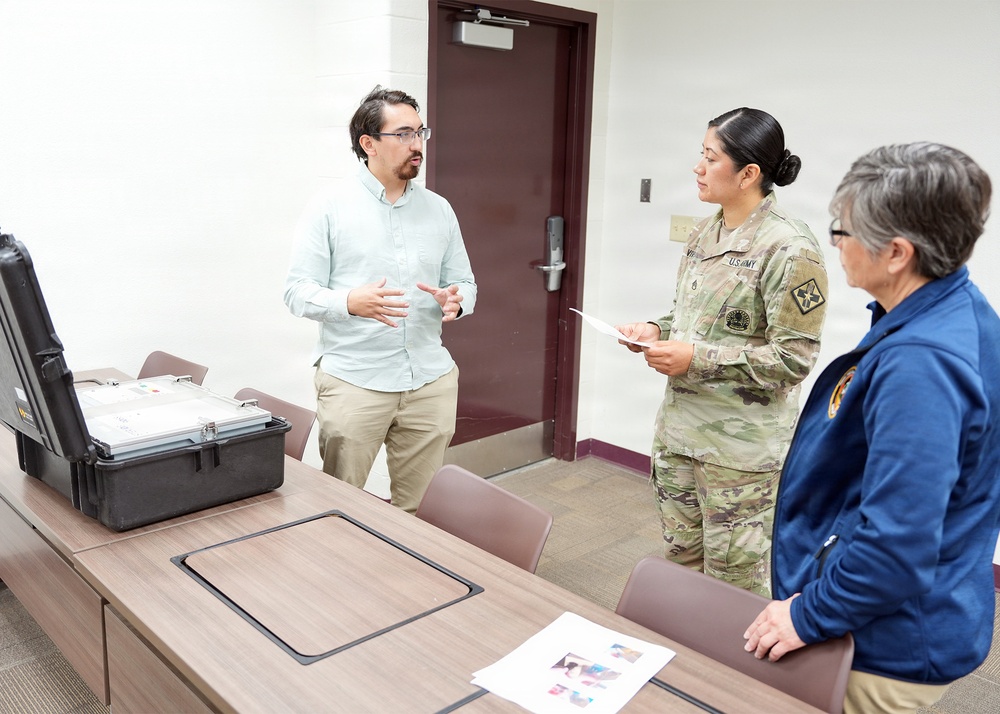
Photo By Burrell Parmer | JOINT BASE SAN ANTONIO – FORT SAM HOUSTON – (April 2, 2026) – Biomedical...... read more read more
JOINT BASE SAN ANTONIO – FORT SAM HOUSTON – (April 30, 2026) – During the month of April, research engineers assigned to the Combat Casualty Care & Operational Medicine Directorate, Naval Medical Research Unit (NAMRU) San Antonio, visited with dental and veterinary science instructors to test the usability of the Rugged Ozone Sterilization System Model M1 (ROSS M1).
The ROSS M1 is a portable device with the capability of sterilizing medical instruments on the battlefield or in austere environments which will help in the treatment and recovery of wounded warfighters.
Created through a partnership with SteriO3, and funded through Naval Medical Research Command’s Navy Advanced Medical Development program, the ROSS M1 will enable combat medics, corpsmen, dentists and surgical personnel to sterilize instruments needed for dentistry and surgery utilizing a process that would sanitize the medical instruments within an hour.
To maintain medical and military readiness, the ROSS M1 has been tested by NAMRU San Antonio’s research engineers on its capability to effectively eliminate a broad spectrum of pathogens, including bacteria and fungi.
To further assess the ROSS M1 on its usability, research engineers visited with Soldiers and civilian personnel assigned to the U.S. Army Medical Center of Excellence (MEDCoE), April 2.
Staff Sgt. Guadalupe Vivar, a non-commission officer in charge, Preventive Dentistry Specialty Course, was the first of several MEDCoE personnel to test the ROSS M1.
“This type of portable sterilizer can be very useful in the field, especially in Role 1 or Role 2,” said Vivar, of Vineland, N.J. “It’s fast and convenient when an autoclave is not readily accessible.”
Role 1 is the initial, frontline medical support in military operations, providing immediate life-saving care, triage, and stabilization near the point of injury.
A Role 2 medical facility provides advanced trauma management, damage control resuscitation, and surgery closer to the battlefield than Role 1, bridging the gap between frontline medics and theater hospitals.
Not only can the ROSS M1 be utilized for the sterilization of medical instruments for humans but for veterinary instruments as well.
According to Staff Sgt. Jason Stokes, of Fort Cambell, Ky., an instructor with the Animal Health Branch, Division of Veterinary Science, U.S. Army Medical Department Center and School, the ROSS M1 provides a way forward on what the Army is looking for regarding portable ruggedized equipment and the ability to operate at a higher level in a field environment.
“We are looking at prolong field care, especially if there are large casualty rates,” said Stokes, during NAMRU San Antonio’s visit, April 3. “We will have to be able to maintain a patient for longer periods of time because we can’t predict the frequency of MEDEVAC air support. So, the ability to sterilize instruments and use them on patients reduces a lot of risk for infection which makes their chances for prolong field care and survival much better.”
“Currently, STEAM Autoclaves are being used at a Role 2 and being that the portal ozone sterilizer can be powered from a SINCGARS radio battery or through cables connected to a vehicle such as a M1195, the portal ozone sterilizer can almost be used in any environment if hydrogen peroxide is available,” Stokes said.
Lastly, NAMRU San Antonio researchers visited with dental specialist instructors assigned to Echo Co., 264th Medical Training Battalion supporting the Medical Education and Training Campus (METC), April 16.
“The equipment is versatile and lightweight. Due to its small size, it is easier to transport than what we currently have which takes at least two Soldiers to carry and takes up a lot of space,” explained Staff Sgt. Erisa Sablan, of Guam. “Having an alternate source of power such as a battery is very beneficial but it would be helpful to know how many sterilization cycles can be executed within one charge.”
Additionally, Staff Sgt. McKeitha Williams, of Henderson, N.C., another dental specialist instructor with Echo Co., thinks having an alternate power source for a portal ozone sterilizer is usable and durable for dental specialists in the field.
“Having two sources of power is a benefit as our current equipment only uses A/C power,” said Williams. “It would be great to be able to sterilize instruments while transiting the battlefield and still carry on with the mission.”
After each test, the subjects completed a feedback form which will be used by NAMRU San Antonio research engineers to improve the ROSS M1.
“We conducted usability testing with these three organizations in order to get a better understanding of what changes need to be made to the ozone sterilizer in order for it to be the best version when ready for deployment,” said Andres Martinez Murillo, lead biomedical engineer with NAMRU San Antonio. “We wanted their opinions and thoughts on what was good or bad about the device and any ideas that they had to make it better.”
According to Martinez Murillo, it is important to conduct this type of testing because medics, corpsmen and dental specialists are the types of service members who will be using the device in forward deployed environments. His team wants to know of any issues with the ROSS M1 before it is ready for distribution.
“Once we process all the information provided to us, we will give our recommendations to SteriO3 for modifying the sterilizer for further development as they get ready for the manufacturing of the prototype,” Martinez Murillo said. “We are fortunate to have organizations such as MEDCoE, METC, and the Animal Health Branch here at Joint Base San Antonio because their instructors are the experts.”
The next steps in the research process of the ROSS M1 are Food and Drug Administration studies that SteriO3 will be performing and NAMRU San Antonio’s further testing of the ozone sterilizer’s capabilities to sterilize 3D printed tools and one time use disposables for prolonged field care scenarios in the future.
Navy Medicine Research & Development (NMR&D) employs highly qualified medical researchers and works alongside a wide range of research and development partners to keep abreast of best practices and advances in medical knowledge on behalf of Navy Medicine to increase warfighter lethality.
NAMRU San Antonio, part of NMR&D, conducts gap-driven combat casualty care, craniofacial, and directed energy research in support of Navy, Marine Corps and joint U.S. warfighter health readiness and lethality while engaged in routine and expeditionary operations.
| Date Taken: | 04.30.2026 |
| Date Posted: | 04.30.2026 16:27 |
| Story ID: | 564041 |
| Location: | SAN ANTONIO, TEXAS, US |
| Web Views: | 165 |
| Downloads: | 1 |

This work, NAMRU San Antonio Conducts Usability Testing of Portable Ozone Sterilizer, by Burrell Parmer, identified by DVIDS, must comply with the restrictions shown on https://www.dvidshub.net/about/copyright.


No keywords found.





