
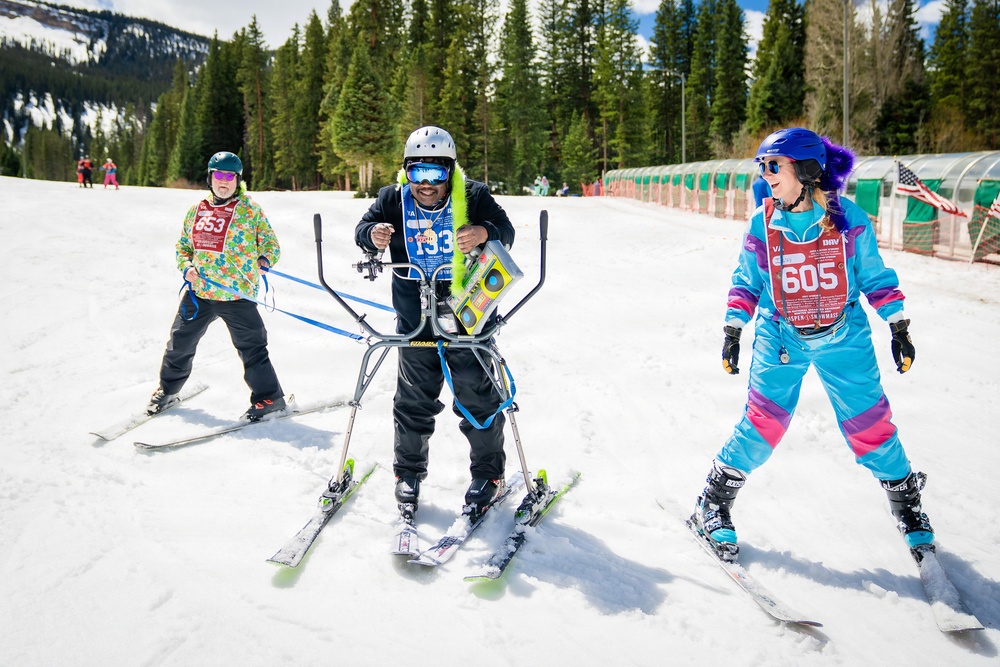
Photo By 1st Lt. Bailey Breving | U.S. Army Veteran Antonio Borden uses a snow slider while participating in the 40th...... read more read more
Antonio Borden, a disabled Army Veteran from Cleveland, Ohio, clicked into skis for the first time on the slopes of Snowmass, Colorado.
At the National Disabled Winter Sports Clinic in Snowmass, Colorado, hundreds of Veterans like Boden are introduced to adaptive skiing, snowboarding, curling, ice hockey and other recreational sport activities. The week-long clinic, co-sponsored by DAV (Disabled American Veterans), combines instruction, specialized equipment, and clinical support to help Veterans with disabilities build confidence and mobility.
Boden, an Operation Iraqi Freedom Veteran who served from 1993 to 2004, had only briefly tried skiing on a small hill back home in Ohio. Snowmass was different. The terrain steeper. The pace faster.
A piece of adaptive skiing equipment called a snow slider made Boden’s participation on the mountain possible. Designed for Veterans who use walkers or need added stability in their daily lives, the slider works as a supportive frame that helps keep the skier upright, maintains proper spacing and posture, and allows for controlled movement down the slope. It bridges the gap between needing assistance and building independence, giving Veteran skiers the confidence to focus on learning turns, navigating terrain, and trusting their movement.
“For me, the slider makes sure my body is postured correctly,” Boden said. “When going down hills, it reminds me to keep my back straight and makes sure my legs are far enough apart.”
At the Winter Sports Clinic, adaptive equipment like the snow slider is provided on-site through the U.S. Department of Veteran Affairs, removing one of the biggest barriers to participation for Veterans who may not otherwise have access to specialized gear.
With instructors skiing alongside him, Boden quickly began to pick it up.
“It was exciting, I loved it,” Boden said after his first run of the day. “My instructors kept me on track as I learned the turns and curves.”
As his confidence grew, his instructors began to step back…literally. After just a few runs side-by-side, they transitioned to coaching from a distance, allowing him to take more control.
“He’s already making the turns and adjusting,” one instructor said. “He’s progressing quickly and doing an excellent job.”
Across the clinic, Veterans use a range of adaptive equipment from standing support systems like snow sliders to sit-skis designed for seated athletes, each tailored to individual needs. Although each Veteran is unique, they are unified by the same goal to gain confidence, mobility, and independence through movement.
For Veterans wondering if adaptive skiing while standing is possible, the ski slider is one answer: a tool that makes the sport more accessible without taking away the experience.
Veterans interested in participating in adaptive sports programs can connect with their local VA recreational or adaptive sports program through their medical facility or learn more about opportunities like the National Disabled Veterans Winter Sports Clinic by visiting https://www.wintersportsclinic.org/.
| Date Taken: | 04.30.2026 |
| Date Posted: | 04.30.2026 16:05 |
| Story ID: | 563992 |
| Location: | SNOWMASS, COLORADO, US |
| Hometown: | CLEVELAND, OHIO, US |
| Web Views: | 20 |
| Downloads: | 0 |

This work, What Is a Snow Slider? How Disabled Veterans Are Learning to Ski with Adaptive Equipment, by 1LT Bailey Breving, identified by DVIDS, must comply with the restrictions shown on https://www.dvidshub.net/about/copyright.

No keywords found.





