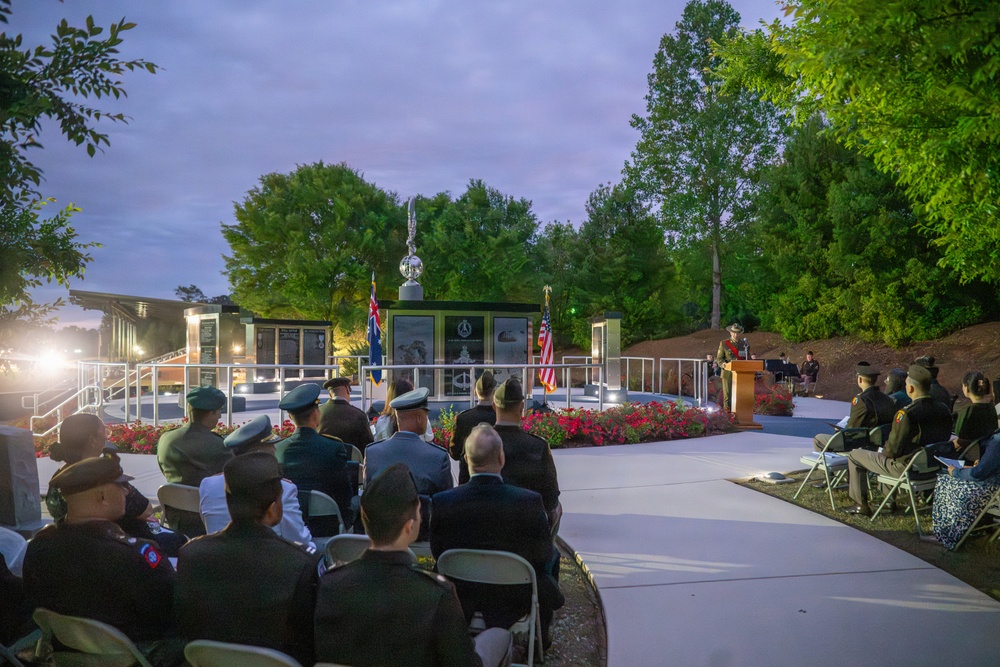
Photo By Patrick Albright | Soldiers and family members listen to Australian Army Sgt. Maj. Robert Cooper, the Sergeant Major of the Command and Tactics Directorate, speak during the Australian and New Zealand Army Corps (ANZAC) Day dawn service April 25, 2026, at the 173rd Airborne Brigade Memorial behind the National Infantry Museum in Columbus, Georgia. The ceremony commemorated the anniversary of the ANZAC landing on the Gallipoli peninsula in the Dardanelles campaign during World War I during the early hours of April 25, 1915. (U.S. Army photo by Patrick A. Albright) see less
| View Image Page
Fort Benning commemorates Anzac Day with dawn service
FORT BENNING, Ga. – Fort Benning and the Maneuver Center of Excellence hosted an Anzac Day ceremony April 25 at the National Infantry Museum.
Anzac Day, observed annually at Fort Benning since 1987, is a national day of remembrance in New Zealand and Australia, the latter of which has military personnel stationed on the installation. Anzac Day gets its name from the Australian and New Zealand Army Corps (ANZAC), a joint military force of the two countries that fought in World War I.
“When we think about Anzac Day and its origin, there’s a significant history of Australians within the U.S. actually commemorating Anzac Day and that’s in a multitude of different forms,” said Maj. Grant Carter, an Australian Exchange Officer and Cavalry Leaders Course Instructor at Fort Benning.
Anzac Day remembers April 25, 1915, the day the ANZACs landed on the Gallipoli Peninsula, located in modern-day Turkey, as part of an Allied operation aimed at knocking the Ottoman Empire out of the war.
The Allies planned to do this by seizing the Dardanelles Straits, which would have allowed them to launch an attack on the Ottoman capital of Constantinople (modern-day Istanbul) and open a supply route to Russia through the Black Sea.
Early that morning, ground fighting commenced with Allied landings along the Gallipoli Peninsula, marking the first major engagement of the war for Australian and New Zealand forces. The ANZACs landed at a beach on the western side of the peninsula, facing the Aegean Sea, which later became known as ANZAC Cove.
The Allies became bogged down by fierce Ottoman resistance and the operation became increasingly costly to a point where they started evacuating from the peninsula at the end of 1915. Both sides suffered over 250,000 casualties in eight months of fighting. More than 8,000 Australian and 2,000 New Zealand soldiers were killed at Gallipoli.
Carter explained that while the ANZACs weren’t on the winning side of the battle, the bravery and perseverance they displayed lived on and helped build a special psyche within the armed forces of the two countries.
“It forged that reputation of courage, endurance, and mateship that Australian and New Zealand soldiers are renowned for,” Carter said. “Not only are we soldiers that demonstrate a lot of courage on the battlefield, but a lot of that courage is going out of the way to helping the guy next to you and getting them through that same fight as well.”
Anzac Day was first commemorated in 1916, with ceremonies taking place in Australia, New Zealand, and Britain, mainly taking the form of patriotic rallies and recruitment drives for the war. In the 1920s, Anzac Day became an official public holiday in Australia and New Zealand to remember the soldiers killed in World War I. Over time, however, the scope of Anzac Day has evolved to include all Australians and New Zealanders who died in war.
“It’s focused on not just honoring those that landed at Gallipoli but honoring all those who served our nation and recognizing the cost of war. When we think about what war brings, not only from that mateship and courage perspective, but there’s an ultimate cost that’s attached to war as well,” Carter said.
The service began at 6 a.m. with a gunfire breakfast, in recognition of the predawn time the ANZACs landed at Gallipoli. The gunfire breakfast gets its name from gunfire, a caffeinated alcoholic drink of black coffee laced with rum, which is traditionally served at Anzac Day services.
Following breakfast, attendees walked over to the 173rd Airborne Brigade Sky Soldier Memorial for the ceremony. During the ceremony, three wreaths were laid at the memorial: one on behalf of the Australian and New Zealand Defence Forces by Carter, a second on behalf of the United States by U.S. Army Maj. Gen. Colin Tuley, commanding general, U.S. Army Maneuver Center of Excellence, and the third on behalf of the Fallen by the children of the two Australian personnel on the installation. Notably, the memorial is the only memorial in the United States where the names of U.S. Army and Australian Army servicemembers killed in action appear alongside each other, giving the ceremony an even deeper meaning.
“Australians and Americans have stood shoulder to shoulder for more than a century and when we think about some of that history, our alliance isn’t just strategic, it’s personal,” Carter said. “This demonstrates that we have shared values; we emphasize our democracies, rule of law, and commitment to collective security.”
Carter added the fact that an American military installation hosts an Anzac Day ceremony every year is living proof the legacy of the ANZACs lives on.
“When I think about what this means to us and how important it is, it demonstrates a continuation of that Anzac spirit,” Carter said. “Anzac Day reminds us that freedom has a cost and that mateship between soldiers and between nations is enduring across all these generations.”

 Subscribe






