
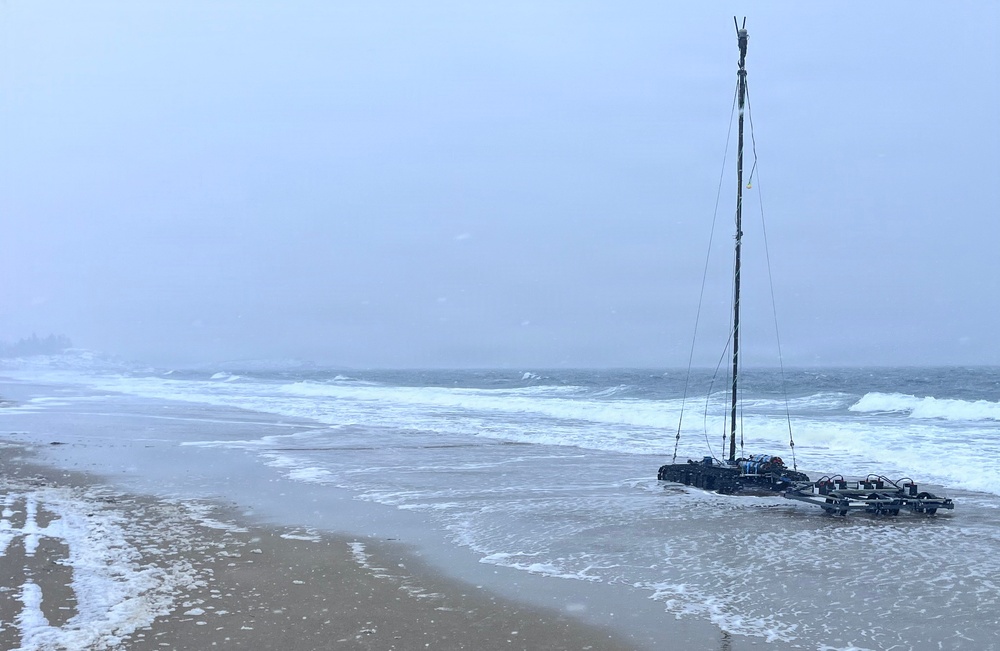
Photo By William Farrow | A robotic chassis with tracked mobility tows a marine-APEX metal detector on the...... read more read more
REDSTONE ARSENAL, Ala. -- Traditional methods to detect Unexploded Ordnance (UXO) on shorelines can be a struggle. As a result\, many impacted areas remain unaddressed due to the difficulty\, cost\, and risk associated with large-scale detection and classification.
In February, a team of U.S. Army Corps of Engineers geophysicists and ordnance explosive safety experts supported a demonstration at the former Maine Bombing Area, a Formerly Used Defense Site (FUDS) located in Reid State Park, Maine, and the site of a World War II bombing range.
The demonstration was a test of a system that could make ordnance-laden beaches safe again.
The Environmental Security Technology Certification Program, a Department of War program that develops and demonstrates innovative, scalable technologies for military infrastructure, funded the demonstration.
Andy Schwartz, U.S. Army Engineering and Support Center, Huntsville (Huntsville Center) geophysicist supporting the demonstration said the site was chosen because it meets the needs of what the ESTCP calls a live-site demonstration site.
“It has the potential to have UXOs (in this case, it being a FUDS), and it presents the complexities associated with using UXO classification technologies on real sites where collaboration with landowners and state or federal regulators is part of the overall equation,” Scwartz said.
In this instance, Schwartz said USACE is currently planning to start the remedial investigation around 2030, but agreed to support ESTCP’s use of the site to demonstrate several innovative technologies. He said USACE will use ESTCP’s data when performing the remedial investigation.
The first step in the demonstration called for seeding the beach and shoreline with anomalies prior to testing an above-ground electromagnetic induction (EMI) technology used for detecting anomalies in surf zones.
Benton Williams, U.S. Army Engineering and Support Center, Huntsville (Huntsville Center) and David King and David Carlin, Baltimore District Ordnance and Explosives Safety, provided the seeding services.
Schwartz provided subject matter expert supporting the autonomous UXO detection and classification demonstration which included the use of a 300-pound Greensea IQ-produced Bayonet 350 crawler—a robotic chassis with tracked mobility— used to tow a White River Technologies—produced marine-APEX (m-APEX) metal detector.
The demonstration would determine if the system can accurately locate and differentiate the anomalies.
If the m-APEX successfully located the items, the system could potentially be used to conduct clearance activities in similar location around the United States in support of ongoing MMRP remediation work.
Although the project was conducted during New England’s notoriously cold February, Schwarz said the winter environment wasn't all that inhospitable.
“There's no such thing as bad weather, just different kinds of good weather,” Schwartz said. “Everyone on the project knew we'd be working in cold, winter conditions, and we all had the necessary winter gear to stay warm and safe,” he said.
“We even had a portable winter shelter for when it was snowing while we were collecting data, but that was more to keep the snow off the computers.”
Schwartz said morning air temperatures were usually between 10 - 15 degrees Fahrenheit and there was a near-constant shore breeze between 15 - 20 miles per hour the whole three weeks they were working.
Morning windchill, Schwartz recalled, were down to zero or below and mid-day temps usually got into double digits, with some days above freezing.
“We normally try to schedule this kind of work for warmer seasons, but, for various reasons, we had to do this project in February,” Schwartz said.
According to Schwartz, the White Reiver Technologies team, the developer and manufacturer of the APEX system, is still analyzing the data.
Identifying and classifying (UXO) in seabed and shoreline environments is a complex and resource-intensive process as tidal areas have historically been a challenge to address due to the constantly shifting environment. With collaborative efforts between USACE, the DOW and private industry, the challenge of locating and subsequently removing UXOs on U.S. shorelines will enhance MIlitary Munitions Response Program future remediation projects.
| Date Taken: | 04.29.2026 |
| Date Posted: | 04.29.2026 14:30 |
| Story ID: | 563919 |
| Location: | REDSTONE ARSENAL, ALABAMA, US |
| Web Views: | 45 |
| Downloads: | 0 |

This work, Collaborative testing demonstration seeks improvement for shorelines remediation projects, by William Farrow, identified by DVIDS, must comply with the restrictions shown on https://www.dvidshub.net/about/copyright.

No keywords found.





