
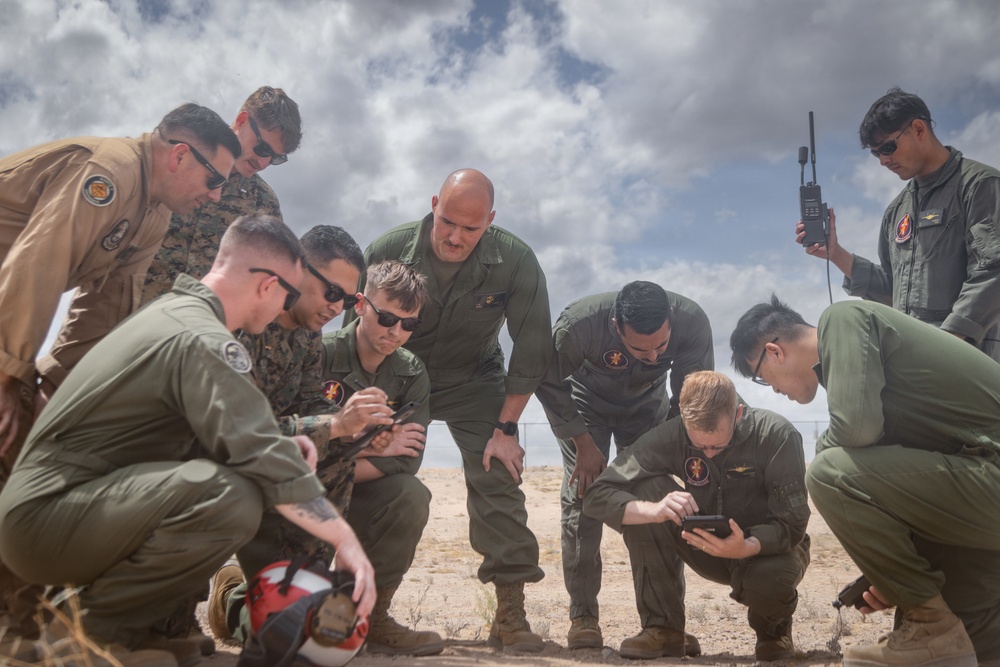
Photo By Lance Cpl. Fabian Ortiz | U.S. Marines assigned to Marine Aviation Weapons and Tactics Squadron One (MAWTS-1)...... read more read more
 Subscribe
MARINE CORPS AIR STATION Yuma, Ariz. - Marines with Marine Fighter Attack Squadron (VMFA) 251 advanced F-35 and other fixed-wing aircraft ground operations by integrating improved communication and digital interoperability capabilities. They demonstrated these advancements during Weapons and Tactics Instructors course 2-26 at Marine Aviation Weapons and Tactics Squadron One (MAWTS-1), Marine Corps Air Station, Yuma, Arizona, on April 13, 2026.
Marines from VMFA-251 led the effort and used training opportunities at MAWTS-1 during WTI to improve coordination between pilots and ground crews. They increased efficiency during aircraft turnaround operations by utilizing gear from the Digital Interoperability (DI) kits compatible with fifth-generation technology.
The Marine Corps DI kit is a suite of hardware, software, and networked devices that connect Marines across incompatible systems. This enables Marines to share situational awareness and coordinate more effectively across the Marine Air Ground Task Force.
Marines observed communication delays and limited situational awareness on the flightline, which slowed maintenance and rearming operations. Chief Warrant Officer 2 Jory D. Reed, an aviation ordnance officer with VMFA-251, spearheaded the effort, identified these gaps, and pursued solutions using existing and emerging technologies. “A lot of this came from observing how Marines execute the mission and identifying where time and effort could be streamlined,” Reed said. “The goal was to make those processes both more efficient and repeatable.”
VMFA-251 Marines integrated the DI equipment and enhanced situational awareness across the flight line. They integrated specialized Digital Interoperability hardware to securely relay Link 16 data to ground-based tablets.
The Link 16 is a secure tactical data link that shares real-time information like aircraft position, fuel status, and mission data between units. By extending Link 16 to F-35 ground crews, Marines can now directly receive and send this data, which improves coordination, planning, and aircraft turnaround on the ground.
Chief Warrant Officer 2 Eladio Vega, avionics officer with VMFA-251, integrated the capability and translated its technical applications into operational use.
“The DI kit consolidates data from multiple communication systems onto a single platform allowing a cohesive flow of information between different military assets,” Vega said. “Using the MAGTAB, Marines can view aircraft location, fuel states, and remaining ordnance in real time, giving ground crews advance knowledge of aircraft needs before landing which is something we couldn’t do before.”
This increased awareness enables Marines to prepare precisely for incoming aircraft, which reduces the need to stage excess ordnance and minimizes equipment movement on the flight line. These combined capabilities reduce Marines’ physical workload and improve the speed and efficiency of rearming and refueling operations in resource limited environments.
“Now we can see what assets the aircraft has expended and what it will require before it even touches down,” Reed said. “That gives us the ability to respond faster and more accurately, preparing exactly what’s needed ahead of time instead of moving excess ordnance and equipment once the aircraft arrives.”
Marines also evaluated newly developed, first of its kind primary support capabilities during WTI exercises. They used a direct communication system utilizing the F-35 Lightning II Internal Communication System, which connects maintainers directly to the aircraft and enables real-time communication with pilots without requiring them to exit the cockpit.
“Previously, maintainers relied on relayed communication or were required to wait for pilots to shut down and disembark before troubleshooting could begin.” Reed said. “The direct connection the F-35 Lightning II ICS cable provides immediate coordination; this allows ground crews to diagnose and resolve problems while keeping the aircraft operational.”
Marines also integrated the handheld radios to expand communication across the flight line during operations. They used the radio to establish a shared frequency between pilots and multiple maintenance sections, allowing personnel across avionics, ordnance, airframes, and maintenance control to monitor and communicate in real time. Marines were able to identify a compatible frequency range establishing a clear connection that enabled pilots to relay aircraft status and discrepancies prior to take-off.
“This eliminates secondhand communication across the flight line and allows maintainers to respond immediately with the information they receive directly from the pilot,” Vega said. “Now, instead of relying on a single point of contact, multiple maintenance sections can monitor the same frequency and receive information from the pilot in real time.”
MAWTS-1 provided the operational environment necessary to test and validate these capabilities under realistic conditions, allowing VMFA-251 Marines to refine their approach and demonstrate its effectiveness. Chief Warrant Officer 2 Richard Wildenhain, an aviation ordnance officer and expeditionary ordnance course director with MAWTS-1, supported the integration and evaluation of the systems during training events.
“MAWTS-1 provides a venue to take concepts like this and apply them in a realistic training environment,” Wildenhain said. “It allows units to test new capabilities, identify what works, and determine how it can be applied improving efficiency and lethality across the entire Marine Corps.”
The collaboration between VMFA-251 and MAWTS-1 highlights how operational units can develop practical solutions by integrating existing technologies in new ways.
As F-35 operations continue to evolve, capabilities like digital interoperability and direct communication systems are expected to play a key role in improving coordination, increasing situational awareness, and reducing the time required to generate combat-ready aircraft.
“This is about improving how we operate as a whole and trying new things with the assets we are given,” Vega said. “When we can share information more effectively, we can make better decisions and execute the mission more efficiently.”
| Date Taken: | 04.13.2026 |
| Date Posted: | 04.29.2026 19:21 |
| Story ID: | 563895 |
| Location: | YUMA, ARIZONA, US |
| Web Views: | 430 |
| Downloads: | 3 |

This work, VMFA-251 pioneers new F-35 communications tactics at WTI, by LCpl Fabian Ortiz, identified by DVIDS, must comply with the restrictions shown on https://www.dvidshub.net/about/copyright.


No keywords found.




