
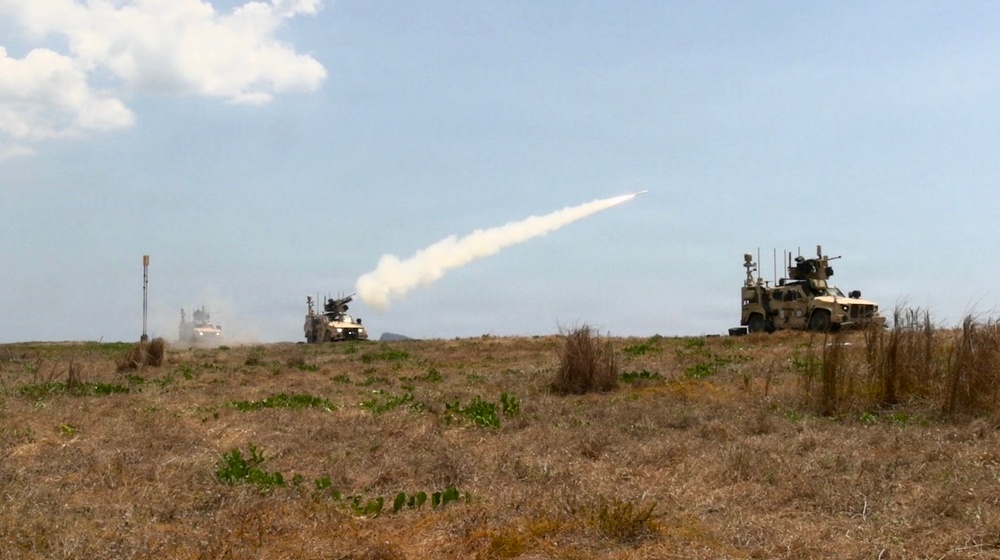
Photo By Cpl. Benjamin Catindig | A U.S. Marine Air Defense Integrated System with 3rd Littoral Anti-Air Battalion, 3rd...... read more read more
 Subscribe
NAVAL STATION LEOVOGILDO GANTIOQUI, Philippines – U.S., Philippine, and Japanese service members successfully conducted a series of Integrated Air and Missile Defense training events during Exercise Balikatan 2026 from April 26-29.
Focused on enhancing combined survivability in the littorals, the training demonstrated the multilateral force’s ability to preserve combat power through a unified effort to detect and engage complex aerial threats.
“The synchronization of our joint and combined air defense assets ensures we can maintain a persistent defensive umbrella, even in the most remote littoral environments,” said Col. Gabriel L. Diana, commanding officer of 3rd Marine Littoral Regiment. “By networking Marine, Army, Philippine, and Japanese systems into a single, cohesive defensive network, we are proving that our allied and partner forces can rapidly deploy and protect vital terrain against any complex aerial threat.”
The training integrated both kinetic and non-kinetic capabilities to destroy simulated enemy aerial targets as part of a multilateral defense. Radar and air defense platforms included the:
“This exercise demonstrates the role of land power in a joint and combined fight,” said U.S. Army Lt. Col. Kenneth Collins, commander of 1st Battalion, 51st Air Defense Artillery Regiment. “By bringing rapid, palletized capabilities like VAMPIRE to the shorelines, we provide a decisive, precision-strike capability against small UAS threats, filling a vital role in the air defense network.”
Participating U.S. Marine Corps units included Marine Air Control Group 38, 3rd Littoral Anti-Air Battalion, and 12th LAAB. These forces operated alongside U.S. Army elements from 1-51 and 6-52 ADA.
The joint force integrated seamlessly with Armed Forces of the Philippines counterparts from the 960th Air and Missile Defense Wing of the Philippine Air Force and the 1st Air Defense Artillery of the Philippine Army. Additionally, Philippine Navy frigates BRP Antonio Luna (FFG 15) and BRP Miguel Malvar (FFG 6) participated in the training via simulated air defense engagements to further extend the integrated network into the maritime space.
Expanding the multilateral scope of the exercise, elements of the Japan Self-Defense Forces integrated into the combined network, deploying the Type 11 to enhance short-range air defense capabilities alongside U.S. and Philippine assets.
"Integrating the 960th Air and Missile Defense Wing, the 1st Air Defense Artillery, and our Navy ships alongside U.S. and Japanese units allows us to build a truly unified tactical picture," said Philippine Marine Corps Col. Dennis Hernandez, BK26 AFP spokesperson. "By sharing sensor data and coordinating our engagements across different platforms, we have proven that our multilateral air defense network is stronger, faster, and more resilient than ever before.”
News media representatives interested in additional information or coverage opportunities may contact the exercise Public Affairs Combined Joint Information Bureau media officer at balikatan_media@usmc.mil.
_____________________________________________________________________________
About Balikatan
Balikatan is a longstanding annual exercise between the Armed Forces of the Philippines and U.S. military that represents the strength of our alliance, improves our capable combined force, and demonstrates our commitment to regional peace and prosperity. For complete coverage of Balikatan 2026 activities, visit https://www.dvidshub.net/feature/Balikatan.
| Date Taken: | 04.28.2026 |
| Date Posted: | 04.29.2026 06:04 |
| Story ID: | 563856 |
| Location: | PH |
| Web Views: | 482 |
| Downloads: | 0 |

This work, U.S., Philippine, and Japanese Forces Integrate Air and Missile Defense, must comply with the restrictions shown on https://www.dvidshub.net/about/copyright.


No keywords found.




