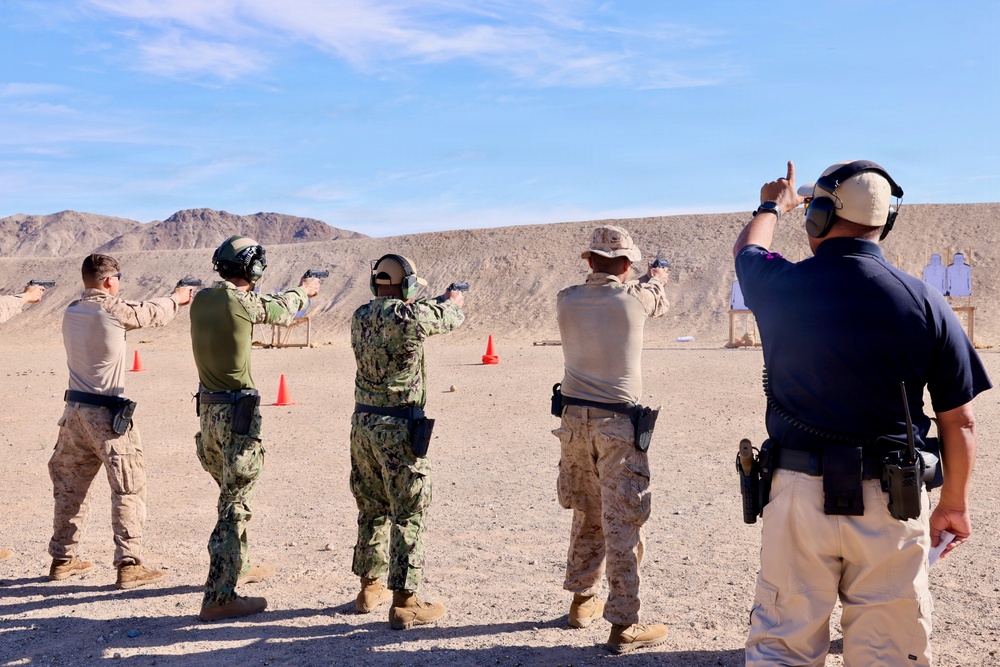
TWENTYNINE PALMS, Calif. — Sailors assigned to Navy Medicine Readiness and Training Command Twentynine Palms completed the Marine Corps Combat Pistol Program qualification course at Marine Corps Air Ground Combat Center Twentynine Palms on March 27, 2026, strengthening interoperability with Marine Corps partners while enhancing individual readiness and weapons proficiency.
The course brought together four Sailors from across the command to train alongside Marines, exposing them to a different service’s weapons handling standards, coaching techniques, and operational environment. Through repetition, coaching, and live-fire exercises, participants developed confidence and proficiency with the M9 service pistol while reinforcing the role of basic combat skills.
Hospital Corpsman 2nd Class Aijalon Newbern, a surgical technologist at NMRTC Twentynine Palms, said his motivation to participate stemmed from a desire to step outside his routine and challenge himself.
“What motivated me to participate in this course was to break away from the normal work routine, learn a new skill, and be outside my comfort zone and interact with the Marines in their space,” Newbern said.
Newbern noted that the most difficult aspect of the training came down to mastering the finer details of marksmanship.
“The most challenging aspect of this course for me was the little nuances in handling, aiming, and firing a firearm,” he said. “The small changes in stance, gripping, and wrist stability really factor.”
He emphasized that repetition and understanding weapon mechanics were key takeaways from Marine Corps instructors.
“Being able to get comfortable with a weapon through repetition and understanding of mechanics,” Newbern said, describing the most valuable coaching he received.
While the training environment differed from Navy-led instruction, Newbern said the experience highlighted strong collaboration between services.
“The training with the Marines was different but familiar to me,” he said. “They were very helpful and insightful, which was a great help in learning. I felt the camaraderie and how everyone was focused but also relaxed on the task.”
For Newbern, the course reinforced the broader importance of weapons proficiency across the Navy.
“Being qualified for me does not directly affect my rate, but it does help for security and defense on a Navy-wide scale and being deployment ready,” he said.
Lt. j.g. Duane Aldous V. Daquioag, a registered nurse assigned to the Maternal Infant Nursing Department, brought prior firearms experience into the course but said the training still presented new challenges.
“I wanted to get my qualifications and ribbons on firearms, and shooting firearms is always fun,” Daquioag said. “I’ve been going to the range with friends and practicing tactical shooting for about two years before I joined the Navy.”
Despite his background, Daquioag said environmental conditions tested his adaptability.
“The heat and having the sun in our eyes when we were shooting,” he said. “I used to only shoot at night or late afternoon, and it was a totally different experience.”
He credited Marine Corps instructors for their deliberate approach to teaching.
“They took the time to get our form right and the step-by-steps on how to properly do each task for the qualifications,” Daquioag said.
Like many participants, Daquioag highlighted both camaraderie and friendly competition throughout the course.
“It was great—there was a sense of camaraderie and a little bit of rivalry with the Marines, as you know, we want to prove our worth and shoot better than them,” he said.
The training also expanded his confidence in more advanced techniques.
“It gave me more confidence in handling a pistol and shooting from the holster, which I knew I needed more practice from my prior experience with firearms,” he said.
Hospital Corpsman 3rd Class Ayden Z. Massey, who serves at the Adult Medical Care Clinic, said the opportunity itself was a motivating factor.
“It was an opportunity that presented itself that not all Sailors get to have at their first command,” Massey said.
“My previous experience with firearms came from growing up with a law enforcement family.”
Massey said he adapted quickly to most aspects of the course but still gained valuable instruction.
“I felt comfortable with the entirety of the course—the only thing different was learning the M9 weapon system,” he said.
Hands-on coaching played a critical role in refining his performance.
“At one point during the qualification, I had a coach take me aside and dissect my grip and helped me form tighter groupings,” Massey said.
Serving alongside Marines as a corpsman further strengthened his connection to the training environment.
“I felt camaraderie during the entirety of the course because I was their corpsman,” he said. “I felt a sense of almost pride shooting with them.”
Massey said repetition led to measurable improvement.
“After drilling and drilling, I saw my groupings get tighter every day,” Said Massey, who ultimately earned an expert-level qualification during the course.
He also emphasized the operational relevance of pistol proficiency, particularly in high-stress scenarios.
“If you aren’t proficient and you don’t have the confidence behind that weapon system to quickly get fast, accurate shots on target, then it serves no purpose,” Massey said. “The pistol in my specific rate serves to protect my patient, and me. It serves as a tool for me to successfully get my patient to a higher echelon of care.”
Participants also encountered unexpected learning points during the course, from environmental impacts on weapons systems to refining small mechanical details.
“The most surprising thing I learned during this qualification is how much sand and dirt can really affect your weapon system,” Massey said.
Newbern learned about the importance of precision.
“How something as little as trigger finger placement can make the aim better or worse,” he said.
For those considering similar opportunities, the Sailors emphasized maintaining an open mindset and fully engaging with the training.
“Enjoy your time there,” Newbern said. “The instructors are very informative and can break it down to the simplest form of understanding.”
“Come prepared to listen and pay attention,” Daquioag added. “Don’t be scared to ask questions and have fun.”
Massey offered a more tactical perspective.
“Be about it,” he said. “You’ve got to think of the target as an enemy that is a real threat—not just paper. Don’t let time be a factor in your mechanics—slow is smooth and smooth is fast.”
Cmdr. William “Bill” Lawson, acting executive officer of NMRTC Twentynine Palms, also participated in the course alongside Sailors, underscoring leadership’s commitment to readiness and professional development.
“This was actually a great way for me to step away from my computer for a little while and learn a new skill,” Lawson said.
He highlighted the broader impact of cross-service training on the command’s mission.
“It really shows the symbiotic relationship we have with the installation here in Twentynine Palms,” Lawson said. “Our teams provide a good amount of medical coverage to the exercises and activities that occur on the base, and in turn, the units we work with provide opportunities such as this, allowing our medical personnel to obtain qualifications that may not be available to them otherwise.”
Lawson said the opportunity was one he had long sought.
“I have wanted to get my pistol qualifications for the past 18 years of my Naval career—this was the first opportunity I’ve had, so I jumped right in,” he said.
Integrating Navy Medicine personnel into Marine Corps weapons training strengthens interoperability while building skills Sailors rely on to provide care and protect patients in forward and operational environments.
| Date Taken: |
04.28.2026 |
| Date Posted: |
04.28.2026 16:20 |
| Story ID: |
563821 |
| Location: |
TWENTYNINE PALMS, CALIFORNIA, US |
| Web Views: |
105 |
| Downloads: |
0 |
PUBLIC DOMAIN

This work, Navy Medicine Sailors complete Marine Corps Combat Pistol Program qualification, by Christopher Jones, identified by DVIDS, must comply with the restrictions shown on https://www.dvidshub.net/about/copyright.