
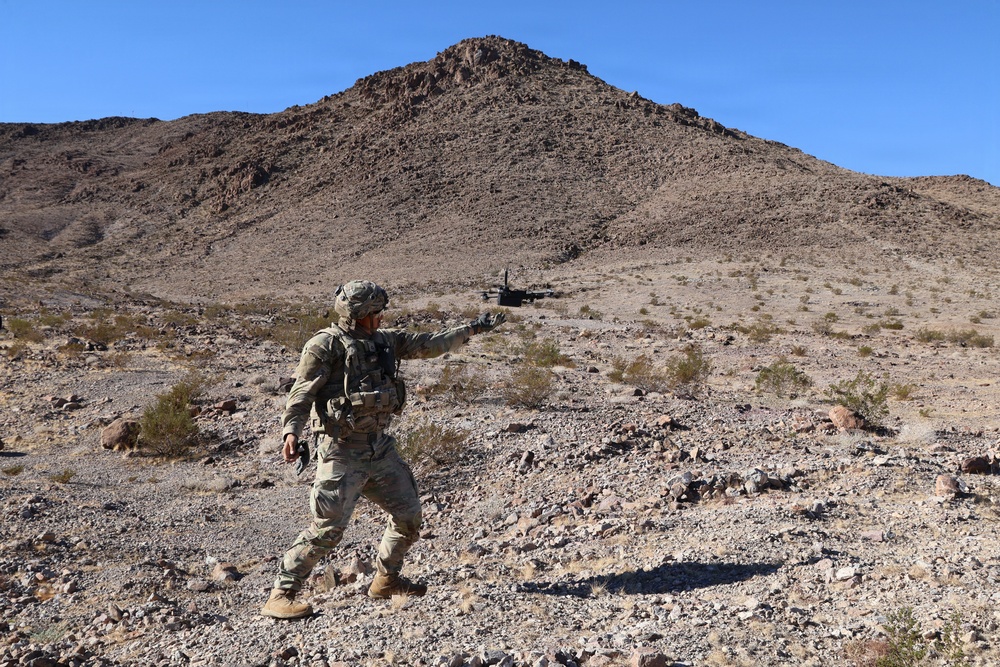
Photo By Maj. William McGehee | Multi-Functional Strike Troop, 6th Squadron, 1st Cavalry Regiment, 1st Armored Brigade...... read more read more
 Subscribe
FORT IRWIN, Calif. - The 1st Armored Brigade Combat Team\, 1st Armored Division “Ready First” tested drone integration at the National Training Center with its Multi-functional Strike Troop\, or MFST\, Concept this past October.
Anyone who has been to the NTC knows just how difficult it is to seize the urban centers. The rotational brigade often gets bogged down even at the smaller sites. But when Ready First sent 2nd Battalion, 37th Armor Regiment, "Iron Dukes," into Barasu, they were augmented by a new addition to the brigade, the MFST, a mix of sensing and strike capabilities built around drone operations.
In the fight for Barasu, the MFST set the stage for the Iron Duke’s attack by occupying key terrain, identifying high payoff targets such as enemy jammers and command posts, displacing armored defenses and disrupting enemy maneuver with drone strikes, and providing timely and accurate information with arial reconnaissance. With the MFST in support, the Iron Dukes swept through Barasu and established defensive positions in a matter of hours.
Col. Bryan Frizzelle, the brigade commander, first heard about the baseline ideas for the MFST and integrating drones into armored formations at the Pegasus Charge conference hosted by the 1st Cavalry Division at Fort Hood, Texas, in March 2025.
By October 2025, Frizzelle and his brigade used their tailored MFST design to dominate 11th Armored Cavalry Regiment “Black Horse” during NTC Rotation 26-01. Ready First’s success demonstrated how armored formations remain viable and lethal on current and future battlefields through transformation and innovation.
“Innovation is a mindset, not a label,” said Frizzelle. “We think we can innovate with the best of them… We understand the Army’s intent, so we dedicated ourselves to forming an [MFST].”
Drones and the birth of the MFST
Over the past few years, units across the U.S. Army have been exploring ways to adapt their formations to the emergence of drone warfare. Based on lessons learned from modern conflicts, drone warfare is well established as an inescapable reality of war.
One of the test beds for drone experimentation and implementation is in a new type of Army unit, known as the Multi-functional Reconnaissance Company, or MFRC. First piloted by the 2nd Mobile Brigade Combat Team, 101st Airborne Division (Air Assault) about two years ago, this unit was designed to replace reconnaissance units that were disbanded within the 101st Airborne Division.
Since then, MFRCs have emerged across the Army, deliberately integrating small drones as a key part of their functionality and lethality.
Ready First’s MFST takes the base MFRC concept and applies it to the armored brigade, integrating First-Person View drones, known as FPVs, with other enabling sensors into company-level operations to innovate and demonstrate that armored forces are not obsolete in the era of drone warfare.
The key difference between the MFRC seen in units like the 101st versus the MFST is that Ready First designed the MFST to work in conjunction with its organic reconnaissance squadron, not replace it. The result is a formation that integrates the reach, speed and innovation of FPVs with the mobility, protection and firepower of armored platforms in a way that potentially augments the best features of both components while also countering their weaknesses.
The problem facing armored forces
Critics of armored formations have been questioning the place of tanks on the battlefield since their inception, so the advent of drone warfare is not the first time the Army has seen an argument for the obsolescence of tanks.
Factors that support the obsolescence argument include the high costs and resource-intensiveness required to maintain and deploy armored forces in addition to the increased armored platform vulnerability to drone strikes. In the face of this combination, drones seem to offer https://www.defensenews.com/unmanned/2025/10/27/drones-could-replace-large-us-army-units-in-europe-expert-suggests/?utm_campaign=dfn-ebb&utm_medium=email&utm_source=sailthru to tanks.
However, those who defend the tank argue it is still required to prevent a static, attrition-based fight. Armored units must figure out how to adapt their formations to meet the requirements of today’s tactical environment.
Ready First’s MFST concept aims to reshape armored doctrine accordingly by leveraging drones to augment an armored unit’s lethality.
The process of integrating drones into traditional armored forces does more than justify the preservation of armored units, it creates a potential advantage in the next major battle.
About the time the brigade was beginning to form its MFST, Maj. Gen. Curtis Taylor, the commander of the 1st Armored Division, was looking over the Narva River in Estonia and speaking with local military leaders.
While talking about the strategic implications of drones, he was struck by a keen observation from one of the Estonian lieutenant colonels who said, “The side that wins the next conflict will be the first army that adapts drones to maneuver warfare.”
The MFST is designed to make that adaptation a reality for armored formations.
Building and testing the MFST
“We started with a purpose,” said Lt. Col. Brendan Wadsworth, commander of 6th Squadron, 1st Cavalry Regiment. “The main purpose was [to] enable the brigade to create a point of penetration that could be exploited by decisive maneuver by [Combined Arms Battalions].”
Wadsworth noted the MFST must, “move fast, strike hard” to ensure its purpose nested with the doctrinal description of the ABCT’s unique capabilities: “Mobility, protection, and firepower enable the ABCT to conduct offensive operations with great precision and speed.”
Employing the base concept described by Brig. Gen. Chad Chalfont, the commandant of the U.S. Army Armor School, and the presentation that Frizzelle viewed at the Pegasus Charge, the brigade created a capability that enabled armored units to extend the reach of their reconnaissance and security operations by integrating key brigade enablers, such as electronic warfare assets, FPVs, loitering munitions and other emerging technologies in a single unit. It also included organic mortars and scouts mounted on Bradley Fighting Vehicles.
“This composition allowed the brigade to sense as far as we can strike and to fill the gap of mid-range reconnaissance and security inside of what our division will already shape for us but beyond what our organic cavalry squadron, 6-1 CAV, can impact with its own optics and direct-fire weapons systems,” explained Frizzelle. “Second, the [MFST] gave us a unique strike capability [with FPV drones].”
The MFST Commander Capt. Kathryn Tenefrancia and her Soldiers experimented with different methods to integrate all the resources allocated to the company during situational training exercises.
“Ultimately, the goal of the [MFST] was to use unmanned systems to create opportunities for manned systems and be able to strike brigade [High Payoff Targets] to create opportunities for the brigade,” said Tenefrancia.
The training allowed them to organize their new formation in a way that enabled synchronized operations across different capabilities at the company level to strike their targets. Having developed the foundational framework for the unit, they recognized the first real test for the concept’s viability would come against a thinking opponent.
The MFST at NTC
While every unit intends to perform well at the NTC, the real purpose of the experience is to see yourself better as a unit and know where to improve.
“As we built it, the intention was to come to NTC with our [MFST] 1.0, be able to employ it and then modify its task organization, employment concepts, task and purpose after we are able to validate it,” said Tenefrancia.
The NTC rotation became a proof of concept for their MFST. Despite finding many areas for improvement, the MFST proved its worth on the battlefield. In addition to conducting the first live-fire one-way FPV drone strikes at the NTC, the MFST flew 91 missions and achieved 15 confirmed kills during the force-on-force portion of the exercise.
Many of these missions and strikes came from the standard use of drones to establish observation posts and probe farther beyond the brigade forward line of troops to identify and strike enemy components on the brigade’s high-value target list, but that was not the only way that the brigade was able to employ the MFST
“[The MFST also] gave Ready 6 an opportunity to weight his main effort proactively, to say ‘this is my main effort, I want the [MFST] to be right on the shoulder of this battalion and I want them to be destroying targets that are just beyond the line of sight or the direct-fire weapon systems,” noted Wadsworth. “The [MFST] was able to destroy vehicles that had great prepared fighting positions and was able to enable the [brigade’s] forward momentum to be restored.”
Placing the MFST “right over the shoulder” of a battalion at a key place and time during an attack shaped the battlefield in favor of Ready First and enabled the battalions to maneuver more aggressively and effectively against enemy forces. This is precisely what enabled the Iron Dukes’ operations at Barasu and the brigade maneuver throughout the rotation.
Ultimately, the MFST extended the lethality of the brigade well beyond the normal direct fire weapons systems of the battalions, while still using maneuver forces as opposed to simply indirect fires.
“Innovation is a Mindset”
Coming out of the rotation, Ready First is confident that they are on the right path with the MFST concept.
“I think we validated that the purpose of the MFST [supporting the brigade’s maneuver in the offense] is achievable and that it is something that we want to keep pursuing,” said Wadsworth.
Ready First’s mindset of experimentation and adaptation enabled them to build the framework of the unit beforehand and adapt continually during the exercise. The continual adaptation that came from the Soldiers and drone operators on the ground during the rotation was crucial to the development of the MFST.
“I am very impressed with the innovation mentality of the junior Soldiers,” said Wadsworth. “I think our Soldiers understand that they are doing something very important for the Army in thinking about the future and how we integrate these technologies to enable our Army to be successful.”
While this is building a culture of innovation within the brigade, Ready First is also sharing what they learned across the Army to help develop a capability that enables the U.S. to win the first battle of the next war and every battle after that.
Even with the level of success the MFST had at NTC, Ready First continues to fine-tune the unit’s organization and tactics to increase its mobility and lethality. Ready First has also begun implementing similar capabilities throughout the brigade with their new Mobile Strike Platoons at the battalion level. The intent of this continuous innovation is to ultimately build an integrated formation that can leverage the mobility and protection of mechanized platforms in combination with the reach and unique capabilities of drone warfare.
Currently in Europe supporting Atlantic Resolve, Ready First is taking advantage of the unique training opportunities available in the theater. They are expanding on their work, developing the material, technical and tactical solutions to launch and operate FPVs from a moving armored vehicle rather than a static observation post. There, they are using the real-world lessons of drone warfare to test and refine their concepts and hone their skills.
With Ready First and its sister brigades across the 1st Armored Division already testing the nascent version of Taylor’s vision of drone-integrated maneuver warfare, the impending obsolescence of the armored platform does not seem so certain. It is only a matter of time before we see the emergence of effective mobile protected firepower on the modern battlefield, as soldiers continue to innovate and iterate.
| Date Taken: | 04.27.2026 |
| Date Posted: | 04.27.2026 19:16 |
| Story ID: | 563717 |
| Location: | US |
| Web Views: | 223 |
| Downloads: | 0 |

This work, “Innovation is a Mindset:” 1st Armored Division’s Ready First Brigade tested drone integration with Multi-functional Strike Troop Concept, by MAJ William McGehee, identified by DVIDS, must comply with the restrictions shown on https://www.dvidshub.net/about/copyright.


No keywords found.




