
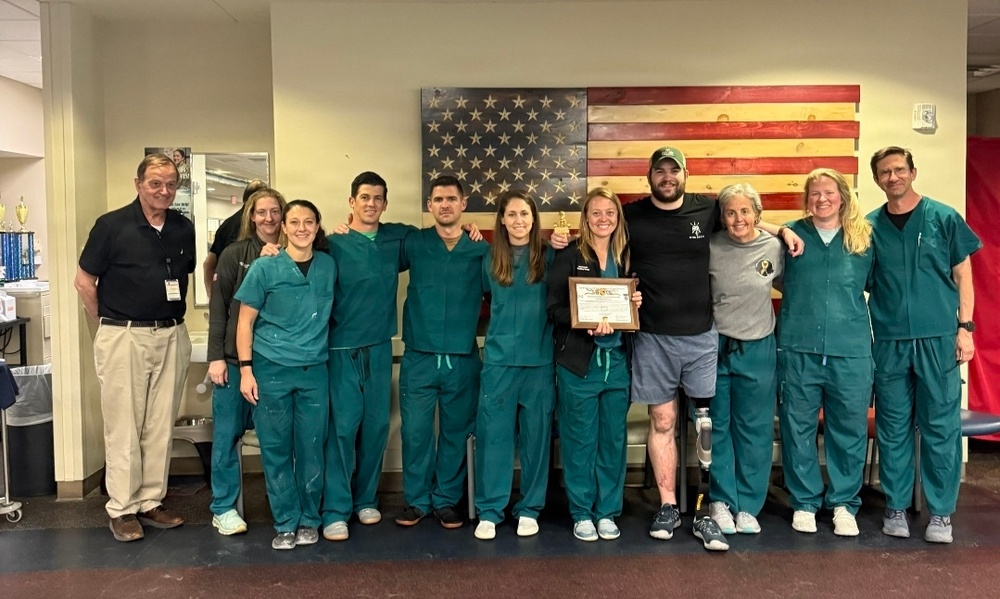
Photo By Christopher Smith | The Military Advanced Training Center (MATC) Team at Walter Reed National Military...... read more read more
 Subscribe
Rehabilitation after limb loss or trauma is about more than recovery. At Walter Reed National Military Medical Center (WRNMMC), the Military Advanced Training Center (MATC) plays a critical role in helping service members rebuild strength, regain independence, and when possible, return to duty.
The MATC was established in 2007 at the original Walter Reed Army Medical Center in response to the number of service members returning from combat overseas with limb loss and complex polytrauma injuries. When Walter Reed relocated to Bethesda, Maryland, joining forces with the National Naval Medical Center as the new WRNMMC, the MATC expanded its capabilities. Today, it is an advanced facility offering a wide range of services and access to high-tech equipment that aid in recovery and rehabilitation.
“The MATC provides comprehensive, integrative and world-class rehabilitative care,” said Dr. Tawnee Sparling, the Medical Director for Amputee Care at the MATC. “We use advanced technologies and therapies focused on building strength, skills and confidence to restore function, promote independence and a sense of self for our patients to facilitate successful re-integration either back to duty or into normal community living as a veteran.”
The MATC is one of three designated Centers of Excellence for amputation and prosthetics under the Department of War. Its multidisciplinary team includes physicians, therapists, prosthetists, orthotists, psychologists, surgeons and case managers working together to support recovery across physical, emotional and psychological domains.
Patients are empowered to make their own choices and not let their futures be dictated by their injuries.
“The complexity of care for this patient population cannot be overstated,” said Sparling. “Success depends on a full complement of interdisciplinary professionals whose skills must be maintained during both peacetime and war.”
The center’s on-site prosthetics and orthotics lab offers a full range of advanced assistive medical devices tailored to each patient. The lab is adjacent to the MATC’s physical and occupational therapy clinic, enabling close collaboration between prosthetists, orthotists, and physical and occupational therapists to ensure proper fit and effective use.
Recovery extends beyond clinical care. Recreational and adaptive sports activities have proven beneficial in supporting amputees’ well-being and reintegration into the community once transitioning to outpatient status. The MATC’s Recreational Therapy staff coordinates a wide variety of experiences outside the clinical setting, including trips to public venues like shopping areas, movie theaters, restaurants and museums.
The center’s adaptive sports program provides access to numerous activities such as scuba diving, therapeutic horseback riding, competitive sports and golf, which allow patients to be challenged and build self-efficacy.
MATC patients also have access to Walter Reed’s service dog program to aid those who require assistance support due to functional impairments.
Peer support plays a vital role in treatment. The center’s open design encourages interaction between patients at different stages of rehabilitation.
“One very effective method of rehabilitation we engage in is to bring our newly injured amputees into the center to see all our advanced amputee patients doing rehab,” said Sparling. “They get to see where they will eventually get to with their own treatment. Our more experienced patients talk to the newer ones and offer their support. This creates a form of camaraderie and informal peer support that can’t be found elsewhere.”
Since its establishment, the MATC has treated approximately 2,000 patients with limb loss. Of those, more than 500 have remained on active duty, and more than 70 service members with significant amputations have returned to the battlefield.
Innovative tools like the Firearm Training Simulator (FATS) support recovery by helping patients regain mission-critical skills.
“We find that warriors are motivated and engaged when we can get a weapons system back in their hands,” said Sparling. “We can begin normalizing their warrior skills and improve their recovery, which also moves our patients faster towards readiness.”
“It is an honor to work with this population,” Sparling added. “Our service members and their families are true heroes. Combat wounds can be both visible and invisible, and both can be equally devastating and require life-long care. Their sacrifices for our country must not be overlooked.”
Please visit the MATC webpage for more information about services offered.
| Date Taken: | 04.27.2026 |
| Date Posted: | 04.28.2026 12:14 |
| Story ID: | 563692 |
| Location: | US |
| Web Views: | 105 |
| Downloads: | 0 |

This work, Walter Reed’s Military Advanced Training Center is speeding up warrior recovery, by Christopher Smith, identified by DVIDS, must comply with the restrictions shown on https://www.dvidshub.net/about/copyright.

No keywords found.




