
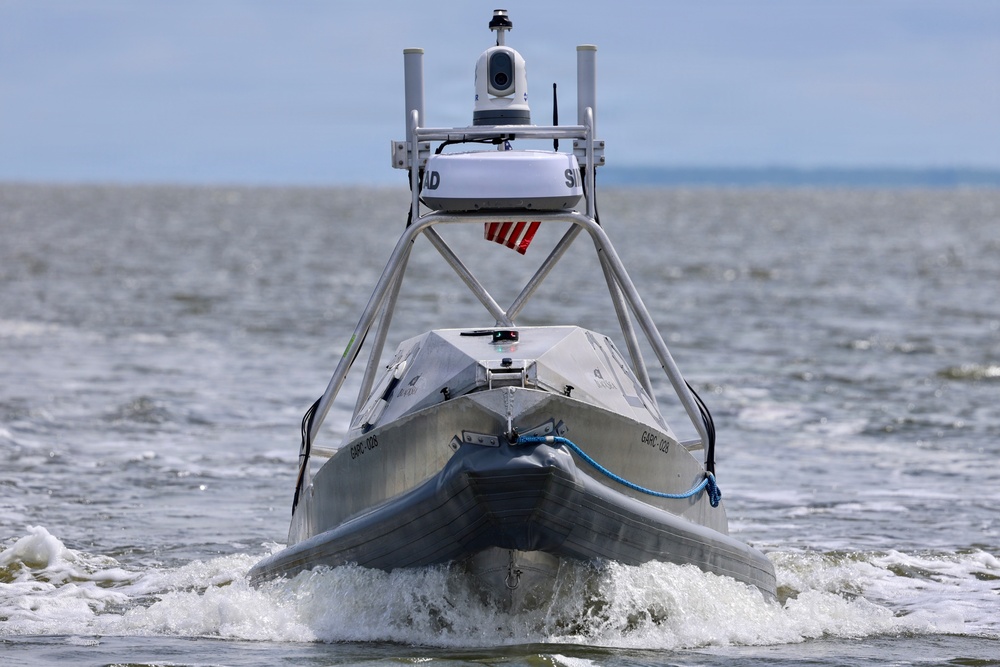
Photo By Chief Petty Officer Justin Stumberg | A Global Autonomous Reconnaissance Craft (GARC) participates in a live robotic and...... read more read more
U.S. Navy Seabees assigned to Naval Mobile Construction Battalion (NMCB) 1 and 22nd Naval Construction Regiment (NCR) are enabling the next generation of maritime operations during Exercise Obangame Express (OE) 2026, constructing expeditionary infrastructure designed to support autonomous systems in the Gulf of Guinea.
The project centers on the development of a floating pier capability to support the launch and recovery of unmanned surface vessels (USVs), an emerging asset critical to expanding maritime domain awareness and operational reach in the region.
Operating alongside a live, multinational exercise, Seabees are demonstrating their ability to deliver expeditionary infrastructure in support of evolving maritime missions. Their work highlights the integration of engineering capabilities with advanced technologies to meet the demands of modern naval operations.
The floating pier provides a flexible, deployable platform that enables operations in austere environments where traditional port infrastructure may be limited or unavailable. This capability is particularly valuable for unmanned systems, which require forward staging areas to maximize effectiveness.
“This project is about enabling future operations,” said Chief Builder David Madmon, 22NCR exercise planner for OE26. “We’re building infrastructure that supports autonomous systems and expands what’s possible in maritime environments.”
Madmon said that by delivering adaptable solutions, Seabees are contributing to a broader effort to integrate unmanned systems into routine naval operations.
“Projects like these enhance both current capabilities and long-term mission readiness,” said Madmon.
For Commander, Task Force (CTF) 66, the ability to operate unmanned systems from expeditionary locations is a key component of future maritime strategy.
“Unmanned systems allow us to extend our presence and improve awareness without increasing demand on traditional platforms,” said Lt. Alex Varon, CTF 66 exercise planner. “Expeditionary infrastructure like this pier allows us to deploy and recover those systems in locations where we otherwise couldn’t operate.”
The integration of USVs provides a scalable solution for maintaining maritime security, particularly in regions like the Gulf of Guinea, where persistent awareness is essential.
Exercise Obangame Express, one of three African regional “Express” series exercises sponsored by U.S. Africa Command and facilitated by U.S. Sixth Fleet, brings together U.S., African, and partner nations to enhance maritime security cooperation and interoperability across West and Central Africa.
Varon said that floating pier construction provides opportunities for collaboration, allowing participating nations to develop shared tactics, techniques, and procedures.
“Exercises like this give us the opportunity to work alongside our partners and build capabilities together,” Varon said. “That collaboration is critical to addressing shared maritime challenges.”
The infrastructure developed during Obangame Express 2026 will continue to support training, experimentation, and the integration of autonomous systems beyond the exercise.
In Cameroon, the work being done today represents a broader investment in future operations, one that connects expeditionary engineering with emerging technologies to meet evolving mission requirements.
From pier to platform, Seabees are helping to establish the foundation for how maritime forces will operate in the years ahead.
| Date Taken: | 04.26.2026 |
| Date Posted: | 04.27.2026 14:14 |
| Story ID: | 563682 |
| Location: | DOUALA, CM |
| Web Views: | 103 |
| Downloads: | 0 |

This work, From Pier to Platform: Seabees Enable Autonomous Operations During OE26, by CPO Justin Stumberg, identified by DVIDS, must comply with the restrictions shown on https://www.dvidshub.net/about/copyright.


No keywords found.





