
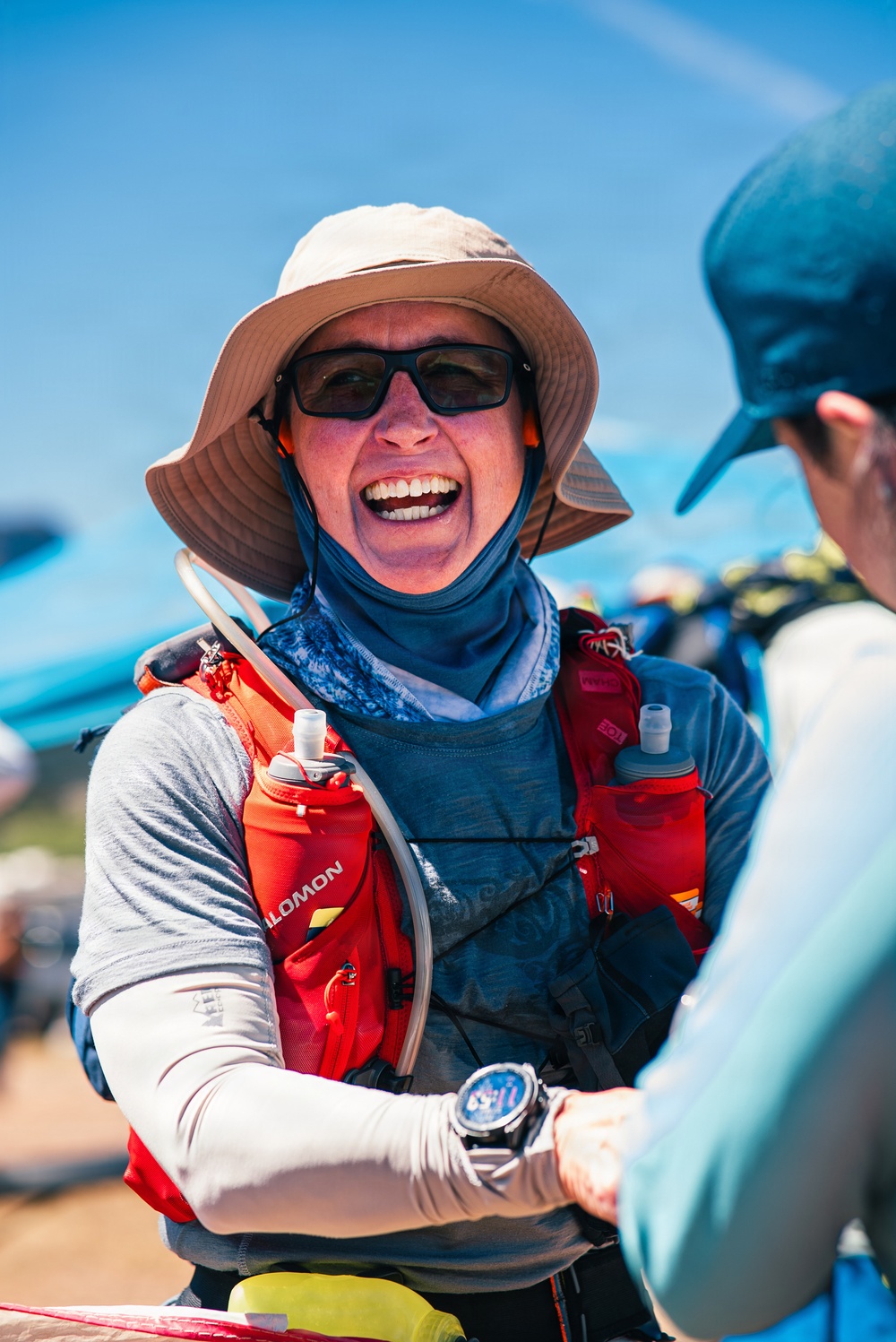
Photo By Spc. Noah Martin | Mental strength coach Shannon Baird, assigned to 1st Special Forces Group (Airborne)...... read more read more
 Subscribe
JOINT BASE LEWIS-McCHORD, Wash. — A mental strength coach with 1st Special Forces Group (Airborne), raced 300 miles across Arizona, assisted by the Green Beret’s she trains for the nation’s most sensitive missions.
Dr. Shannon Baird, CMPC, has spent more than two decades studying how people perform under pressure, first with athletes and later with U.S. Soldiers. Since 2018, she has focused on special operation forces, helping service members understand how mental processes influence performance in high-stress environments.
“What are the performances that matter, and what training can I provide to ensure consistency or next-level performance?” Baird asked.
That same question ultimately led her into one of the most demanding endurance events; the 300-mile “Monster” ultramarathon across the Arizona desert.
Raised in a military family and influenced by her mother’s service in the Air Force, Baird said her career path and personal pursuits have always centered onperformance and endurance. Her interest in endurance sports developed alongside her work, eventually pushing her from a 100-mile race to a goal of completing a 200-mile event before turning 50. She achieved that milestone in 2025.
“There is something about the distance,” she said. “I just want to see it.”
Baird said she is not motivated by winning. Instead, her focus is on the experience itself.
Preparing for a race of that magnitude required a coordinated effort between Baird and a small support team that included her wife, Danielle, 1st Special Forces Group (Airborne) Doctor of Physical Therapy, Dr. Casey Lindquist and four Special Forces Green Beret pacers.
Baird’s first pacer, an 18D, Special Forces Medic, was a pacer for her previous 200-mile race and has worked with her for years. When asked this time to pace a 23-mile portion of the race, he recalls feeling excited but having pressure to perform.
“I was nervous about being a pacer,” he said. “If you fall out of the race or get injured, it’s on the runner and they get disqualified.”
Lindquist, who has worked as a physical therapist for nearly 12 years, described the preparation as a continuous process of tracking, adapting and problem-solving, often without the benefit of established research. She tracked Baird’s mileage, elevation and time on her feet for months leading up to the race while managing recovery from prior injuries and adjusting for work demands.
“I’ve basically been tracking Shannon since August,” Lindquist said.
The approach mirrored her work at the 1SFG(A) Human Performance Program preparing Green Berets for deployments and operational missions.
“You prepare as much as you can and then figure it out,” Lindquist said.
Baird said she applied the same mental performance strategies she teaches Green Berets including structured routines, goal setting and emotional regulation, throughout her training and the race itself.
“Everything that I teach, I use,” she said.
The Arizona Monster is a 300.5-mile point-to-point race through Southern Arizona's Sonoran Desert. The race began at noon March 27th, under temperatures exceeding 100 degrees, Baird was forced to slow her pace almost immediately.
The conditions proved overwhelming for many competitors. Of the 120 starters, 48 did not finish, while 11 didn’t even start because of the heat.
Baird faced challenges early during a 22-mile stretch with no water access. Despite rationing her 5-liter supply, she ran out 2 miles before reaching the next aid station and arrived dehydrated and on the verge of heat exhaustion.
“I was already in a hole 28 miles into the race,” Baird said.
The course itself added further complications. At one point, runners were required to cross a river using ropes to reach an aid station, only to cross back again immediately after. Poor trail markings increased the risk of getting lost, and environmental hazards, including unstable terrain, snakes and spiders, demanded constant attention.
To make up for delays caused by daytime heat, she used the night to catch up to speed, sacrificing much needed sleep for distance. Sleep deprivation, fatigue, and loneliness began to affect her mental game. She considered quitting the race but remembered those who had come to support her and felt the weight of finishing. At that moment, Baird made a deal with herself.
“Even if I’m dead last, I’m finishing,” she said.
On March 28th at 4:38 P.M., after running 75 miles, Baird reunited with her crew for the first time since the race began. She said she felt an incredible sense of joy and relief. However, because of the race's schedule, she couldn’t stay for long.
At mile 91 Baird incurred an injury to her foot, when a blister tore away all the skin on her pinky toe. As she stopped to inspect, she recalls a scene that triggered her vasovagal response.
“I pulled the bandage off, and my flesh came with it,” she said.
Despite significant bleeding and a near-fainting response, she treated the injury herself and continued to the next aid station, where it would be wrapped and treated by her crew.
At mile 114, Baird met with her crew and received her first pacer for the next 23 miles. The Green Beret pacer recalls seeing Baird run up to the aid station.
“When we saw her, she was kind of out of it, it reminded me of ranger school” he said.
Baird and her pacer ascended Mt. Lemmon to over 7,000 ft. At the peak she got to sleep for an hour, her first rest during the race.
On March 30th 1:42 A.M., She started her next 27 miles with the decent down Mt. Lemmon by herself. She tripped roughly 16 times and broke her trekking pole, attributing it to her road shoes not being suitable for trails.
Baird reached the aid station to rest and refit, where the crew examined her previously injured toe. Lindquist and the Special Forces Medic saw the injury had worsened and worried she might need to drop out to seek additional medical treatment.
“When we unwrapped it, we both looked at each other and had to step away to discuss what we just saw,” said Lindquist.
After their brief discussion, they decided to cut away the dead tissue, clean and re-apply the bandages. Baird described it as painful but necessary to complete the race.
The incident prompted the team to procure medical supplies from a nearby town to assist during the next stages of the race. After pacing Baird, the Special Forces Medic visited a local medical supplier and acquired surgical instruments intended for debridement.
“It was cool using what I have been training on for the last 20 years to support Shannon and the team.” He recalled.
Later that evening Baird departed with her second Green Beret pacer to cover the next 18 miles on the Tuson Loop. She observed that sleep deprivation at this stage significantly intensified the occurrence of hallucinations.
“Is that a stack of books?” she recalled asking her pacer. “Nope, that’s a rock.”
At the following aid station, she regrouped with her crew before setting out for the next 44 miles in the Arizona desert.
On March 31st, the desert itself became an obstacle. During one stretch, Baird encountered a “jumping cactus,” a plant that releases spine-covered segments when disturbed. As she passed too close, multiple segments detached and embedded in her arm.
The spines lodged into her skin and could not be removed without assistance. She flagged down another runner, who used needle-nose pliers to pull them out one by one.
At the next aid station, she exceeded her previous race record of 200 miles and kept moving forward without hesitation.
“I didn’t notice, I just wanted to get to the next aid station to be with my crew” she said.
On April 1st, 2:30 A.M., she joined her crew to rest and prepare for the upcoming 66-mile segment with her third Green Beret pacer. Baird says her pacers played a key role, helping her maintain direction, pace and perspective during the most difficult stretches.
“It’s distraction, company, laughter,” she said. “And someone to help you make better decisions.”
As the finish line approached, both excitement and exhaustion intensified. Baird recounts hitting a physical wall near mile 262 while still experiencing persistent hallucinations.
On April 2nd, Baird and her pacer arrived at the last aid station with just 16 miles left. Her crew advised two hours of sleep for recovery, but the proximity to the finish kept her awake, resulting in only about an hour of rest.
Baird and her last Green Beret pacer head toward the finish line. Compared to her earlier distance, 16 miles now seemed very close.
With two miles remaining, Baird increase her speed toward the finish line. She described the speed as double.
“Our pace went from a 27:35 to a 10:10,” she said.
On April 3rd at 1:45 A.M., Barid crosses the finish line. Completing the race in 157 hours and 45 minutes, she rejoined her crew and embraced her wife, feeling overwhelmed with joy.
Throughout the race, Baird said her support team was critical to her success. Crew members managed logistics, treated injuries and provided emotional support while navigating their own exhaustion, sleeping outdoors, and avoiding actions that could disqualify Baird.
“The demands on the crew are exceptionally high,” Lindquist said.
Baird recounted immense gratitude for her volunteer support team. She acknowledged the significance of the relationships and trust built over the past decade working with 1st Special Forces Group (Airborne) service members, and the appreciation she felt that these Green Berets showed up to support her to perform her best, just as she has for their operations.
For Lindquist, the experience highlighted the uncertainty inherent in supporting an individual, Soldier or ultramarathon runner, through such extreme conditions.
“The thing I was most worried about is not having the right answer at the right time,” she said.
By the end of the race, Baird said the experience reinforced both the limits of endurance and the importance of preparation, adaptability and support.
For Baird her takeaway was more personal. The race was never about winning or proving anything to others. It was about understanding the limits of her own endurance, continuing forward despite them, and using the knowledge she gained to better herself and the Special Operators she supports.
| Date Taken: | 04.27.2026 |
| Date Posted: | 04.27.2026 17:25 |
| Story ID: | 563674 |
| Location: | JOINT BASE LEWIS-MCCHORD, WASHINGTON, US |
| Web Views: | 87 |
| Downloads: | 0 |

This work, Practice what you teach: 1st Special Forces Group (Airborne) Mental Strength Coach completes 300-mile race across the Arizona desert, by SGT Alec Byrd, identified by DVIDS, must comply with the restrictions shown on https://www.dvidshub.net/about/copyright.


No keywords found.




