
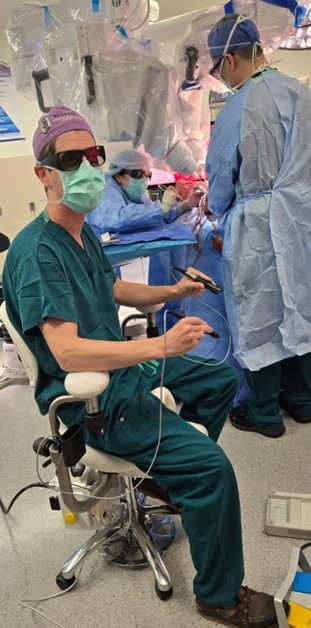
Photo By Ann Brandstadter | Plastic and reconstructive surgeon and Director of the Walter Reed Lymphatic Disease...... read more read more
 Subscribe
By Ann Brandstadter
Walter Reed Hospital Communications
Walter Reed National Military Medical Center was designated a Lymphatic Disease Surgery Center of Excellence by the Lymphatic Education and Research Network, becoming the first center in the Department of War to receive this distinction. Of 44 centers nationwide, only 14 hold this specialized surgical designation.
A diagnosis of lymphedema can mean a lifetime of managing a chronic, often debilitating condition. Whether it affects cancer patients, those recovering from trauma, or individuals with congenital conditions, the disease can significantly impact daily life.
Lymphedema is a chronic condition characterized by the buildup of protein-rich lymph fluid in tissues, causing swelling, usually in the arms or legs, but may also affect other areas of the body.
“Lymphedema surgery really is reconstructive microsurgery, so I would say I am a plastic and reconstructive surgeon who practices reconstructive microsurgery,” said U.S. Army Lt. Col. (Dr.) Ean Saberski, on staff at Walter Reed. He also serves as director of both the hospital’s Peripheral Nerve Clinic and Lymphatic Disease Surgery Center of Excellence.
“It’s a tough disease and impacts people with cancer diagnostics,” Saberski explained. “The lymphatic system is complicated; it carries fluid around the body. There are lymph nodes all over the body, so when it goes crazy, it causes swelling.”
Saberski described the body's lymphatic system as a complex “highway” that carries fluid or “lymph” throughout the body. When damaged, the results can be severe. “The limbs are highways for the fluids. If there is a roadblock, the fluid is trapped in the limbs forever."
Lymph contains water, white blood cells, nutrients, electrolytes, metabolic waste, bacteria, and plasma proteins.
In addition to swelling, Lymphedema can lead to heaviness and recurrent infections. “There are always infections, sometimes wounds, the worst version is like what you see in the Elephant Man,” Saberski added.
Until recently, treatment options focused on managing symptoms with compression wraps or procedures that reduce limb size without fixing the underlying condition.
Over the last decade, advances in diagnosis and treatment have transformed care. At Walter Reed, Saberski and U.S. Army Lt. Col. (Dr.) Jennifer Sabino, director of Surgical Services and associate director of the Lymphatic Disease Surgery Center of Excellence, have spent the last five years building a reconstructive microsurgery program that physically rebuilds damaged limbs.
“The technique is an elegant, super microsurgery, under a millimeter—the size of the channel,” said Saberski.
Saberski compared the damaged lymph nodes to a broken bridge. In lymphovenous bypass procedures, instead of letting the fluid back up and spill over, surgeons create an "early exit ramp." By connecting the lymphatic system directly to the venous system, it gives the excess fluid a new home that allows it to drain safely into a vein and helps to drastically reduce swelling and heaviness.
A lymph node transplant is a procedure where healthy lymph nodes are moved from other parts of the body into a swollen limb. Designed to "drink" lymphatic fluid, these transplanted nodes are placed "onto the highway in the middle of traffic" to actively drain the excess fluid and restore balance.
Led by Saberski, the team’s work has earned national recognition. Within their Center of Excellence status, Walter Reed was awarded an added qualification for robotic microsurgery and is now one of seven centers in the world, and one of five in the United States to hold this elite categorization.
"This is a very big deal, and a huge milestone for the microsurgical capabilities of Walter Reed and the DOW," said Saberski. "The team is coming together in ways that we are leading reconstructive microsurgery altogether. I’m super proud of our team."
Through pioneering techniques, interdisciplinary teamwork, and world-class technology, Walter Reed is doing more than clearing the roadblocks of lymphedema, they are giving patients their lives back.
| Date Taken: | 04.24.2026 |
| Date Posted: | 04.27.2026 11:27 |
| Story ID: | 563548 |
| Location: | US |
| Web Views: | 116 |
| Downloads: | 0 |

This work, Walter Reed receives Lymphatic Disease Surgery Center of Excellence designation for groundbreaking lymphedema treatments, by Ann Brandstadter, identified by DVIDS, must comply with the restrictions shown on https://www.dvidshub.net/about/copyright.


No keywords found.




