
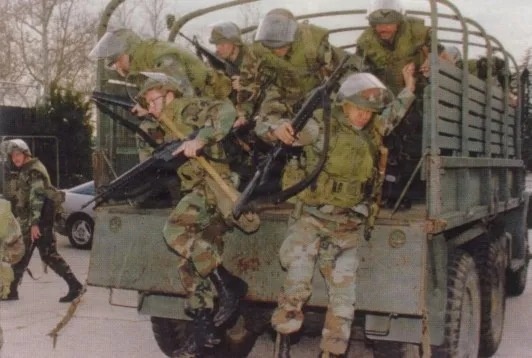
Photo By Erin Thompson | California National Guard personnel arrive in Los Angeles to assist local law...... read more read more
 Subscribe
On Apr. 29, 1992, widespread violence broke out throughout much of Los Angeles County after four Los Angeles Police Department (LAPD) officers were acquitted of charges of police brutality in the arrest of Rodney King. Intelligence personnel of the Joint Task Force-Los Angeles (JTF-LA) faced significant challenges analyzing the threat in this civil disturbance.
On Mar. 3, 1991, California Highway Patrol (CHP) and LAPD officers arrested Rodney King after a high-speed chase in Los Angeles. King’s arrest was videotaped by a civilian bystander and televised by media outlets around the country. Four LAPD officers involved were charged with using excessive force. After seven days of deliberations, on Apr. 29, 1992, the jury acquitted the officers of the charges, the catalyst for widespread rioting, looting, violence, and arson throughout a 900-square-mile area of Los Angeles County. City, county, and state law enforcement agencies were quickly overwhelmed, leading Governor Pete Wilson to request assistance from the California Army National Guard.
As the violence continued into the next day, the first National Guard unit, the 670th Military Police Company, arrived in the afternoon. A dusk-to-dawn curfew seemed to quell some of the violence overnight, but at 1:00 a.m. on May 1, Governor Wilson requested federal assistance. Through executive order, President George H.W. Bush called for the activation of the Department of Defense’s Operation Gardon Plot civil disturbance plan to restore law and order to the city’s streets. Active military forces were deployed to Los Angeles, and National Guard forces were federalized. By evening, Maj. Gen. Marvin Covault, the 7th Infantry Division commander, had arrived from Fort Ord, California, and established JTF-LA headquarters. He would oversee 10,000 California Army National Guard troops from the 40th Infantry Division, 2,000 active-duty soldiers from the 7th Infantry Division, and 1,500 members of the 1st Marines Division. By the time JTF-LA stood up, much of the crisis had passed, although sporadic violence would continue for a few more days.
Col. (later Maj. Gen.) James A. “Spider” Marks, the deputy G-2 for the 7th Infantry Division, served as the JTF J-2. His first priority was to analyze the threat, which at that time was the 40,000+ gang members and other criminal elements capitalizing on the chaos to pursue their own violent agendas. To better understand the situation, the J-2 turned to the Los Angeles Sheriff’s Gang Enforcement Unit and also tapped into the area expertise of soldiers and marines with ties to Los Angeles. Additionally, some personnel were assigned as liaison officers to local and federal law enforcement agencies. This helped accelerate the sharing of intelligence, particularly human intelligence otherwise unavailable to the military.
Due to a lack of analysts, much of the information the J-2 gathered in Los Angeles was sent to intelligence analysts back at Fort Ord who had not deployed with the JTF. They found pattern analysis difficult because the presence of military forces altered the normal patterns of gangs and other criminals. The J-2 also lacked ground and aerial photographic support to help in the planning process, to identify trouble spots, or to assess damage. In retrospect, the JTF-LA J-2 recognized several other requirements for more effective civil disturbance operations: robust augmentation of the division’s tactical and strategic CI capability; additional off-the-shelf communications equipment (cellular phones, police scanners, and fax machines) to exchange intelligence updates with local law enforcement; and reliance on non-intelligence personnel for intelligence gathering to ensure strict adherence to intelligence oversight regulations. More training in low intensity conflict was also recommended.
Federal troops redeployed to home station on May 9; National Guard forces remained for several weeks. While no military personnel were killed or injured, more than 60 civilians were killed, nearly 2,400 injured, and over 12,000 arrested. Property damage topped $1 billion, making it the most destructive civil disturbance in American history until eclipsed by the 2020 nationwide protests following the death of George Floyd in Minnesota.
Article by Lori S. Stewart, USAICoE Command Historian. New issues of This Week in MI History are published each week. To report story errors, ask questions, request previous articles, or be added to our distribution list, please contact: TR-ICoE-Command-Historian@army.mil.
| Date Taken: | 04.24.2026 |
| Date Posted: | 04.24.2026 14:06 |
| Story ID: | 563537 |
| Location: | US |
| Web Views: | 266 |
| Downloads: | 0 |

This work, Intelligence Lessons Learned from the Los Angeles Riots (29 APR 1992), must comply with the restrictions shown on https://www.dvidshub.net/about/copyright.

No keywords found.




