
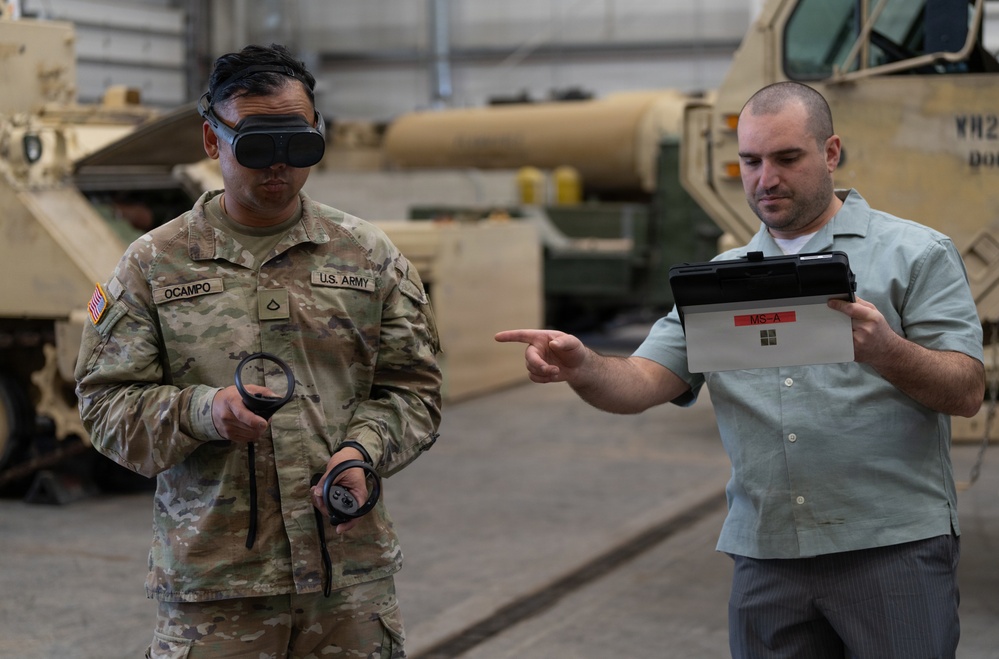
Photo By Sgt. Russell Savage V | U.S. Army Pfc. Charlie Ocampo, left, a self-propelled artillery system mechanic,...... read more read more
 Subscribe
FORT BLISS, Texas — Soldiers and leaders across the 1st Armored Division explored how emerging augmented reality and virtual reality technologies could reshape the future of maintenance, training, and mission readiness, at Fort Bliss, Texas, April 14.
During a demonstration, maintainers were introduced to a suite of AR-enabled tools designed to reduce repair times, improve access to technical information, and connect Soldiers directly with subject matter experts in real time.
Joshua Zawislak, branch chief for Net Centric Maintenance Armament Readiness Technologies Division, U.S. Army Combat Capabilities Development Command Armaments Center, with more than 20 years of experience, explained the driving force behind the technology.
“We’re trying to come up with automated test capabilities that make supporting the systems easier,” Zawislak said. “The goal we have is to reduce the time to repair. We’re giving you the information you need when you need it.”
The systems demonstrated combine traditional technical manuals with advanced digital overlays, allowing maintainers to see step-by-step instructions directly on the equipment they are working on.
Two primary systems were highlighted: Enhanced Multi-Sensory Maintenance Assistant, a local, on-device guide, and Augmented Reality Maintenance System, a remote collaboration tool connecting Soldiers to experts
“EMMA is your local guide,” Zawislak said. “It’s kind of like Alexa, but trying to be more visual: you can talk to it, use hand gestures, and it can present information to your eyesight.”
Through EMMA, Soldiers can access schematics, warnings, videos, and interactive 3D overlays aligned directly to vehicles such as the Bradley, Paladin, and an M777 howitzer. The system allows multiple users to collaborate on the same procedure, ensuring synchronization across maintenance teams.
ARMS expands these capabilities beyond the immediate workspace.
“ARMS is designed to give you the ability to reach back with equipment that you’re working on anywhere in the world,” Zawislak said. “The subject matter expert can direct your attention in real time.”
Using ARMS, a remote expert can see exactly what a maintainer sees, mark up their field of view, and provide live guidance - eliminating the need for travel and reducing delays.
Sgt. Maj. William Frazer, the senior enlisted leader with the G4 maintenance team, 1st Armored Division, emphasized the direct impact this technology could have on operational readiness.
“AR-enabled maintenance puts speed and expertise right at the point of need,” said Frazer. “You may not be the subject matter expert, but with this technology, you get the data faster and make better decisions.”
The ability to connect maintainers with experts instantly can dramatically reduce repair timelines.
“What used to take an hour could now take 15 to 20 minutes,” Frazer added. “This technology is going to reduce timelines and eliminate delays in getting the right information.”
By combining diagnostics, collaboration and real-time data, the systems are moving maintenance beyond simple part replacement toward a more advanced, data-driven process.
“We’re not just replacing parts anymore, we’re doing real diagnostics and troubleshooting in a collaborative, virtual space,” Frazer said.
One of the most significant advantages of the system is its ability to merge maintenance and training into a single platform.
“We don’t see the point of having different software for helping you on the vehicle as we do for training,” Zawislak said. “Since everything is virtual, we can also do the virtual training.”
Through VR, Soldiers can practice maintenance procedures on virtual systems when physical equipment is unavailable, increasing repetition and proficiency without additional wear on real vehicles. For junior Soldiers, the technology offers a powerful learning tool.
“I didn’t think it would be too useful at first, but it definitely has potential,” said Pvt. Matthew Perry, a Bradley Fighting Vehicle system maintainer, assigned to Base Maintenance, 4th Battalion, 27th Field Artillery Regiment, 1st Armored Division Artillery Brigade. “For new Soldiers, it can highlight parts inside the vehicle and show exactly where to go.”
Perry noted that while the system is still developing, its ability to improve efficiency and training is clear.
“I could definitely see it improving work time once it becomes faster and more reliable,” he said.
A key advantage of the system is its ability to operate in disconnected or deployed environments. EMMA is designed to function fully on a headset or tablet without requiring external connectivity - critical for field operations.
The long-term vision includes integrating these tools with digital logistics systems, maintenance records, and diagnostic data to create a fully connected maintenance ecosystem.
“The goal is for any maintainer, anywhere, to reach back to the person who knows the system best,” Zawislak said. “If a Soldier doesn’t know a system, they can put on the headset and still complete the maintenance. This helps get vehicles back to mission-ready faster.”
As the Army continues to modernize, AR and VR technologies are poised to play a critical role in bridging knowledge gaps, accelerating repairs, and enhancing readiness across formations.
“We’re leveraging the knowledge of subject matter experts to guide users step-by-step in real time,” Zawislak said. “Instead of waiting days for someone to travel out, Soldiers can get help on demand, right at the point of need.”
With continued development and integration, these tools could redefine how Soldiers train, troubleshoot, and sustain the force - ensuring equipment stays operational and units remain ready for any mission.
| Date Taken: | 04.16.2026 |
| Date Posted: | 04.30.2026 11:52 |
| Story ID: | 563399 |
| Location: | FORT BLISS, TEXAS, US |
| Web Views: | 133 |
| Downloads: | 0 |

This work, Augmented reality transforms Army maintenance and training, by SGT Russell Savage V, identified by DVIDS, must comply with the restrictions shown on https://www.dvidshub.net/about/copyright.


No keywords found.




