
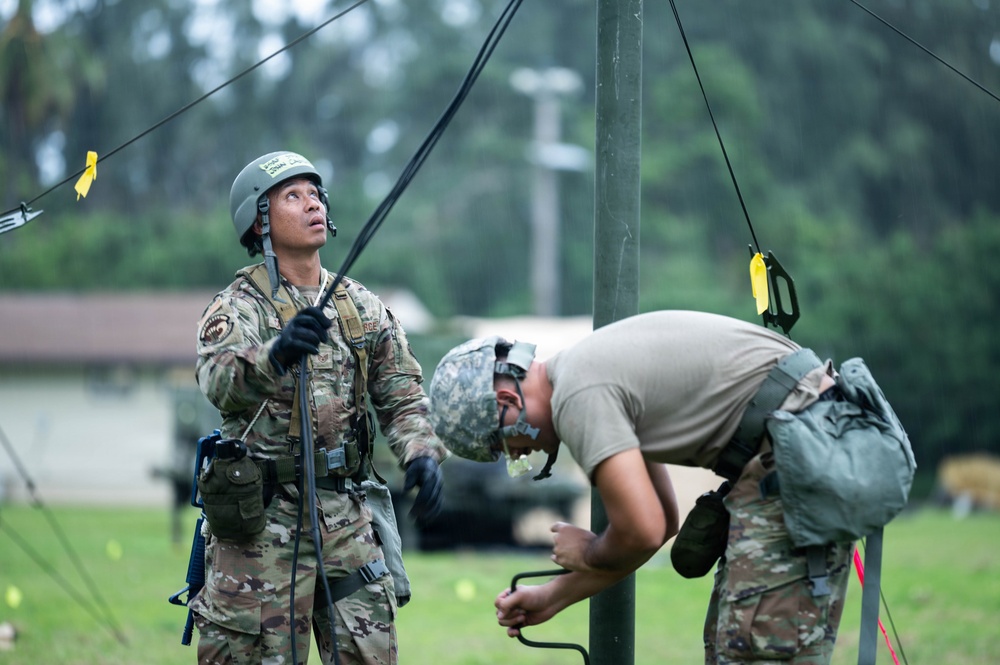
Photo By Airman 1st Class Lydia Tristan | U.S. Air Force Staff Sgt John Casison 297th Combat Air Operations Squadron, Radar,...... read more read more
 Subscribe
The 154th Civil Engineer Squadron (154CES) and the 297th Combat Airfield Operations Squadron (297CAOS) teamed up for a Joint Field Training Exercise at Bellows Air Force Station (AFS) April 9th-12th.
Dubbed the Bellows AFS Super Drill, the training tested and validated the unit’s ability to deploy, establish independent operations, and sustain the mission. Personnel sharpened critical wartime skills by building a fully self-sustaining encampment that simulated a forward operating base.
“During this exercise, airmen engaged in a variety of hands-on activities designed to simulate a real-world, contested deployment,” said Senior Master Sgt. George Demesillo, 297th Combat Airfield Operations Squadron logistics planner. “These activities are structured to test both individual skills and unit cohesion under pressure.”
The FTX pushed the 154CES into a high-tempo environment where skill sets were tested against simulated threats and stormy tropical weather. Personnel maintained a rigorous base defense posture against ground and air assaults, while inside Unit Control Centers, leadership navigated the complexities of Command and Control through numerous drills including operating with compromised communication channels.
“The ability to operate in contested, degraded, and operationally limited environments are direct responses to the changing nature of modern warfare,” said Demesillo.
The training took a critical turn when a simulated medical evacuation of the commander forced a seamless transfer of airfield command to the 154CES testing the unit's leadership depth under duress. On the flight line, teams practiced Tactical Combat Casualty Care and executed an Airfield Damage Repair mission following a downed-helicopter scenario,a massive undertaking that saw engineers operating heavy machinery and cutting concrete to restore the runway.
Even amidst simulated chemical, biological, radiological, and nuclear threats that required full protective gear, the focus remained on operational continuity, with robust communication links and accountability checks ensuring that every moving part of the mission remained synchronized.
The Bellows AFS Super Drill served as a critical milestone in the wing’s readiness cycle, marking the first of four major operations that comprise Hoʻoikaika, the Hawaii Air National Guard’s biannual Combat Readiness Exercise. Meaning "to strengthen and encourage," Hoʻoikaika is designed to move beyond basic proficiency, bridging the gap between individual technical skills and the collective power required to project air power globally.
This commitment to readiness was echoed by U.S. Air Force Col. Shane H. Nagatani, 154th Wing commander.
“The strength of our Wing resides in us: the individual members of the Hawaii Air National Guard,” Nagatani said. “I am excited to see us demonstrate the skills and abilities we employ each day in service to our State, defense of our country, and the projection of air power around the globe.”
Ultimately, that strength is defined by a refusal to let external conditions dictate the mission. As the island braced for heavy storms and potential flooding during the exercise, the priority at Bellows never wavered.
When asked if the training would be canceled or delayed due to the weather, Demsillo offered a confident laugh, his response making the unit's resolve clear before he even spoke.
“Yes,” he said. “We’re a combat unit.”
| Date Taken: | 04.15.2026 |
| Date Posted: | 04.21.2026 22:19 |
| Story ID: | 563302 |
| Location: | JOINT BASE PEARL HARBOR-HICKAM, HAWAII, US |
| Web Views: | 88 |
| Downloads: | 0 |

This work, Bellows Super Drill: Engineers and Operators Simulate Forward Base Survival, by A1C Lydia Tristan, identified by DVIDS, must comply with the restrictions shown on https://www.dvidshub.net/about/copyright.


No keywords found.




