
Photo By Douglas Holl | Microplastics and a class of chemicals called per- and polyfluoroalkyl substances, or...... read more read more
 Subscribe
By Marc A. Williams, Joanna Reagan, Farinaz Firouzi, and Wendy LaRoche Military families become highly skilled at rapid pack-out and quickly establishing new living space. Each new house becomes a home, and the kitchen is its heart. It’s where you fuel up for the day, reconnect after time apart, and create a sense of normalcy — no matter the duty station. But what if some of the most common, durable items in that kitchen are introducing unseen guests to your family's table?
We're talking about microplastics and a class of chemicals called per- and polyfluoroalkyl substances, or PFAS. These substances are widespread, but with a little know-how, you can significantly reduce your family's exposure and make your kitchen an even safer haven.
What are microplastics and PFAS?
Microplastics and PFAS are connected: Microplastics can act like tiny vehicles, absorbing and carrying PFAS and other toxins which can then be released inside the body.
What are the potential health concerns of microplastics and PFAS? Scientists continue studying the health effects of these substances; so far, the evidence suggests we need to be careful. This is called the "precautionary principle." This principle means prevention is better than having to heal or recover later. A major challenge is that our bodies have a hard time breaking down these particles and chemicals. The Environmental Protection Agency identifies PFAS health risks based on current research. For example, the academic journal Foods published an article titled “Research Progress in Current and Emerging Issues of PFASs’ Global Impact: Long-Term Health Effects and Governance of Food Systems” in March 2025 that linked long-term exposure to certain PFAS with several health issues, including;
While direct research on humans is emerging, microplastics have been found in human blood, lungs, and even brain tissue.
Animal and cellular studies suggest a link between microplastic exposure and inflammation, cell damage, and hormone disruption.
Developing children are considered especially vulnerable to these effects.
What are the potential sources of microplastics and PFAS in my kitchen? Awareness is the first step toward making a change. Your mission is to identify common sources of microplastics and PFAS in the kitchen.
| Kitchen Item | Potential Contaminant(s) | What to Know |
|---|---|---|
| Nonstick cookware | PFAS (for example, Polytetrafluoroethylene, also known as PTFE or "Teflon") | The coating can break down at high temperatures or when scratched, releasing PFAS into food and the air.Claims of "PFOA-Free" may be misleading, as other types of PFAS could still be used. |
| Plastic cutting boards | Microplastics | The knife action on a plastic board can release millions of microplastic particles directly into your food.This shedding increases as the board becomes more worn and grooved. |
| Plastic food storage and utensils | Microplastics, Bisphenol A, also known as BPA, and Phthalates. Phthalates are a family of chemical compounds used primarily as plasticizers to make polyvinyl chloride (PVC) soft and flexible. | Heating plastic containers in the microwave significantly increases the release of micro- and nanoplastics.Using plastic spatulas and spoons, especially with heat, can also cause particles to flake off into your meal. |
| Takeout and fast-food packaging | PFAS | The grease- and water-resistant linings in pizza boxes, fast-food wrappers, and molded fiber bowls are often made with PFAS, which can move into your food.As of 2024, the Food and Drug Administration no longer allows PFAS substances to be sold for use in food packaging in the U.S. |
| Certain tea bags | Microplastics | Many "silken" pyramid tea bags are made of plastic (nylon or polyethylene terephthalate, also known as PET), and paper tea bags are often sealed with heat-sensitive polypropylene.Steeping these in hot water can release billions of microplastic particles into your cup. |
How can I reduce my exposure to microplastics and PFAS?
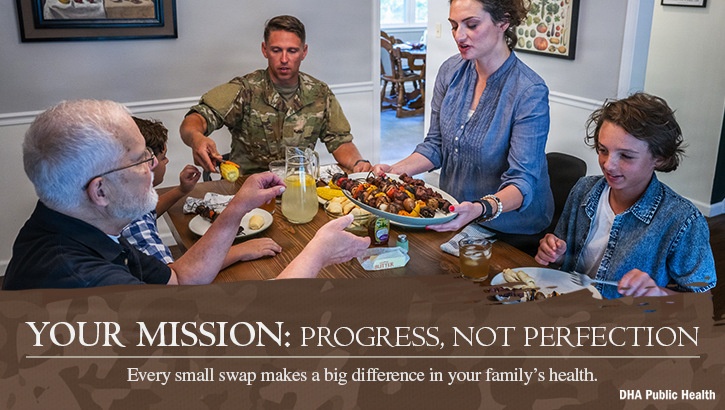
The goal is progress, not perfection. Every swap you make reduces your family's exposure. Here are some actionable steps you can take toward a healthier kitchen:
Small changes make a difference!
Creating a healthy home for your family is a top priority, and you are in command of what comes into your kitchen. By being aware of the unseen guests like microplastics and PFAS, you can make informed, deliberate choices to reduce their presence in your home or office.
Don't feel pressured to replace everything at once. Start with one or two changes, like switching to a wooden cutting board or brewing loose-leaf tea. Every step you take creates a healthier environment for your family to thrive, no matter where your service takes you.
Author Information:
The Defense Health Agency operates the world’s premier military health enterprise—unique in mission, purpose, and obligation to our nation, our Military Service leaders, and our Combatant Commanders.
NOTE: The mention of any non-federal entity and/or its products is for informational purposes only, and is not to be construed or interpreted, in any manner, as federal endorsement of that non-federal entity or its products.
| Date Taken: | 04.21.2026 |
| Date Posted: | 04.23.2026 09:01 |
| Story ID: | 563269 |
| Location: | US |
| Web Views: | 25 |
| Downloads: | 0 |

This work, Unseen guests in your kitchen: A military family's guide to decrease forever chemicals like PFAS, microplastics, must comply with the restrictions shown on https://www.dvidshub.net/about/copyright.


No keywords found.




