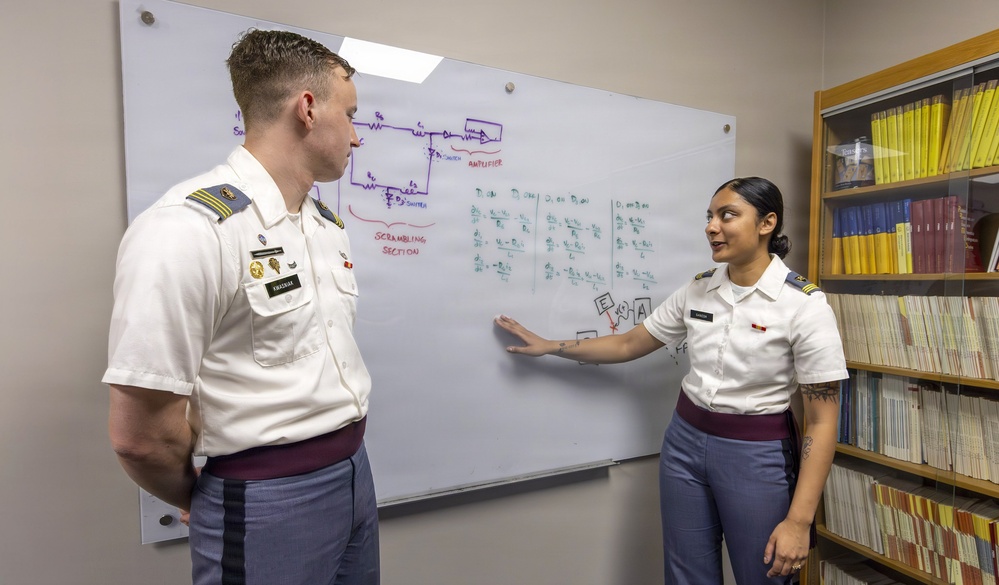
Cadet Ananya Ganesh did not expect to be a math major. Cadet Babe “BK” Kwasniak was planning to study history. Together, they are using one of the most counterintuitive concepts in mathematics to solve one of the Army’s most pressing drone vulnerabilities.
The problem starts with a step back in technology. While huge advancements have been made in securing digital communications, the security of analog communications has not been a strategic priority - until now. As drones emerge in increasing numbers and roles in the modern battlespace, many first-person view drones use analog cameras that are affordable and less impacted by jamming; however, those same drones come with one critical weakness: their signals are easily intercepted.
Ganesh explains, “If an adversary captures the signal being transmitted, they have access to the drone feed and can just follow it back to the (command post).” This is where chaos theory comes in.
Ganesh, a Mathematical Sciences major working on the scrambling side of the project, reaches for a familiar concept to explain an unfamiliar one: “Have you heard of the butterfly effect?” she asks. Indeed, most of us have. The idea that a small change in input produces a large change in output is the mathematical engine behind the team’s encryption approach, known as “chaotic scrambling.” Feed an analog video signal through their system and what transmits out the other side is unrecognizable. An intercepted feed reveals nothing.
The hardware making that possible is deliberately simple. “Entirely off-the-shelf standard electronic components are far cheaper than current digital encryption systems” according to Ganesh. Any analog camera can be wired directly into the scrambler, no specialized equipment required.
Of course, an unrecognizable image is useful for adversaries but would need reassembly for productive use and intelligence. This is where Cadet Kwasniak comes in, an Applied Statistics and Data Science major who is the other half of this team. Kwasniak is the descrambling specialist on this project.
His work focuses on training a model to learn the mask applied to scramble the signal in order to reconstruct the original feed on the receiving end. Because the model trains on large volumes of data, it can identify patterns even when transmission noise produces variation, which is one of the project’s most persistent technical challenges.
“Any kind of noise in a small change in input,” Kwasniak noted, “which can create adverse effects on the descrambling side.” The butterfly effect again.
The scrambling and descrambling systems are intentionally separate. Unlike traditional symmetric key encryption, where the same key locks and unlocks, this approach uses two distinct systems that never share a key. That asymmetry makes it significantly harder to crack.
There are still open questions: real-world noise, transmission frequency, frames per second, and more; however, the prototype represents proof of concept, not a finished product. The foundation is there: a low-cost, reproducible encryption solution designed specifically for the analog systems the Army would need to scale drone production. This is innovation at its finest.
This team’s innovative work earned them this year’s Scott R. Clark Innovation for Soldiers Award as part of the annual U.S. Military Academy [Projects Day Research Symposium](https://www.westpoint.edu/about/academy-events/projects-day-research-symposium/2026). Cadets Ganesh and Kwasniak along with their advisors – Dr. Jessica Libertini, Dr. Jasmin Mohn, Major Katherine Rutherford, Major John Borger, and Captain Nolan Hedglin – are solving Army problems one butterfly effect at a time.
The Encrypting and Decoding Drone Feeds team is part of the [Department of Mathematical Sciences](https://www.westpoint.edu/academics/departments/mathematical-sciences)’s presentation at West Point’s 27th annual [Projects Day Research Symposium](https://www.westpoint.edu/about/academy-events/projects-day-research-symposium/2026), which showcases hundreds of cadet-led research projects. Learn more about this year’s select project features and how to partner with West Point at [www.westpoint.edu/werx](https://www.westpoint.edu/werx).
| Date Taken: |
04.21.2026 |
| Date Posted: |
04.21.2026 14:37 |
| Story ID: |
563261 |
| Location: |
WEST POINT, NEW YORK, US |
| Web Views: |
49 |
| Downloads: |
0 |
PUBLIC DOMAIN

This work, The signal they cannot see: West Point Cadets research encrypting and decoding drone feeds, must comply with the restrictions shown on https://www.dvidshub.net/about/copyright.

 Subscribe






