
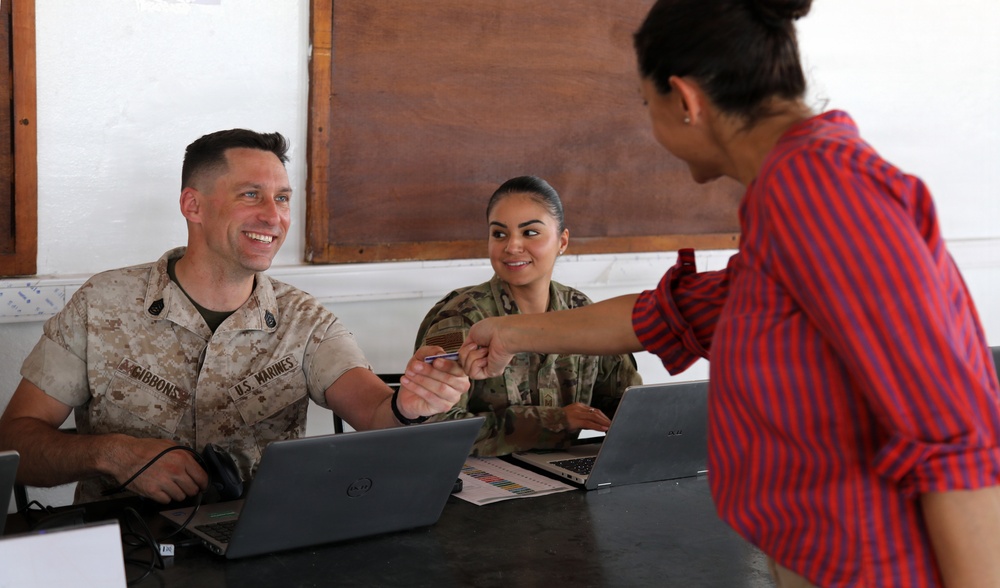
Photo By Sgt. 1st Class Rodney Roldan | U.S. Marine Corps Gunnery Sgt. David Gibbons, a contingency personnel planner, and...... read more read more
 Subscribe
AGADIR, Morocco — In a rapidly evolving operational environment where speed, accountability and real-time awareness are critical, military personnel assigned to U.S. Africa Command are leveraging African Lion 26 as a battle lab to test emerging technologies designed to enhance personnel tracking and operational efficiency at Southern Zone Headquarters, April 20-May 8.
At the forefront of that effort is Guardian, a software-based, personnel-tracking proof of concept under evaluation for the first time during this multinational exercise. The tool represents a forward-looking approach to how commanders visualize, manage and safeguard personnel across dispersed and dynamic areas.
“This is a proof of concept that allows us to improve personnel accountability in complex operational environments,” said U.S. Army Maj. Lisa Rousseau, USAFRICOM contingency, exercise and personnel planner. “This is a system that we are stress testing in African Lion.”
Guardian is designed to provide near real-time visibility of personnel across a theater of operations. By integrating data inputs, the tool enables planners and commanders to maintain a more accurate and dynamic understanding of where personnel are located and how they are moving.
Traditionally, personnel tracking has relied on manual reporting methods, spreadsheets or fragmented systems that can lag in real-world conditions. Guardian aims to bridge that gap by automating aspects of data collection and visualization.
“It’s about giving leaders a clearer picture, faster,” Rousseau said. “It’s going to give them that decision dominance to have that near or real-time fused picture of personnel and their locations with complete status updates in under 30 seconds per person to scan.”
During AL26, users are employing Guardian in a large-scale, multinational environment, allowing planners to stress-test its capabilities across multiple locations, units and partner forces.
As USAFRICOM’s largest annual military exercise in Africa, AL26 provides a unique opportunity to evaluate new technologies in realistic conditions. With thousands of participants from multiple nations operating across vast distances, the exercise serves as an ideal battle lab for innovation.
“This exercise gives us the scale we need to truly understand how this capability performs,” Rousseau said. “We knew African Lion afforded us the opportunity to not only test the sheer magnitude of personnel coming through, but also to work with foreign partners and civilians who do not have common access cards.”
The integration of emerging tools like Guardian reflects a broader emphasis on innovation that drives readiness, which not only prepares forces for today’s missions, but also equips them for tomorrow's challenges.
“Guardian has the potential to transform how we maintain accountability in a dynamic environment," said U.S. Army Col. George Zuniga, director of staff, USAFRICOM J1. "By consolidating personnel data into one accessible platform, it strengthens situational awareness while reducing reporting redundancies and discrepancies. The ability to deliver real-time updates enables commanders to make faster, more informed decisions, and its automated processes ease the administrative burden on units, allowing Soldiers and planners to stay focused on mission execution.”
As a proof of concept, Guardian is still undergoing evaluation, and exercise participants are actively identifying limitations and its strengths.
“It’s important to recognize that this is not a finished product,” Rousseau said. “We are not yet fully at operational capability yet. As we continue operational testing during the exercise, we are simultaneously making updates and improvements.”
These insights are critical to refining the system and determining areas of improvement before any potential broader implementation.
Its use during AL26 also opens the door for joint and multinational integration. Tools like Guardian could potentially support a more unified operational picture since personnel tracking is a shared requirement across services and partner nations.
Guardian's testing during AL26 underscores USAFRICOM’s role as a leader in operational innovation. By using the exercise as a battle lab, planners can experiment with new technologies in realistic conditions, accelerating the development process and informing future capabilities.
As the U.S. Army continues to prioritize innovation that drives readiness, efforts like this demonstrate how emerging technologies can integrate into operations to enhance effectiveness, accountability and mission success.
“We’re learning in real time,” Rousseau said. “We’re already making in-stride improvements every day that we’re here.”
The results of this proof of concept will help shape the future of personnel tracking across the force, ensuring that Soldiers and leaders have the tools they need in increasingly complex operational environments.
AL26 is USAFRICOM's largest annual joint exercise, designed to strengthen collective security capabilities of the U.S., African nations and global allies. Led by U.S. Army Southern European Task Force, Africa (SETAF-AF) from April 20 to May 8, 2026, and hosted in Morocco, Tunisia, Ghana and Senegal, AL26 involves over 5,600 civilian and military personnel from more than 40 nations, using innovation to drive partner-led regional security.
| Date Taken: | 04.22.2026 |
| Date Posted: | 04.21.2026 08:39 |
| Story ID: | 563202 |
| Location: | AGADIR, MA |
| Web Views: | 200 |
| Downloads: | 0 |

This work, US tests personnel tracking tool during African Lion 26, by SFC Rodney Roldan, identified by DVIDS, must comply with the restrictions shown on https://www.dvidshub.net/about/copyright.


No keywords found.




