
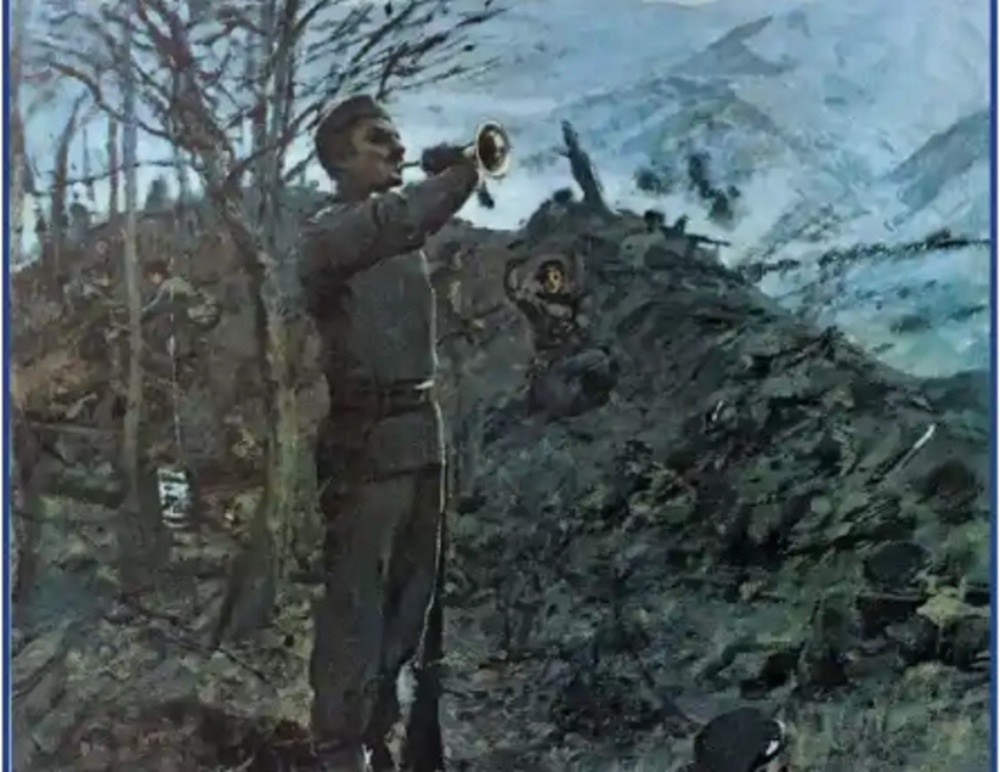
Photo By Maj. Alexia Croizer | The Long Reveille by artist Ken Howard depicts Drum-Major Philip Buss from the...... read more read more
April 1951: Battle of the Imjin River
Seventy-five years ago, the Chinese launched their Spring Offensive on April 22,1951, a massive counterattack with the primary goal of recapturing Seoul. Their initial attack fell on the 29th British Brigade. Supported by the Belgian battalion, they were defending a 12-mile front along the Imjin River to block the primary route to Seoul. The 29th Brigade faced approximately 27,000 soldiers of the Chinese 63rd Army. Over three days of intense, often hand-to-hand combat, the battalions in the Brigade, the Belgian/Luxembourgish Battalion, the Royal Northumberland Fusiliers, the Royal Ulster Rifles, and the Gloucestershire Regiment, held their ground against waves of Chinese infantry.
The most famous stand occurred at Hill 235. The engagement began on the night of April 22, when Chinese forces waded across the Imjin. By the morning of April 23, the Glosters were cut off from the rest of the 29th Brigade. Despite being surrounded and under constant mortar and machine-gun fire, the battalion consolidated its four companies onto the high ground of Hill 235. The Glosters ran low on ammunition, water, and medical supplies, and several attempts by Centurion tanks and infantry to break through to them were repelled by Chinese anti-tank teams. On the final night, the Chinese launched relentless "human wave" attacks, signaling their charges with bugles and drums. The Glosters responded with disciplined fire and, eventually, bayonet charges when ammunition was exhausted.
In defiance of the Chinese Bugles, Lieutenant Colonel James Carne ordered Drum Major Buss to sound his bugle to "answer" the Chinese. Amidst the chaos of Hill 235, Buss stood and played several standard British Army calls. The choice of the specific calls sounded was intentional, signaling to the Chinese that the Glosters were so unfazed by the assault that they were preparing for dinner or routine administrative duties. The effect of the bugle calls was immediate, providing a brief but vital surge of morale and a reminder of their unit’s identity to the cold, wet, and hungry British soldiers, who were nearly out of ammunition. For the Chinese attackers, the calls were reportedly confusing. Having used their own bugles to signal tactical maneuvers, they were momentarily uncertain if the British calls were signals for counterattack or reinforcements. This brief hesitation provided the Glosters with a temporary reprieve during the final hours of the defense. See the headquarters kiosks for a depiction of Drum Major Buss playing the 'The Long Reveille' in a painting by Ken Howard.
By the morning of April 25, Lieutenant Colonel Carne received the order to "break out if possible." With no ammunition left to sustain a defense, the battalion split into small groups to attempt the reach UNC lines. Most were captured, including Colonel Carne and Drum Major Buss, who spent the remainder of the war in POW camps. Only "D" Company’s remnants and a few others managed to evade capture and reach friendly positions.
Their sacrifice was not in vain, however. The Glosters' refusal to yield forced the Chinese to commit their reserve and delayed their advance by three critical days. The delay allowed UNC to establish "No-Name Line" north of Seoul, effectively ending the Chinese Spring Offensive.
Hill 235 is now known as "Gloster Hill." On April 23, the UK Embassy will hold a ceremony at Gloster Hill commemorating this battle.
| Date Taken: | 04.20.2026 |
| Date Posted: | 04.21.2026 00:07 |
| Story ID: | 563182 |
| Location: | KR |
| Web Views: | 140 |
| Downloads: | 0 |

This work, April 1951: Battle of the Imjin River, by MAJ Alexia Croizer, identified by DVIDS, must comply with the restrictions shown on https://www.dvidshub.net/about/copyright.

No keywords found.





