
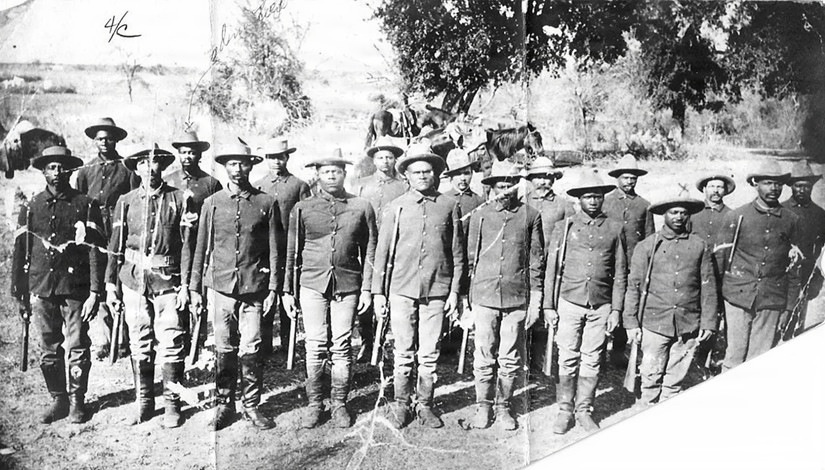
Photo By Erin Thompson | A detachment of Black Seminole Scouts, 1885. Medal of Honor recipients Sgt. John Ward...... read more read more
 Subscribe
On Apr. 25, 1875, three U.S. Army Black Seminole Scouts rescued their commander, Lt. John L. Bullis, during a reconnaissance patrol in Texas. Their bravery earned them the U.S. military’s highest decoration for valor, the Medal of Honor.
The Black Seminoles are the descendants of runaway slaves and native Seminoles. In the 1850s, many fled Indian Territory (present-day Oklahoma) into Mexico to escape the poor conditions on the reservations and possible enslavement. With the threat of slavery gone following the American Civil War, they began seeking repatriation back to the U.S. At the same time, the U.S. Army had turned its attention to the increased violence between settlers and indigenous tribes on the western frontier. To support its campaign against the raiding bands, in 1866, the Army authorized the recruitment of Native Americans as scouts, guides, and interpreters.
Some Black Seminoles had previously served in the Mexican army during its own campaign against the Apache and Comanche. Recognizing the value of their prior military experience for operations in the west, the Army encouraged them to return to the U.S. and seek enlistment as scouts. The first Black Seminole Scouts volunteered for service in Texas in August 1870 and were attached to the 24th Infantry at Fort Duncan, Texas. By 1873, approximately fifty scouts were divided between Fort Duncan and nearby Fort Clark.
Under the command of Lieutenant Bullis between 1873–1881, the scouts reportedly guided twenty-five Army expeditions into Mexico. They also frequently embarked on lone scouting patrols and acted as guides and trackers for Army operations on the southern plains. Their unique experiences living in Mexico and fighting indigenous warriors with the Mexican army proved instrumental in tracking the raiding bands threatening the lives and property of American settlers. Maj. Zenas R. Bliss, commander of the 24th Infantry, described them as “excellent hunters, and trailers, and brave scouts…splendid fighters.”
In April 1875, Fort Duncan received reports of a large band of warriors who were in possession of approximately seventy-five stolen horses. On Apr. 16, Bullis set out for the mouth of the Pecos River with three scouts alongside a company of infantry soldiers. The scouts included Sgt. John Ward and Pvt. Pompey Factor, two of the original volunteers from 1870 who had already served through multiple six-month enlistment periods by 1875. The third scout was trumpeter Isaac Payne, who had been born in Mexico and was on his first enlistment.
Between Apr. 22–24, Bullis and the scouts made a series of reconnaissance patrols ahead of the infantry along the river, tracking the movements of the traveling band. On Apr. 25, the scouts finally spotted a fresh trail which led them to the camp of between 25–30 Native warriors armed with repeating Winchester rifles and the stolen horses. They reconnoitered the camp for some time, but rather than reporting their intelligence back to the infantry soldiers, Bullis instead dismounted and moved within seventy-five yards before opening fire.
Over the next forty-five minutes, Bullis and the scouts killed three enemy warriors and twice gained control of the horses, but they were twice pushed back by the overwhelming number of combatants. Bullis finally ordered the scouts to retreat but was prevented from following when he was surrounded and his horse spooked. The scouts quickly returned to the melee and, with Factor and Payne providing covering fire, Ward pulled Bullis onto his own horse and narrowly avoided being shot himself during the escape. For their bravery during the fight, Bullis recommended the three scouts for the Medal of Honor, which they received on May 28, 1875.
All three scouts would remain in the Army for several more years: Factor until 1880, Ward until 1895, and Payne until 1901. All three are buried in the Seminole Indian Scout Cemetery in Texas. The Black Seminole Scouts were officially disbanded in 1914.
Article by Erin E. Thompson, USAICoE Staff Historian. New issues of This Week in MI History are published each week. To report story errors, ask questions, request previous articles, or be added to our distribution list, please contact: TR-ICoE-Command-Historian@army.mil.
| Date Taken: | 04.17.2026 |
| Date Posted: | 04.17.2026 12:24 |
| Story ID: | 562973 |
| Location: | US |
| Web Views: | 67 |
| Downloads: | 0 |

This work, Black Seminole Scouts Earn the Medal of Honor (25 APR 1875), by Erin Thompson, identified by DVIDS, must comply with the restrictions shown on https://www.dvidshub.net/about/copyright.

No keywords found.




