
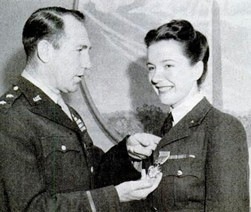
Photo By Erin Thompson | Constance Babington Smith is presented with the Legion of Merit by U.S. Army Air...... read more read more
 Subscribe
On Apr. 19, 1943, the British Air Ministry ordered the Allied Central Interpretation Unit (ACIU), headquarters of Allied photographic analysis efforts, to find evidence of German “secret weapons.” The ACIU was to look for, in particular, long-range guns, remote-controlled rockets, or “some sort of tube out of which a rocket could be squirted.” Thus began Operation Crossbow to identify and defeat Germany’s long-range weapons programs.
In April 1943, 31-year-old Flight Officer Constance Babington Smith was chief of an ACIU section focused specifically on the aircraft industry. She had developed an early fascination with airplanes and, before the war, wrote articles for an aviation magazine. Commissioned a British Women’s Auxiliary Air Force (WAAF) officer in December 1940, she and eleven other photo interpreters analyzed aerial photographs to identify new enemy aircraft types and monitor their development to determine when they might become operational.
Per the Apr. 19, 1943 Air Ministry’s order, Babington Smith’s section concentrated specifically on Peenemünde in northern Germany, thought to be a major weapons center. In late November, while studying recent photographs of the site, she noted, “Right at the edge of the road there was something I did not understand—unlike anything I had seen before…a sort of ramp banked up with earth—you could tell from the shadow—supporting a rail that inclined upwards….” She conferred with her colleagues who had seen similar features but assumed they were related to nearby dredging operations. Intrigued, Babington Smith requested a new set of aerial photographs. Although the prints were poor quality, “even with the naked eye I could see that on the ramp was something that had not been there before. A tiny cruciform shape, set exactly on the lower end of the inclined rails—a midget aircraft actually in position for launching.” She had just confirmed the existence of Germany’s V-1 (V for Vengeance) flying bomb.
Knowing now what to look for, the photo interpreters scoured 1.2 million aerial photos identifying what they called “ski sites” set up throughout France and within range of England. At that point, Operation Crossbow took on higher priority. Using the targeting information provided by Babington Smith’s section, the Allies launched a bombing campaign against those sites, dropping more than 36,000 tons of bombs in 25,150 sorties. The toll to the Allies was high: 771 men and 154 Allied aircraft were lost. Yet, the destruction of at least 83 ski sites probably delayed Germany’s V-1 program during the critical months in which the Allies were preparing to execute the D-Day landings on the Normandy beaches. Indeed, Germany launched its first V-1 attack on England just one week after the Allied landings.
A year later, after Germany surrendered, Babington Smith went to work for U.S. Army Air Forces intelligence in Washington, D.C., where her photo interpretation skills were used to plan the possible invasion of Japan. In late 1945, she became the first British woman to receive the U.S. military’s Legion of Merit for “exceptionally meritorious conduct in the performance of outstanding services and achievements.” Her citation read, "Recognized as the outstanding Allied authority on the interpretation of photographs of aircraft, she provided the Eighth Air Force with extremely vital intelligence for the strategic bombing and destruction of the German aircraft industry and contributed materially to the success of the U.S. Army Air Force’s strategic mission to Europe."
In 1957, Babington Smith published "Evidence in Camera" about her wartime accomplishments in the field of photo intelligence. She continued writing throughout her life, eventually publishing six additional books, primarily biographies. She passed away in 2000 at the age of 87. The National Geospatial-Intelligence Agency inducted her into its Hall of Fame in 2015.
Article by Lori S. Stewart, USAICoE Command Historian. New issues of This Week in MI History are published each week. To report story errors, ask questions, request previous articles, or be added to our distribution list, please contact: TR-ICoE-Command-Historian@army.mil.
| Date Taken: | 04.17.2026 |
| Date Posted: | 04.17.2026 12:24 |
| Story ID: | 562971 |
| Location: | US |
| Web Views: | 80 |
| Downloads: | 0 |

This work, Searching for German Secret Weapons (19 APR 1943), must comply with the restrictions shown on https://www.dvidshub.net/about/copyright.

No keywords found.




