The U.S. Army Aviation and Missile Command is sharpening its focus on sustainment, data analytics and advanced manufacturing to ensure warfighters remain ready for current and future operations, its commanding general said.
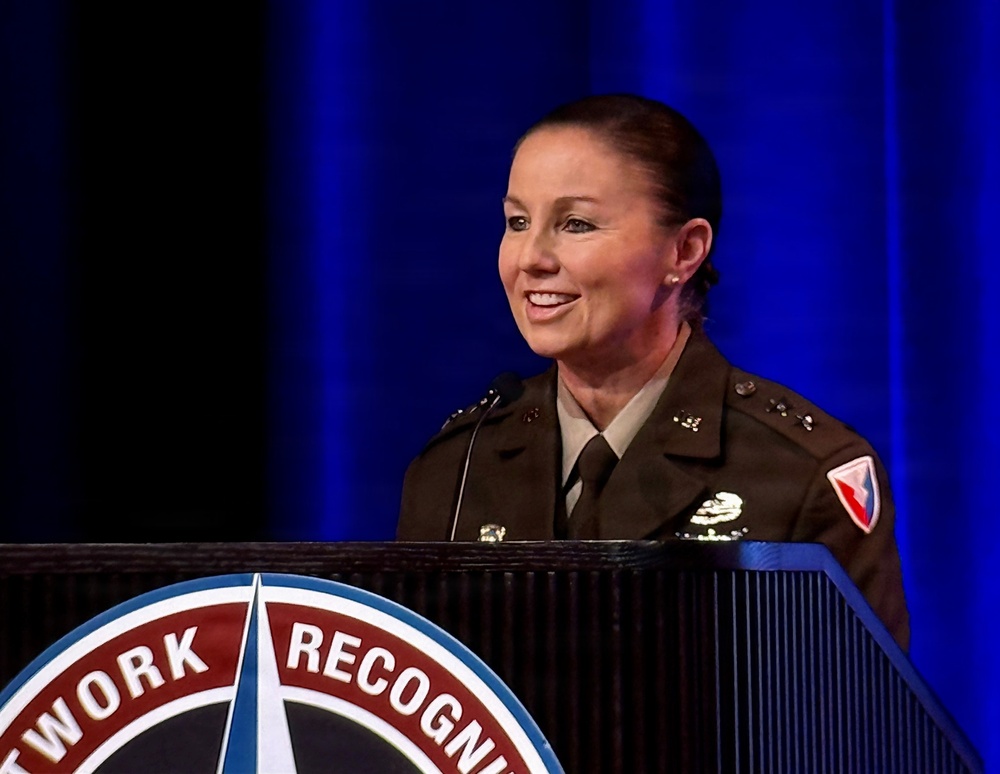
Maj. Gen. Lori Robinson, AMCOM commanding general, addressed Army leaders, industry partners and international representatives during the 2026 Army Aviation Association of America Warfighting Summit, emphasizing that maintenance and sustainment remain foundational to mission success.
“Sustainment and maintenance are fundamental,” Robinson said. “We heard units describe themselves as maintenance organizations, and that’s exactly right. It is critical to everything we do.”
Robinson thanked partners across government and industry, noting that readiness requires a collective effort.
“It takes a village,” she said. “That village comes together at events like this, but more importantly, it comes together every day in the field to deliver the capabilities our warfighters need.”
She highlighted the command’s role in supporting ongoing global operations, stressing that forces deploy with existing equipment while new capabilities are integrated as quickly as possible.
“We go to war with what we have, while continuously working to infuse new capabilities,” Robinson said. “What we do every day enables the warfighter to respond whenever the nation calls.”
AMCOM’s mission, she said, remains unchanged: delivering “continuous and responsive aviation and missile sustainment” to the field.
Robinson underscored the importance of the civilian workforce, calling it “the heart of what we do,” and emphasized continued investment in workforce development and technical expertise.
The command is also leveraging data to anticipate challenges before they impact readiness. Robinson pointed to a comprehensive analytics effort designed to provide visibility across supply chains and maintenance operations.
“We’re using data to see ourselves more clearly — to predict where challenges will arise and get ahead of them,” she said.
Artificial intelligence is playing an increasing role in that effort. AMCOM has implemented AI-enabled tools to support oil analysis, back-order management, environmental compliance and inventory tracking.
“We’re exploring where AI best fits into our daily workflows,” Robinson said. “These tools help us identify shortages and improve decision-making across the enterprise.”
She also highlighted collaboration with other Army Materiel Command organizations to develop AI-assisted maintenance tools that allow soldiers and maintainers to interact with technical manuals in more intuitive ways.
On the modernization front, Robinson emphasized the growing role of advanced manufacturing, particularly additive manufacturing, to address supply challenges.
“In the end, it has to work,” she said. “Regardless of how a part is made, it must perform within the system safely and reliably.”
AMCOM has expanded its advanced manufacturing repository from 20 parts in September 2025 to more than 160 today, a step Robinson described as incremental but critical.
“We have to start somewhere,” she said.
She stressed that safety and airworthiness remain non-negotiable.
“My responsibility is ensuring everything we field is safe and airworthy,” Robinson said. “That does not change, regardless of how it’s manufactured.”
Robinson also addressed efforts to integrate unmanned aircraft systems and clarify how they operate alongside traditional aviation platforms, particularly in increasingly complex airspace environments.
“We are working across the joint force to define systems more clearly and ensure they operate safely together,” she said.
Another priority is strengthening the Army’s organic industrial base, including depots, arsenals and ammunition plants. Robinson highlighted ongoing modernization efforts and new organizational structures designed to better align workloads and capabilities across the enterprise.
She pointed specifically to Corpus Christi Army Depot as a critical component of Army aviation readiness, citing its skilled workforce and expanding modernization initiatives.
“That workforce is generational, highly skilled and deeply committed,” Robinson said. “They handle low-density, high-complexity work that is essential to sustaining our fleet.”
Robinson invited industry partners to collaborate more closely with the depot and other Army organizations to increase capacity and capability across the sustainment enterprise.
“Our aviation units need parts every single day,” she said. “Readiness is a warfighting task — it takes planning, discipline, technical skill and the right parts at the right time.”
Closing her remarks, Robinson reflected on her time in command and the people she has served alongside.
“It has been my honor to lead and serve with such dedicated professionals,” she said. “They truly are among the very best.”
| Date Taken: |
04.17.2026 |
| Date Posted: |
04.17.2026 09:44 |
| Story ID: |
562958 |
| Location: |
NASHVILLE, TENNESSEE, US |
| Web Views: |
104 |
| Downloads: |
1 |
PUBLIC DOMAIN

This work, AMCOM commander highlights sustainment, innovation at Army aviation summit, by Nicholas Janeway, identified by DVIDS, must comply with the restrictions shown on https://www.dvidshub.net/about/copyright.

 Subscribe





