
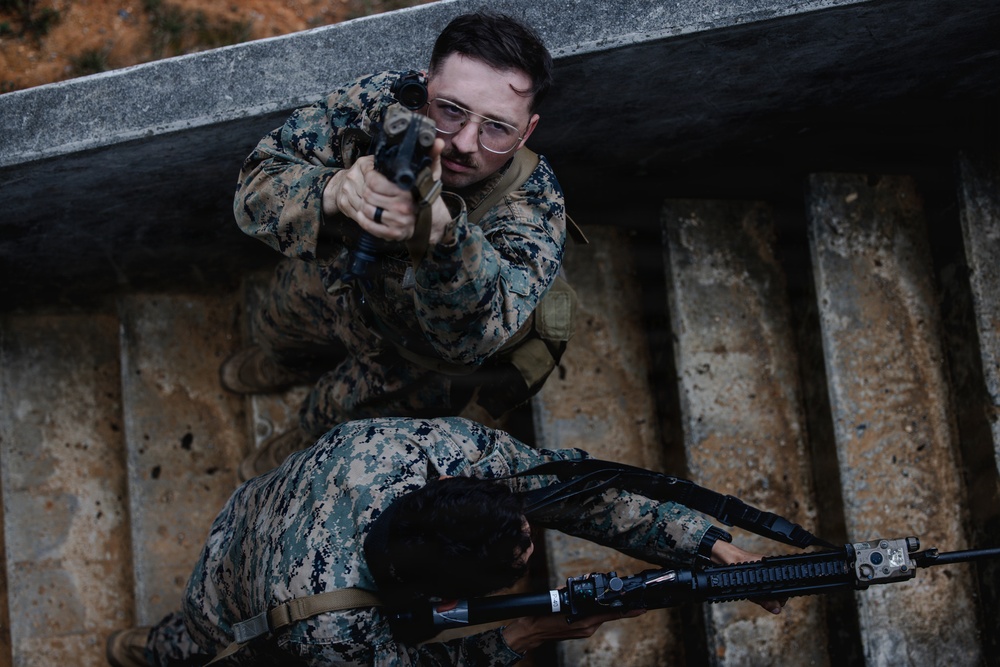
Photo By Cpl. Meshaq Hylton | U.S. Marine Corps Sgt. Jackson Ricker, top, a native of Colorado and a combat...... read more read more
 Subscribe
CAMP HANSEN, Okinawa, Japan — Sweat dripped from helmets, boots sank into uneven terrain, and cameras swung alongside rifles as Marines with III Marine Expeditionary Force (MEF) pushed through a demanding communication strategy and operations (COMMSTRAT) field training exercise (FTX), designed to test both their storytelling ability and their warfighting mindset, April 6–10, 2026.
Unlike controlled environments or garrison operations, this exercise placed Marines in a fast-paced, unpredictable setting where fatigue, time constraints and physical strain mirrored real world conditions. For communication strategy and operations Marines, the challenge wasn’t just documenting the mission. It was surviving while doing so.
“My role in this exercise is as a squad leader and team leader,” said Sgt. Ramon Cardoza, a combat videographer with 5th Air Naval Gunfire Liaison Company (5th ANGLICO). “I’m tasked with controlling and accounting for multiple teams while also leading my own. That means balancing leadership, coordination and still being able to perform my job behind the camera.”
Cardoza emphasized that leadership in this environment requires constant awareness. “You might be thinking about 10 things at once,” he said. “But there are always 11 or 12 things that still need your attention. That’s the reality of being a leader out here.”
The physical demands of the training were equally unforgiving. Marines navigated obstacle courses, long movements and continuous tasking with little downtime, forcing them to rely on both mental resilience and teamwork.
“I had to acknowledge that I couldn’t do one of the obstacles on my own,” Cardoza said. “As a leader, you have to have humility and be honest with your team. Asking for help doesn’t make you weak, it makes you effective.”
That mindset carried through the entire exercise, where Marines learned to push past fatigue and rely on one another. “Towards the end, the biggest challenge was just muscle fatigue,” he added. “But knowing your team is counting on you, that just keeps you going.”
For Sgt. Jackson Ricker, a combat videographer with III MEF, the training highlighted the true nature of operating in the field, where conditions are rarely ideal and pressure is constant.
“This training feels real because there’s no time to reset,” Ricker said. “You’re always tired, you’re always hungry, you’re always on your toes. There’s no safety net, and that’s what makes it valuable.”
Ricker, who previously served in an aviation unit, described the experience as a return to the fundamentals of what it means to be a Marine.
“Coming out here and doing ground side operations again has been refreshing,” he said. “It’s something I haven’t experienced in a long time, and it reminds you what the Marine Corps is really about.”
Beyond the physical and tactical aspects, the exercise reinforced the dual identity of COMMSTRAT Marines as both warfighters and storytellers.
“I see myself more as a storyteller,” Ricker said. “But being a Marine means, you can’t let one side outweigh the other. You have to be both. Being a good warfighter will make you a better storyteller, and vice versa.”
That balance becomes even more critical when Marines are required to carry both a weapon and a camera.
“Your rifle comes first,” Ricker said. “That’s what’s going to keep you and the Marines around you alive. The camera tells the story, but the mission always comes first.”
He added that documenting Marines carries a deeper responsibility. “When you’re capturing these moments, you’re potentially capturing something that could mean everything to someone later,” he said. “That’s why it matters, but it never outweighs the safety of the Marines next to you.”
For Lance Cpl. John-Paul Haubeil, a combat photographer with 5th ANGLICO, the exercise provided an opportunity to develop both technical skills and a deeper understanding of the mission.
“Being a COMMSTRAT Marine means getting products out to the public as fast as humanly possible,” Haubeil said. “Whether it’s photography, videography or graphics, it’s about telling the story of the Marines and what they’re doing.”
As a junior Marine, Haubeil used the training to observe and learn from more experienced leaders while refining his own craft under pressure. “It’s a great opportunity to grow,” he said. “You’re not just working on your technical skills, you are learning how to operate in an environment where everything is moving fast, and nothing is guaranteed.”
The realism of the training environment played a significant role in that development. Marines were required to carry their full gear for extended periods, forcing them to evaluate what was essential and what could be left behind.
“One of the biggest things I’ve learned is how to pack properly,” Ricker said. “Cutting down on excess weight, knowing what’s mission critical and understanding how your gear affects your movement.”
After days in the field, those lessons became impossible to ignore. “You start to feel every ounce you’re carrying,” he added. “And that forces you to rethink how you prepare for future operations.”
The exercise also revealed differences in how Marines approached adversity. “It’s interesting to see who embraces the challenge and who struggles with it,” Ricker said. “Some Marines really lean into it and want more of it, and others are still figuring that part out.”
For many, that process of adaptation is exactly the point.
“I want to do more training like this,” Ricker said. “I want it to be more realistic, and I want more Marines to take it seriously. This is where you actually grow.”
Through long days, limited rest and constant movement, the COMMSTRAT Marines of III MEF demonstrated that their role extends far beyond documentation. They are expected to think, move and operate like any other Marine while capturing the story of those around them.
“Life is worth more than a picture,” Ricker said. “At the end of the day, your responsibility is to the Marines next to you. The story will come, but the mission and your people always come first.”
As the exercise concluded, one thing remained clear: the ability to balance a camera and a rifle is not just a skill, it is a responsibility that defines the modern COMMSTRAT Marine.
| Date Taken: | 04.09.2026 |
| Date Posted: | 04.20.2026 00:09 |
| Story ID: | 562939 |
| Location: | OKINAWA, JP |
| Web Views: | 183 |
| Downloads: | 0 |

This work, Balancing the Rifle and the Lens: Communication Strategy and Operations Marines train under pressure, by Cpl Meshaq Hylton, identified by DVIDS, must comply with the restrictions shown on https://www.dvidshub.net/about/copyright.


No keywords found.




