
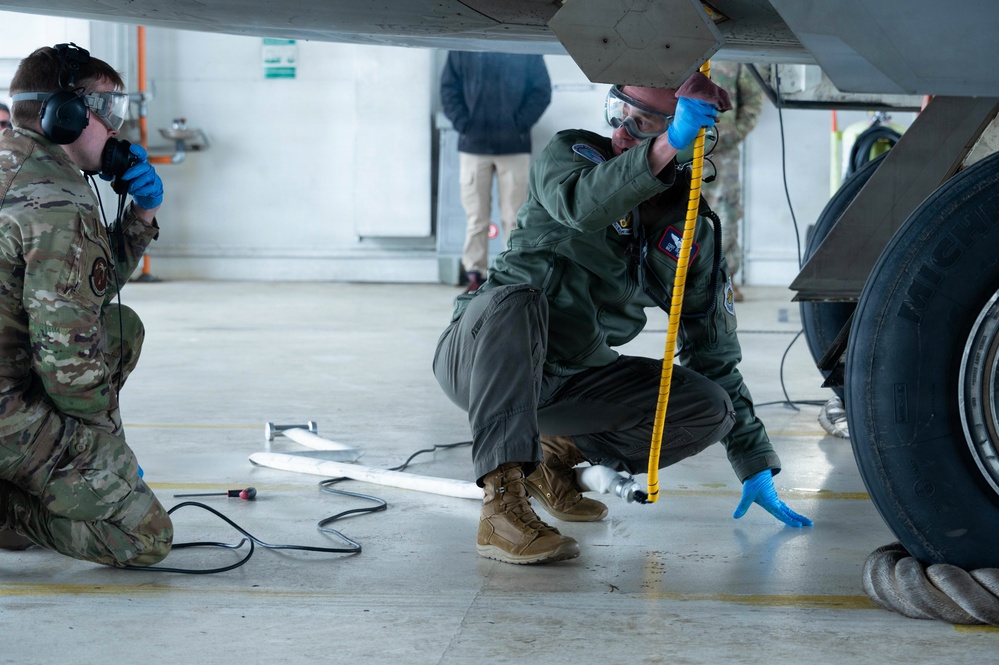
Photo By Tech. Sgt. Joseph Miller | A U.S. Air Force F-22 Raptor pilot performs maintenance on an F-22 while U.S. Air...... read more read more
 Subscribe
JOINT BASE ELMENDORF-RICHARDSON, Alaska – In September 2024, during an analysis of exercise Hungry Hungry Halibut, pilots from the 302nd Fighter Squadron identified a process that could be innovated upon for the oil servicing of an F-22 Raptor engine in austere environments.
This call for innovation was met.
The research funding was provided through the Air Guard Air Force Reserve Command Test Center and their innovation hub – ARCWERX.
The AATC is responsible for operational and developmental test and evaluation, as well as tactics development and evaluation for all Air Reserve combat weapons systems.
ARCWERX partnered with the United States Air Force Academy to begin considering ways to improve the process the pilots had previously identified. Cadets from USAFA took the initial request and began to run with it creating a new oil servicing device designed so that the pilots manning the F-22 could stow it in the aircraft and perform the maintenance independently.
The ideas started humbly, with the cadets looking at many possible solutions and crunching the numbers to make the science work. In total, seven cadets worked through the process with rigorous intent.
“This started out as a research opportunity, but it blossomed into a senior capstone,” said Cadet 1st Class Max Haas. A capstone is a research project that is identified as one that could develop into a positive solution for the Air Force and then is funded, explained Haas.
After 18 months of ideation and iteration, the team of cadets were able to finally see their oil servicing device operationally evaluated on JBER F-22s.
“I was looking forward to getting some real feedback from maintainers and pilots,” said Cadet 1st Class Aaron Staiger. “I wanted to see what they liked about it and what they could improve.”
Once testing on the oil servicing device began, it provided clarity to the team of cadets on improvements for their prototype. Simply experiencing the logistics of how the Airmen and the F-22 would interact with the device created two additional iterations of the prototype on site, said Staiger.
The evaluation for the oil servicing device went through a crawl-walk-run progression while on JBER. With the final phase having the F-22 complete two flights while stowing the device and where oil servicing was conducted by a separate F-22 pilot while the engine remained on.
“This is one of my proudest moments at the academy,” said Haas. “This is a whole different realm of activity, where we’re taking our academic pursuits and foundational knowledge and now applying it.”
After a successful first flight, spirits were high among the cadets.
“I never thought I’d have this type of reach and impact,” said Staiger. “A lot of my friends back at the academy were super impressed at what our capstone has been able to accomplish in such a short time.”
However, pride and a feeling of accomplishment were not the only things the cadets got to take away from these tests. They also learned valuable lessons as they head into their burgeoning careers.
“One of the coolest things we’ve gotten out of this is our officership development,” said Haas. “We have seen into the enlisted side and how we as future officers can support them, what they might need and what they want for systems that actually work for them.”
Learning about the other members of your team can prove valuable as no mission or objective is accomplished alone, especially in the armed forces.
“I think my biggest takeaway from this is that if you want to be able to make change in the Air Force or Department of War you have to work alongside others,” said Haas. “There were so many moving parts, nobody could have done it alone.
There were pilots working on getting new [technical orders] so we can test this product and get it where it needs to be,” said Haas.
“Even we as a team of cadets have different and diverse perspectives and opinions, and that group of diverse people coming together is what helped us create this novel idea.”
Even with their work nearly finished on the oil servicing device and graduation on the horizon, the cadets still have words for the next people to work on the project.
“My biggest advice would be if they decide to make changes just make sure they are not unnecessary,” said Staiger. “Adding too much complexity might decrease its efficiency; just make sure they are getting the feedback from the maintainers and pilots and not over-engineering for a rough solution.”
Keeping the warfighter in mind – not just the pilot but the maintainers too – is important, said Haas.
The ensuing tests were roaring successes and led to an initial bulk order of the oil servicing device for manufacturing and field distribution amongst the F-22 fleet.
“The team did a phenomenal job,” said a F-22 Raptor pilot from the 302nd FS and the project lead. “The concept was proven through math and science from engineers and subject-matter experts across eight different locations before we executed our incremental approach on an actual aircraft.
“It was no surprise that the widget worked exactly as expected,” he added.
However, the success of the oil servicing device does not stop there; it has been picked up by the Air Force Life Cycle Management Center, Pratt and Whitney and Lockheed Martin for future integration. The device has also earned the cadets a spot at the Gen. Donald R. Keith Memorial Capstone Conference at the U.S. Military Academy. The conference will allow the cadets a forum to present their innovation to professionals, scholars, clients, and fellow students from other colleges and universities.
| Date Taken: | 04.12.2026 |
| Date Posted: | 04.24.2026 18:53 |
| Story ID: | 562896 |
| Location: | US |
| Web Views: | 666 |
| Downloads: | 0 |

This work, Innovate, ideate, iterate: Partnership leads to improvement, by TSgt Joseph Miller, identified by DVIDS, must comply with the restrictions shown on https://www.dvidshub.net/about/copyright.


No keywords found.




