
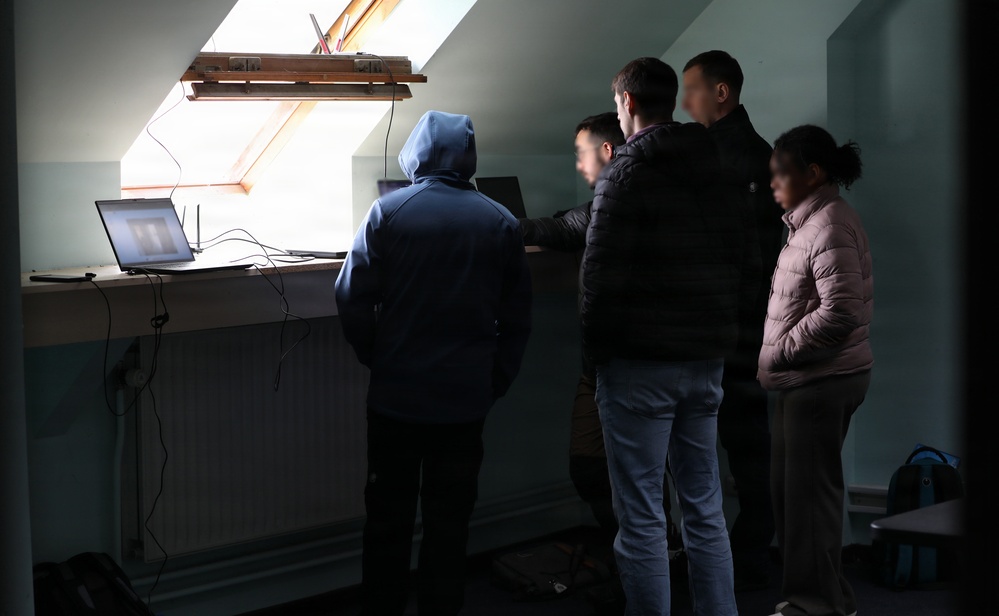
Photo By Staff Sgt. David Thomson | Personnel with U.S. Special Operations Command Europe analyze digital signatures in...... read more read more
 Subscribe
CHIÈVRES, Belgium – Thirty special operations cyber experts from 16 NATO countries gathered at NATO Special Operations University for the Combined-Arms Operational Digital Enablers Course in Mons, March 16-26, 2026.
The participants, including personnel with U.S. Special Operations Command Europe, learned how innovative cyber capabilities enable special operations forces in tactical environments during the three-day course. Their participation in the course illustrates how SOCEUR strives to integrate new technology like cyber capabilities with special operations to enable fast, adaptive solutions in contested environments.
“It’s an unclassified, practical seminar where we use open resources like the Raspberry Pi,” one NATO special operations forces participant said about the computer programs they use. “This isn’t just theory, it’s real skills we’ll bring right back to our teams.”
Participants exchanged lessons learned from their respective nations and left with a shared understanding of how cyber and special operations can support each other in the modern battlefield. Multinational training aligns special operations forces and cyber capabilities across NATO, enabling forces to operate together as a cohesive team.
Engagements like this illustrate SOCEUR’s focus on empowering and enabling U.S. allies and partners to take on greater responsibilities in defense and security operations to enhance their collective defense.
“Our goal is that every participant leaves ready to lead cyber-special operations integration,” a SOF instructor said. “Every partner nation brings something to the table and it’s on us to understand how those capabilities fit into the environment we work in.”
A major focus of the seminar centered on practical applications in the field through training scenarios. One scenario involved the students identifying a drone logistics facility and with limited information, teams conducted a baseline digital scan of the surrounding environment. Through their efforts, they captured more than 5,000 real-world digital signatures, and with analysis, they narrowed the data to 10 signatures. With innovative digital scrutiny the students were able to narrow their sights to two key targets within 18 hours.
The NATO participants gained access to enemy networks and servers, building a target intelligence packet for the ground assault force. Building layouts, emails and communications can all aid SOF. Wireless camera feeds were used to create an accurate blueprint of the target building, giving the ground assault team real-time visibility of the objective.
“This is where the money is made,” one SOF instructor said. “Cyber and special operations work side by side during planning and execution, giving access to doors, cameras, alarms and networks that directly help the assault force.”
SOCOM’s cyber integration approach focuses on fast, adaptive solutions using accessible tools and commercial equipment. Techniques such as handshake capture, Network Mapper scanning, wardriving and passive versus active cyber reconnaissance were taught only to the level needed for immediate hands-on application.
Unlike highly technical cyber courses centered on penetration testing or forensics, this seminar was focused on the tactical level. Students were exposed to the cyber concepts needed to quickly integrate into special operations missions.
“Students leave understanding what’s in the realm of possible,” a SOF instructor said. “We often look for complex solutions, when often the best answer is already within our formations.”
The interoperability gains were equally significant. Nations entered the seminar with different levels of cyber skills. By working together through realistic contested environments, students developed common uses for cyber integration. Training scenarios forced teams to account for denied physical access, digital signatures, smartphones, Bluetooth devices, vehicle Wi-Fi and other vulnerabilities that the enemy could exploit.
Beyond offensive effects, the course reinforced defensive awareness. By seeing the offensive side of cyber operations firsthand, students gained a stronger understanding of their own digital footprints and how to reduce exposure in deployed environments.
“When we return to our units, we’ll teach our teams in ways we hadn’t before,” one NATO SOF participant said.
As cyber capabilities continue to grow within special operations forces, instructors said the course is helping shape the future of how cyber teams and ground forces operate together. By building that partnership, the seminar prepares NATO allies to work more effectively across multiple domains in future operations.
| Date Taken: | 03.24.2026 |
| Date Posted: | 04.14.2026 14:02 |
| Story ID: | 562660 |
| Location: | CHIEVRES, HAINAUT (WAL), BE |
| Web Views: | 688 |
| Downloads: | 4 |

This work, How cyber warfare empowers special operations, by SSG David Thomson, identified by DVIDS, must comply with the restrictions shown on https://www.dvidshub.net/about/copyright.


No keywords found.




