
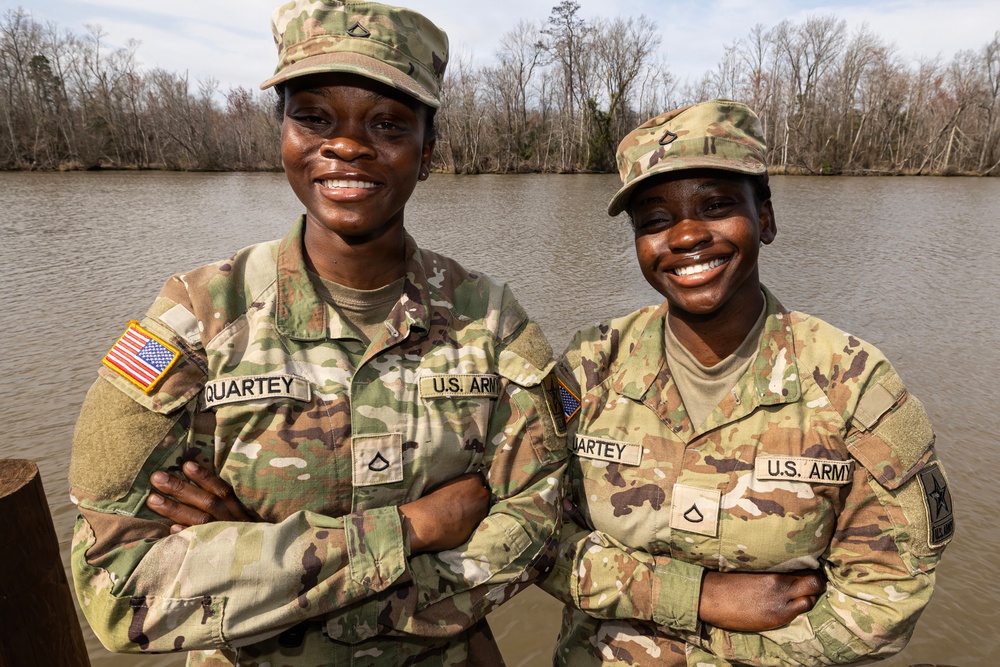
Photo By Chad Menegay | Pfc. Queenster Quartey (left), 22, and Pfc. Queenly Quartey (right), 25, sisters born...... read more read more
FORT LEE, Va. — U.S. Army Fort Lee has been dealt a pair of queens.
Pfc. Queenly Quartey, 25, and Pfc. Queenster Quartey, 22, sisters born and raised in Accra, the capital city of Ghana, are training here as water treatment specialists at the U.S. Army Quartermaster School’s Petroleum, Water and Energy Department.
Known as the “gateway to Africa,” Accra has recently served as more of a “gateway from Africa” for the Quartey family.
Since the 1990s, Quarteys from the tribe of Ga have been coming to the U.S. to pursue the American dream, and their father, Samuel Quartey, came to the U.S. when the two “Queens” were still children.
“I left them in the hands of family, and they made sure that I am always in contact with them and how they are doing with their education,” Samuel said.
The Quartey sisters said that their dad was very present in their lives despite the distance.
“I really wanted to come here because I was really little when my dad came to the U.S., so it was more like talking to him on the phone,” Queenster said. “So, I finally get to spend time with him.”
Samuel eventually encouraged his daughters to come to the U.S., so they can pursue opportunities to achieve their dreams, he said.
“I said, ‘why don’t I bring my children here to be closer to me and so that they can also experience the greatness of this country,’” Samuel said. “The decision was not to abandon their country, but to come here and achieve greater heights.”
I know the plans I have for you
Aunts, uncles and grandparents in Ghana were very supportive of their decision to move to the U.S., often providing rides to the embassy and waiting for them to complete the necessary steps, Queenster said.
“It was a family decision,” Queenly said, “and we wanted to move closer to family.”
The Quarteys, who arrived in the U.S. in March 2024, have more than 15 family members spread among three generations who live in the Worcester, Massachusetts area including aunts and cousins, Queenly said.
“You don’t have to go far to see a family member in Worcester,” Samuel said. “That made their stay here more comfortable because they have family members they can consult to show them the way of how to settle down in this country,” Samuel said.
The decision to join the U.S. military was also a family decision for the Quarteys.
Samuel floated the idea based on his cousin’s service in the U.S. Army and advice based on his experiences that he provided in recommending military service as an option for the girls to develop and help pay for tuition.
At first, they were not receptive, but soon after they met with a local Massachusetts Army National Guard recruiter, Staff Sgt. Jose Cintron.
The recruiter was a great first example to the girls of a dedicated Soldier who showed love for his job, Samuel said.
“This guy was there for them from day one,” Samuel said. “He made it easy for them to decide, provided all the information and put in much effort to convince them.”
The two made their decisions to join on separate occasions but ended up traveling the same path.
“I told her, ‘Hey, let’s join together,’ and then she decided to join with me,” Queenly said.
“Lady luck” would have it that they somehow chose the same Military Occupational Specialty without even first discussing the subject.
“We didn’t plan on choosing the same MOS,” Queenly said. “We didn’t go to the recruiter at the same time.”
Queenster said she read about the water treatment specialist MOS (92W) and decided it could apply to her civilian life because she is pursuing a degree in civilian engineering.
“I’m like, ‘what MOS did you choose?” and she’s like, ‘92W,’ which is like ‘that’s what I chose,’” Queenster recalled, sharing a laugh with her sister.
They enlisted at the Military Entrance Processing Station together and shipped out to Fort Jackson, South Carolina, on the same day, Nov. 4, 2025, about two months after gaining their U.S. citizenship through joining military service.
Plans to prosper you and not to harm you
“Everybody supported our decision to join the Army,” Queenster said. “Everybody was so happy and proud because nobody would have thought that I would join the Army because I don’t do the woods or any of that.”
Queenster soon realized the need to adapt.
Queenly had a reputation in the family of being the more adventurous and outdoorsy of the two, going horseback riding for example while Queenster would stay home.
“Back home, I didn’t really push myself physically,” Queenster said. “I just joined the track team for fun, but here you have to stay disciplined and focused. That is another thing I’m grateful to the Army for because every evening I go to the track and run, then the time keeps coming lower, and I keep adding more miles. It’s pushing you above your limits.”
Queenster overcame difficulties in achieving ‘a go’ in tasks like planking, rucking and weapons qualification largely through the support of her family, she said.
The two, who were placed in separate companies at Fort Jackson, could only see each other at religious services on Sundays, but there they would share stories, and Queenly showed Queenster how to properly plank, Queenster said.
“Back in Ghana, you barely see people with weapons,” Queenster said. “They barely have guns. It was a struggle for me to use an M4. I used to cry, call home, and my mom and my dad will have to go and watch videos and then tell me what to do.”
Samuel continually shared the bible verse Jeremiah 29:11 with his girls, encouraging them to keep faith and stay focused on their goals.
If the family was worried that this military adventure could end up in failure, they kept this to themselves and stayed positive outwardly.
“When they went to Fort Jackson, I had some doubts that they could make it, especially the combat training because they are females despite all they had already achieved growing up,” Samuel said. “But, when they called back in the first few weeks, and they said, ‘Daddy, the training is hard,’ I kept encouraging them.”
They were able to go through the toughness of the training because they have each other, Samuel said.
Queenly worried as well in basic training, she said. She literally fell a few times and was injured, she said, but she surprised herself with what she could accomplish.
“I did not see myself doing a 12-mile ruck,” Queenly said. “I would have never told my 140-pound self to carry a rucksack with a weapon and go 12 miles.”
Samuel attended their basic training graduation at Fort Jackson and was filled with pride and a sense that his girls were changing in positive ways, he said.
The two have seen one another overcome challenges, develop and grow, so that they know each other on a deeper level now and have greater mutual respect, they said.
“I feel like us coming here together has made our bond stronger,” Queenster said.
Plans to give you hope and a future
They arrived at Fort Lee Feb. 4 and are slated to graduate April 25.
Though water dog training has its own set of challenges, the two are excelling here, they said.
“So far, we both have had 100 on all our tests,” Queenster said. “We hope to keep that streak going.”
They are thinking about finishing as distinguished honor graduate or honor graduates and credit the school with being both supportive and challenging.
The instructors train students on different models of water treatment devices with a ‘crawl, walk, run’ method of instruction, Queenster said.
“If you are a weak student, they don’t leave you behind,” Queenly said. “They want everyone to interact, get involved and participate in class discussions. They appoint quiet people to do more to keep them engaged.”
There is a focus on cooperative and peer learning, guided and unguided instruction with checks on learning, Queenster said.
“They don’t give up on you until you give up on yourself,” Queenster said. “They always encourage motivation, to stay focused and be disciplined.
The Quarteys bring a community-based mindset to their water purification training by supporting teammates positively and encouraging them to push through struggles, they said.
They developed this mindset in Ghana, the sisters said.
“Accra is a very hospitable, homey place,” Queenly said. “We’re more family oriented in Ghana. You’re going to find a lot of people living in a house with [extended] family.”
Accra is a major coastal tourist destination and has a reputation for its welcoming culture.
“There is a joke that Ghanaians use the word ‘please’ a lot,” Queenly said. “In certain sentences, there’s no need to use ‘please,’ but where I’m from, we always use it.”
Community members are always courteous and take care of each other in Accra, Samuel said.
This collectivist approach has proven useful in water dog training, the sisters said.
“We had a few Soldiers who are not used to public speaking, so in the preparation we worked as a team to help them make it through the brief,” Queenly said. “We cheered them on and said, ‘hey, come on, you can do it. You just got to speak up a little bit.’”
There are U.S. military courtesies and ways of showing respect that the Quarteys are quickly adapting to through immersion.
Samuel noticed a difference in his girls and is proud that they have developed and achieved so much in a short amount of time, he said.
“Their minds and their focus now is on the Army,” Samuel said. “There is so much discipline. When they came home for Christmas holidays [during Holiday Block Leave], I realized they have changed, the way they talk, the way they even walk. With the Army, I see now that they are always on time with whatever they do. I said, ‘Wow, I have brought warriors home,’ and that made me so proud.”
Now they are spreading positive cheer about military service and have even already helped with recruiting in the Ghanaian-American community of Worcester with one recruit currently at basic training in Fort Jackson, Samuel said.
“What they have learned in the Army about toughness and determination, they are trying to impact it on me too now in areas that I’m feeling [doubtful], they are bringing encouragement,” Samuel said.
Samuel said his daughters are falling in love with their service to the nation.
“They told me about the Soldier’s creed, and they are like a family with other trainees, other recruits,” he said. “I was telling them jokingly, ‘hey, don’t let the Army take you away from me.”
After graduation, the two will report to the 125th Quartermaster Company out of Rehoboth, Massachusetts.
They both intend to make use of the Massachusetts National Guard’s 100 percent tuition program.
Queenster is currently enrolled in the University of Massachusetts at Dartmouth to pursue a civil engineering degree. Queenly intends to return to nursing studies with a pediatric nursing degree.
The Quartey sisters, who signed a three-year commitment, said they already intend to stay in the military past that commitment, to “stay until the end,” they said.
| Date Taken: | 04.09.2026 |
| Date Posted: | 04.09.2026 14:27 |
| Story ID: | 562388 |
| Location: | FORT LEE, VIRGINIA, US |
| Hometown: | ACCRA, GH |
| Hometown: | WORCESTER, MASSACHUSETTS, US |
| Web Views: | 30 |
| Downloads: | 0 |

This work, Ghanaian-American sisters train together at U.S. Army Quartermaster School, by Chad Menegay, identified by DVIDS, must comply with the restrictions shown on https://www.dvidshub.net/about/copyright.


No keywords found.





