
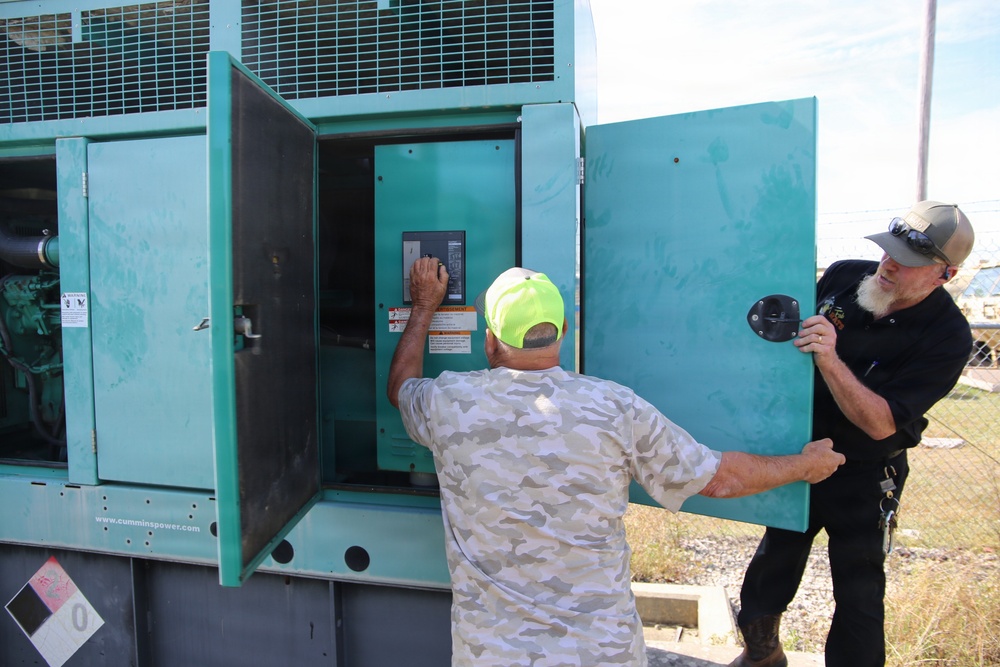
Photo By Kelsie Steber | Members of the Fort Stewart Directorate of Public Works work to get a generator back...... read more read more
Fort Stewart-Hunter Army Airfield went completely dark at 8:30 a.m. Wednesday, April 8, not because a car hit a power line or because the installation forgot to pay the electric bill but intentionally.
Within a minute, the sound of generators hummed throughout the installation, “exercise, exercise, exercise” was being repeated in the Emergency Operations Center, and the Black Start exercise was afoot.
Black Start is congressionally mandated and requires all Department of War installations to test its ability to operate without power for eight hours in an emergency. It also focuses on the resilience of security measures and responses.
“The main objective is to determine the resiliency, find out some of those gaps, and then be able to use this as an advocate for funding to close those gaps,” said David Spence, electrical engineer with the U.S. Army Corps of Engineers, Huntsville District, and Black Start exercise lead.
Spence noted that the exercise is not an inspection or a pass/fail evaluation.
Over 15 evaluators were spread out in the field observing how facilities and personnel respond to an extended power outage. They were also looking to see if organizations could execute their Continuity of Operation Plan, which is a strategic initiative designed to ensure essential, mission-critical functions continue to operate during emergencies.
“It’s important to exercise. You must have emergency plans and contingency plans when the power goes out because it is going to go out at some point,” said Jeff Bergeron, Directorate of Plans, Training, Mobilization and Security emergency contingency operations officer. “If you don’t practice at the Department of War, shame on us. It’s going to happen whether it is a bad actor or its weather or a cyber-attack.”
But this exercise wasn’t sprung upon the garrison overnight. Fort Stewart-Hunter Army Airfield was selected in 2024 to be one of five installations to execute a Black Start during fiscal year 2026.
“Jeff Bergeron really took on a lot of leadership setting everything up, making sure all the parties involved know exactly what is going to occur, how to best execute this and make sure this is as organic as possible,” said Spence. “A lot of the time, we try to keep this as close hold as possible because we do lose value if everyone knows this is happening.”
Fort Stewart-Hunter Army Airfield organizations eventually knew the month, but not the day, and have been planning and practicing for over a year.
“When we got to the 12-month mark, we decided to test one circuit on Fort Stewart and one on Hunter Army Airfield every month during the monthly emergency operations center exercise,” Bergeron said. “After that we would have a black start working group to flesh out what went well and our gaps. We were able to identify problems and issues in our generators and correct them.”
Exercises of this scale take meticulous planning and formulation of injects, scenarios and storylines to make sure each part of the installation is being tested.
“You don’t want it to be perfect, if it went perfect nobody learns anything and then I didn’t do my job,” Bergeron said. “As the exercise planner, it is my job to stress everyone in the emergency operation center, emergency response, and all the support services, so they can train and identify where they should train.”
Throughout the day circuits to housing areas, schools, child development centers, the commissary, and Winn Army Community Hospital came back online. With it were new insights as to where organizations can improve energy resilience in their footprint.
“Fort Stewart has been one of the more responsive installations, at least in my limited experience,” Spence said. “I definitely know they are going to take whatever they learn from here and be proactive at closing those gaps and making sure that next time they are a little stronger.”
| Date Taken: | 04.09.2026 |
| Date Posted: | 04.09.2026 11:28 |
| Story ID: | 562336 |
| Location: | FORT STEWART, GEORGIA, US |
| Web Views: | 18 |
| Downloads: | 0 |

This work, Fort Stewart-Hunter Army Airfield goes dark for Black Start, by Kelsie Steber, identified by DVIDS, must comply with the restrictions shown on https://www.dvidshub.net/about/copyright.


No keywords found.





