
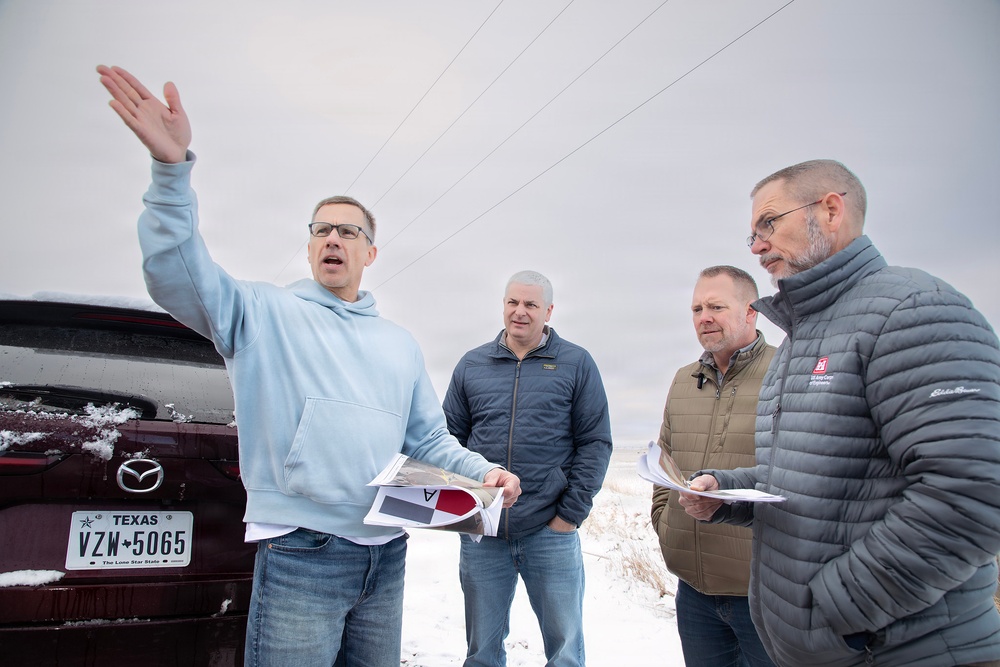
Photo By Delanie Stafford | Regulatory staff from the U.S. Army Corps of Engineers, Omaha District, along with...... read more read more
OMAHA, Neb. — The U.S. Army Corps of Engineers, Omaha District, is serving as the lead federal agency responsible for preparing an Environmental Impact Statement and evaluating a federal permit application for the proposed Perkins County Canal project.
A Section 404 permit application was submitted by the Nebraska Department of Water, Energy and Environment and was determined complete by USACE, along with a formal determination that an EIS is required due to the project’s potential to significantly affect the environment.
“The Clean Water Act and National Environmental Policy Act processes ensure a thorough evaluation of environmental impacts, alternatives and mitigation measures,” said Aaron Eilers, a senior project manager with the Omaha District’s Denver Regulatory Office. “The decision whether to issue a permit will be based on an evaluation of the probable impacts of the proposed activity. Our role is to act as an independent federal regulatory authority and conduct an objective, science-based review.”
The proposed canal traces its origins to the South Platte River Compact, an agreement between Nebraska and Colorado ratified by Congress in 1923. The compact allows Nebraska to divert water from the South Platte River under certain conditions if a canal is constructed. The proposed project would divert water into a canal near Ovid, Colorado for storage in two reservoirs in western Nebraska.
In recent years, Nebraska has taken steps to pursue that opportunity. In 2022, the state passed legislation to fund efforts aimed at securing its full entitlement under the compact, and the canal proposal has since moved into the federal permitting phase.
Five public scoping meetings were held in March to solicit public comments from stakeholders along the proposed route. Officials say community input will play a meaningful role in shaping the scope of the environmental analysis.
“Public input is an important part of the NEPA process,” Eilers said. “Stakeholder and community feedback is formally considered as part of the regulatory decision-making process.”
More than a dozen federal, state and local agencies have been invited to participate as cooperating or coordinating agencies while Tribal Nations and other local interest groups have been invited to participate in the Section 106 consultation process.
The Omaha District is currently reviewing public comments and coordinating with partner agencies to inform the scope of the EIS. A draft version of the document is expected in approximately one year.
The EIS will be prepared by a third-party contractor, Merjent Inc., under the direction and oversight of USACE. Officials emphasized that the project’s purpose and need from a federal perspective have not yet been defined.
“The review process is structured to ensure technical accuracy, legal compliance and fairness,” said Kiel Downing, branch chief of the Omaha District’s Denver Regulatory Office.
Ultimately, the Omaha District’s Regulatory Division will decide whether to issue or deny the permit based on environmental impacts, regulatory compliance, alternatives analysis and overall public interest considerations.
“Our responsibility is to ensure the process is thorough, transparent and grounded in the law,” Downing added.
The final EIS is expected to take approximately two years to prepare. Until then, the permit application remains under federal review, with any decision dependent on the outcome of a comprehensive and carefully structured regulatory process.
| Date Taken: | 04.08.2026 |
| Date Posted: | 04.08.2026 14:24 |
| Story ID: | 562250 |
| Location: | OMAHA, NEBRASKA, US |
| Web Views: | 89 |
| Downloads: | 0 |

This work, EIS underway for proposed Perkins County Canal project, by Delanie Stafford, identified by DVIDS, must comply with the restrictions shown on https://www.dvidshub.net/about/copyright.


No keywords found.





