
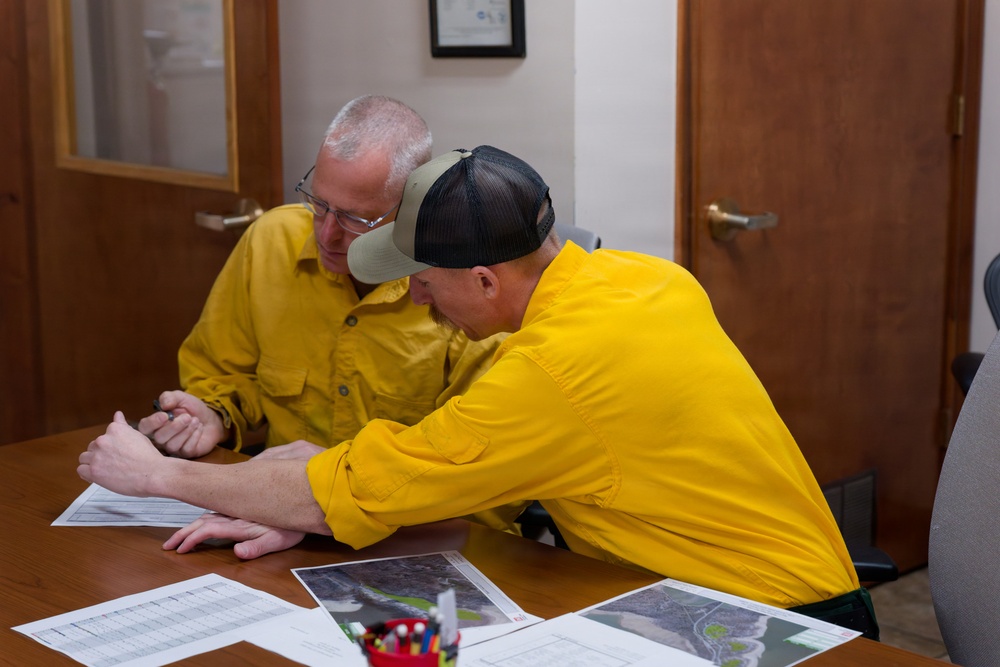
Photo By Charles Delano | Louisville District Wildland Fire Program Manager Chris DeSmit, acting as burn leader...... read more read more
LOUISVILLE, Ky. - Late winter and early spring mark a strategic time for the U.S. Army Corps of Engineers Louisville District. During this dormant season, crews take advantage of narrow weather windows to ignite prescribed burns across district lake projects to manage fuel loads and support native ecosystems.
Guided by an updated Wildland Fire Management Program policy, the district's operations prioritize safety, training, and interagency coordination. According to Louisville District Wildland Fire Program Manager Chris DeSmit, the updated policy creates "a more standardized, defensible, and scalable program," ensuring that burn teams operate with qualified personnel and a strong emphasis on accountability.
But putting fire on the ground is far from a simple task; it requires extensive planning. Before a single drop of fuel is ignited, a designated Burn Leader on the ground evaluates a strict go/no-go checklist within an approved burn plan. Wind speed, relative humidity, fuel moisture, and smoke dispersion must all fall safely within limits.
"A burn plan is a technical document that ensures we apply fire in a controlled, predictable, and effective manner," DeSmit explained. He noted that if any single element falls outside the prescription, the team does not proceed. "It’s a disciplined, risk-informed decision every time."
Executing those disciplined decisions is frequently complicated by the landscape and the weather. USACE lakes present unique operational hurdles, from highly fragmented shorelines to the proximity of public campgrounds and roadways where smoke management is paramount. Furthermore, the rapidly changing weather patterns typical of the Louisville District region – where humidity frequently fluctuates and winds rapidly shift – can severely limit consecutive burn days. Crews must maintain strong situational awareness and be ready to act the moment conditions align.
When that window opens and the fire is successfully lit, the primary beneficiaries are the natural resources. Without the reintroduction of this "good fire," these ecosystems suffer from encroaching invasive species, dangerous fuel loading, and a steep decline in native biodiversity. Low-intensity burns act as an ecological reset button: they remove competing vegetation, recycle vital nutrients back into the soil, and stimulate the germination of fire-adapted plants.
"Fire is a natural and necessary process in many of the ecosystems we manage," said DeSmit. "Prescribed fire allows us to safely reintroduce that process and maintain these systems as they were intended to function."
For the public visiting these lakes, seeing a charred, blackened landscape immediately after a burn can initially be jarring. However, the ecological rebound is swift. Native plants typically show a visible response within a single growing season, leading to measurable habitat improvements for wildlife and pollinators within two to five years.
"What I would want visitors to understand is that the blackened landscape they see right after a burn is not an endpoint—it’s the starting point of recovery," DeSmit emphasized. "Prescribed fire may look dramatic in the moment, but it’s one of the most responsible and effective tools we have to ensure these public lands are sustainable for generations to come."
| Date Taken: | 03.25.2026 |
| Date Posted: | 04.08.2026 13:42 |
| Story ID: | 562243 |
| Location: | GLASGOW, KENTUCKY, US |
| Web Views: | 32 |
| Downloads: | 0 |

This work, USACE prescribes ‘good fire’ to spark landscape renewal, by Charles Delano, identified by DVIDS, must comply with the restrictions shown on https://www.dvidshub.net/about/copyright.


No keywords found.





